Table of Contents
There’s a moment in most garden room projects — usually somewhere between the insulation going in and the internal lining going up — when the space stops feeling like a building site and starts feeling like a room. The proportions become readable. The light comes in properly through the windows. And you start to understand what the space wants to be.
That moment is the beginning of the interesting part. Getting a room in garden to function well is a question of construction and specification. Getting it to be genuinely stunning — a space that feels extraordinary rather than merely adequate — is a design question, and it deserves the same level of thought that any interior room in the main house would receive. More, arguably, because the garden setting introduces a layer of opportunity that interior rooms simply don’t have.
What follows is how we approach the design of a room in garden, from the relationship between the building and its surroundings through to the interior decisions that determine whether the finished space is good or exceptional.
Start With the Setting, Not the Building
The most common design mistake with a garden room is treating it as a self-contained object — designing the building in isolation and then placing it in the garden. The better approach is to design the building and the garden together, because the relationship between the two is what gives the finished project much of its quality.
A room in garden that sits on a concrete pad surrounded by lawn, accessed by a path that runs straight from the house, feels institutional regardless of how beautifully it’s been finished inside. The same building set within a planted surround, approached via a path that curves slightly or passes through a gate, with a small deck or terrace that creates a transitional zone between inside and out — that building feels like a destination. It has a relationship with the landscape around it.
The orientation of the building in relation to sunlight is the first design decision. A room you’re planning to use as an office benefits from north or east-facing glazing — good, consistent light without the glare and heat gain that south-facing glass produces. A room you’re planning as a leisure or relaxation space wants the afternoon and evening sun, which means west or south-west facing doors and windows. Getting this right at the outset costs nothing and has an enormous impact on how the space feels in daily use.
The aspect also determines what you see from inside. A carefully positioned room in garden can frame a view of the garden back toward the house, which creates a very particular quality — the sense of being both outside and inside simultaneously, of occupying a vantage point on the garden rather than simply being in it. This is one of the genuinely distinctive things that a room in garden can offer, and it’s only available if the building has been positioned and oriented with this in mind.
The Threshold: From Garden to Room
The transition from garden to garden room is a design opportunity that most people underuse. The moment of entry — crossing from outside into the interior space — is one of the most experientially charged moments in any built environment. Getting it right sets the tone for everything that follows.
A simple step up into the room and straight through a standard door is functional. A small deck or terrace in front of the entrance, bounded by low planting, with a slightly generous door width that invites rather than simply permits entry — that is something quite different.
The deck or terrace serves multiple purposes beyond the aesthetic. It creates a pause before entry, a moment of transition that reinforces the sense of the room as a distinct destination rather than just an extension of the path. It provides an outdoor sitting area that extends the room’s usable space in good weather. And it gives the building a visual base that connects it to the ground rather than sitting on it as an afterthought.
The planting around the threshold and along the approach should be chosen to give the building a sense of permanence and belonging. Structural planting — grasses, low shrubs, established perennials — that frames the entrance without blocking the light, that softens the base of the building, that connects the structure visually to the garden floor. Plants that change with the seasons give the approach to the room a quality that a permanent hard-landscaping treatment can’t produce.
Glazing: The Most Important Interior Design Decision
In a room in garden, the glazing — the windows and doors — are simultaneously the building’s most important structural feature and its most important interior design element. They determine the quality of light inside, the visual connection to the garden, the sense of space, and the relationship between inside and out.
The default specification for many garden room builders is a standard double door and perhaps one or two side windows. It’s adequate. It’s not ambitious. The difference between adequate glazing and well-designed glazing is often the single biggest variable between a garden room that feels pleasant and one that feels genuinely special.
More glass is almost always better in a garden room, up to the point where solar gain becomes a problem. A full-width glazed wall facing the garden — either as a series of fixed panels with opening sections, or as a folding or sliding door system that opens the entire wall to the outside — transforms the interior experience. With the doors open on a warm day, the room becomes continuous with the garden. With the doors closed in winter, the garden becomes the room’s artwork: a framed, living, constantly changing view.
Roof lights are worth serious consideration, particularly in rooms where the roof pitch allows them without creating thermal performance problems. A well-placed rooflight introduces a quality of overhead light that vertical windows can’t provide — the sense of the sky being directly above, the way light falls into the interior from above and illuminates the floor and low surfaces rather than the walls. It changes the character of the space profoundly.
The one glazing decision that most often disappoints is going too small. The cost of larger glazing is a relatively modest increment on the overall project cost. The experiential difference is significant and permanent. Most clients who’ve been through the process once wish they’d gone bigger with the glass.
Interior Design: Treating It as a Proper Room
A room in garden deserves a proper interior design approach, not the compromised thinking that often applies to spaces seen as “just a garden building.” The same principles that produce a good interior in the main house — considered colour palette, appropriate materiality, layered lighting, furniture that fits the space and the use — apply here, sometimes more acutely because the space is smaller and every element has more visual weight.
Colour in a garden room has a particular dynamic. The visual connection to the outside — to green planting, to sky, to changing seasonal colours — means the interior palette is always in dialogue with what’s beyond the glass. Colours that sit harmoniously with garden greens and natural tones tend to work well: warm whites, natural linens, earthy mid-tones, deep greens that reference the planting. Cool colours can feel slightly at odds with the natural setting, though a well-designed garden room can carry almost any palette if the relationship between interior and exterior has been thought through.
Materials should reference the setting without being rustic or clichéd. Natural timber in the flooring or as a structural visible element connects the interior to the exterior cladding and to the garden. Stone — even small amounts, a tiled threshold or a stone hearth if there’s a wood burner — grounds the space physically. Linen, jute, unglazed ceramic, warm metals: these are the materials that feel right in a room that’s fundamentally connected to the natural world.
Furniture scale is one of the things that most often goes wrong in small, well-proportioned spaces. Oversized furniture that would work in a main house living room makes a garden room feel cramped and defeated. Furniture chosen for the actual dimensions of the space — a compact sofa, a carefully scaled desk, a built-in bench that doesn’t take floor space — makes the same room feel generous and well-considered.
Lighting: Three Layers, Not One
Garden rooms are consistently underlighted, and it’s a significant missed opportunity. The instinct is often to put a couple of ceiling lights in and consider the job done. A properly layered lighting scheme does something quite different.
The first layer is ambient light — the general illumination that makes the space usable. This can be recessed downlights, a pendant fitting, or in more contemporary buildings, an LED strip concealed behind a ceiling batten that washes the ceiling with light. The ambient layer should be dimmable. A garden room at dusk, with the ambient lighting dimmed low and the garden visible through the glass, is one of the more beautiful domestic environments available.
The second layer is task lighting — directed light for the specific activity the room is used for. A good desk lamp for office work, a reading light positioned correctly for the chair. This doesn’t need to be complicated, but it needs to be present, because ambient light alone is rarely sufficient for extended focused work.
The third layer is accent lighting — the layer that most garden rooms completely omit. A small spotlight on a piece of artwork. An LED strip beneath a floating shelf. A table lamp in a corner. These are the lights that make a space feel inhabited and considered when the ambient light is dimmed. Without them, a garden room in the evening with the overhead light turned down just looks dark. With them, it looks like someone designed it.
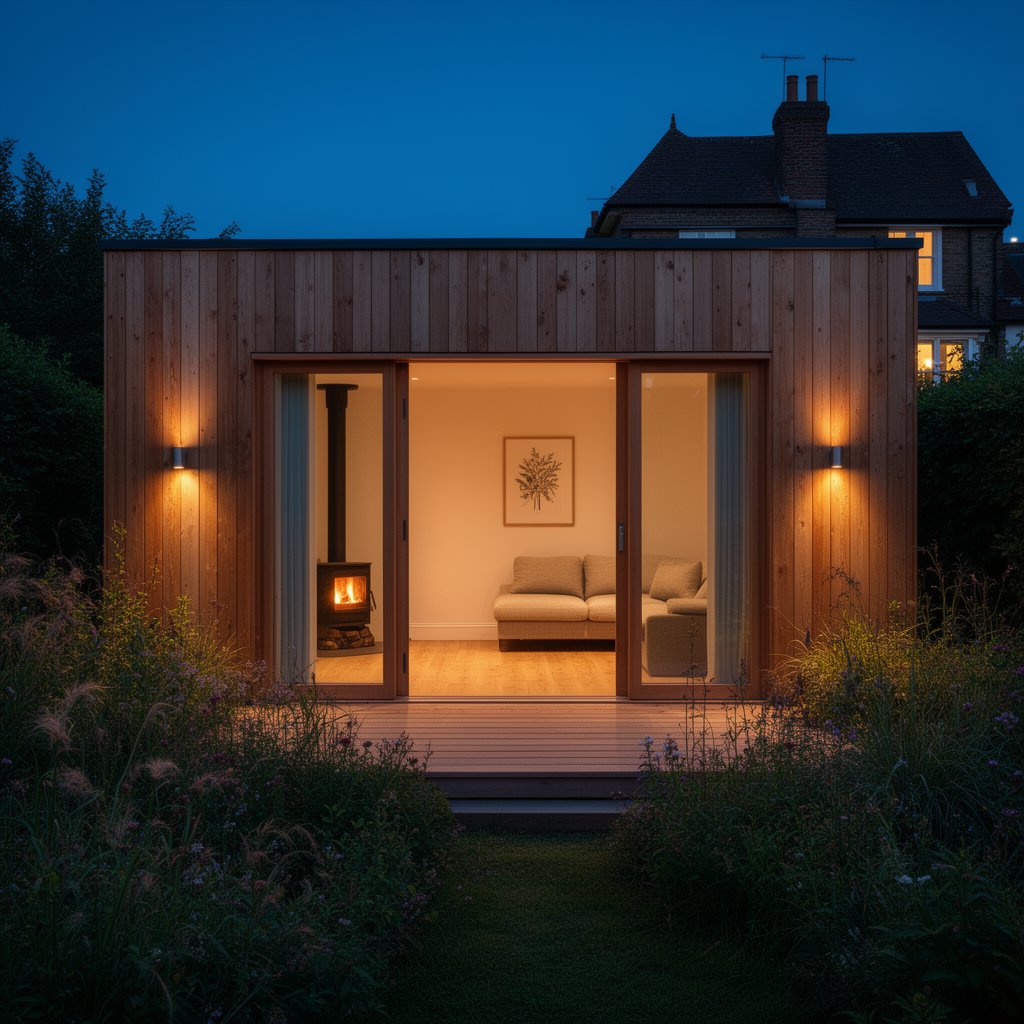
External lighting is equally important and equally neglected. Path lighting that makes the garden room safely accessible after dark, exterior wall lights flanking the door, perhaps subtle uplighting in the planting around the building — these are what make the garden room usable as an evening space and what make the building look considered from the house rather than simply disappearing into the darkness at the end of the garden.
The Year-Round Question
A room in garden earns its value by being used throughout the year, not just on sunny summer days. This is partly a construction question — insulation, heating, weatherproofing — but it’s also a design one.
A wood-burning stove is perhaps the single most transformative element in a garden room used in autumn and winter. The functional case is strong — it provides warmth without relying on electrical heating, which in an insulated garden room is more responsive and pleasant than a panel heater or even underfloor heating. But the experiential case is stronger still. A fire in a small, well-insulated room at the end of a garden on a dark October evening produces a quality of cosiness that is genuinely difficult to achieve any other way. It makes the room into a destination in a way that no other element quite manages.
The logistics require some thought: a flue through the roof or wall, a suitable hearth, a log store accessible from outside without bringing logs through the interior. None of these are complicated, but all of them need to be planned at build stage rather than retrofitted.
Winter planting around the building extends the year-round quality to the exterior too. Structural evergreen planting that maintains its presence through the dark months, perhaps some winter-flowering plants around the approach, lighting in the garden that makes the path to the room inviting rather than simply lit — these details make the building feel active and welcoming when everything else in the garden has gone quiet.
Making It Personal
A room in garden has a characteristic that main house rooms often lack: it can be entirely personal. Nobody else’s requirements need to be accommodated. It doesn’t have to function as a through route, doesn’t need to serve multiple household members in multiple ways, doesn’t need to balance competing aesthetic preferences.
This makes it the room where design risk is most rewarding. The wallpaper that would be too bold in the hallway, the colour that would be vetoed in the bedroom, the collection of objects that would clutter a main room — these find their natural home in a space that belongs entirely to whoever uses it.
The best rooms in garden we’ve worked on have a specific, personal character that makes them feel unlike any other room in the house. Not designed to impress visitors but to work perfectly for their occupant. One had walls covered entirely in a dark, dense botanical wallpaper — exactly the space for it. Another had a collection of ceramics arranged on open shelving that covered an entire wall. Another was stripped back to almost nothing, the design so restrained it verged on austere, which was exactly right for the person who used it to think and write.
That specificity is the thing worth pursuing. The question to ask at the start of the design process isn’t “what should a garden room look like?” It’s “what do I want this room to be?” — and then designing backwards from a clear answer to that question. The rooms that come out of that process are the ones worth building.