Table of Contents
The term gets used loosely. Ask ten people what a garden room is and you’ll get answers ranging from “a glorified shed” to “basically an extension” — and both camps have a point, depending on what’s actually been built. A garden room can be a plywood box with a window and a socket or it can be an insulated, plastered, fully heated space that functions year-round as a home office, studio, gym, or guest room. The word covers both, which makes it genuinely important to understand what you’re actually planning before you start making decisions about how to build one.
Our experience comes from having built one and from helping clients through the process on several occasions since. What follows is an honest account of what a garden room actually is, what separates a good one from a disappointing one, and what the process of planning and building involves.
Garden Room vs Shed vs Extension: Where the Lines Are
A shed is a storage structure. Uninsulated, unheated, typically unlined — a functional outdoor store for tools, bikes, and things you don’t want in the house. Nobody expects to spend extended time in a shed.
A summer house sits somewhere above a shed — it has a window, maybe a veranda, perhaps a little more care in the construction — but it’s fundamentally a fair-weather space. Not designed for winter use, not insulated to any meaningful standard.
A garden room, properly understood, is a habitable structure separate from the main house, built to a standard that allows it to be used comfortably year-round. That means insulation in the walls, roof, and floor. It means heating. It means proper electrics rather than an extension lead from the house. It means windows and doors that seal properly against the weather and don’t turn the space into a greenhouse in summer or an icebox in winter.
An extension, by contrast, is attached to the main house and forms part of the house’s structure. It requires planning permission in most cases above a certain size, and it’s subject to the full weight of Building Regulations.
A garden room sits in interesting territory between the last two. It’s separate from the house, which means it doesn’t trigger the same planning requirements as an extension. But if it’s genuinely habitable — heated, insulated, used regularly — it’s being treated like part of the house in functional terms, even if it’s technically classified as an outbuilding.
Planning Permission: What the Rules Actually Say
This is the question everyone asks first, and the answer — as with most planning questions in England — is “it depends, but probably not.”
Under permitted development rights in England, outbuildings in a residential garden can generally be built without planning permission provided they meet certain conditions. The main ones are: the building must be single-storey with a maximum eaves height of 2.5 metres; the total area of all outbuildings on the plot, including any existing ones, must not exceed 50 percent of the total garden area; the building must not be used as a separate dwelling; and for properties in designated areas (national parks, Areas of Outstanding Natural Beauty, conservation areas), additional restrictions apply.
The Planning Portal at www.planningportal.co.uk sets out the full permitted development criteria clearly and is the reliable first reference for any specific situation. If your property is listed, permitted development doesn’t apply and any outbuilding will require planning permission regardless of size.
One important practical point: even where planning permission isn’t required, Building Regulations may be. If the garden room is to be used as sleeping accommodation, or if it has a floor area exceeding 30 square metres, Building Regulations approval is likely required. For most home office and leisure garden rooms under 30 square metres, Building Regulations don’t apply — but the electrical installation still needs to comply with Part P of the Building Regulations, which governs electrical work in dwellings and their outbuildings. Any electrical work beyond very simple alterations should be carried out by a registered electrician or notified to Building Control.
What Makes a Good Garden Room
The difference between a garden room that gets used every day for years and one that becomes a damp storage facility within two winters is almost entirely down to the quality of the build. Specifically: insulation, weatherproofing, and ventilation. These are the three things that garden room builders cut corners on when they’re trying to hit a price point, and they’re the three things that determine whether the space is actually habitable.
Insulation needs to be adequate in the walls, roof, and floor. The floor is the one most often neglected — a garden room built on timber joists with no floor insulation will be cold from below regardless of what’s been done to the walls and roof, and cold floors make a space feel cold even when the air temperature is fine. Rigid insulation boards between the joists, or a properly insulated concrete slab base, are both workable approaches. The walls should have insulation between the structural timber frame — typically mineral wool or rigid foam — and the roof should be insulated to at least the standard you’d expect in a habitable loft conversion.
Weatherproofing starts with the cladding and roofing material choice and continues through the quality of the window and door seals, the detailing at junctions between different materials, and the treatment of the base where the structure meets the ground. A poorly detailed junction at the base of the cladding — where water can track along the timber, sit against the structure, and eventually work its way in — is one of the most common causes of long-term deterioration in garden buildings. It’s also entirely avoidable with the right design.
Ventilation is the one that most people don’t think about at all. A sealed, insulated space with occupants in it generates moisture — from breathing, from any cooking or drinks preparation, from clothing. Without adequate ventilation, that moisture has nowhere to go except into the fabric of the building, leading to condensation, mould, and eventually structural damage. A trickle vent system in the windows, or a small mechanical ventilation unit, addresses this without requiring significant airflow that would compromise the thermal performance.
How We Built Ours
Our garden is roughly 18 metres deep. The bottom third was largely unused — beyond the limits of where the children played and too far from the house to be practical for most garden uses. It seemed like the obvious location, and a 4 by 5 metre footprint felt proportionate without being either too modest to be functional or too large to be reasonable in planning terms.
We went with a specialist garden room company rather than a general builder, for a simple reason: the detailing and specification knowledge that produces a genuinely high-performing garden room exists primarily in companies that do this specific thing regularly. A general builder can build the structure competently; the accumulated knowledge of what goes wrong and how to prevent it tends to sit with specialists.
The base went in first — a concrete pad with a damp-proof membrane and a perimeter of concrete blocks to raise the timber frame slightly above ground level. This detail at the perimeter, small as it sounds, is the difference between a structure that stays dry at the base and one that slowly rots from the ground up over several years.
The frame is structural timber, designed with insulation cavities in mind from the outset — the stud spacing chosen to suit the insulation board dimensions rather than standard stud spacing, which eliminates cutting and waste and ensures complete coverage without gaps. External cladding in thermally modified timber — a process that alters the wood’s chemistry to make it naturally more stable and resistant to moisture and decay without chemical treatment. Roof in standing seam metal over a warm flat roof construction: insulation above the structural deck, fully waterproof membrane, and a material with a long maintenance-free lifespan.
Inside: the insulation was vapour-controlled on the warm side before the internal lining went on, which prevents interstitial condensation forming within the wall build-up. Plasterboard and skim gave a finish indistinguishable from an interior room. Underfloor heating — electric mat on a timer — proved sufficient for the insulation level achieved. We haven’t had the heating on for more than an hour a day even on cold winter days.
The windows are double-glazed timber frames, opening with a trickle vent. The door is a double door unit with a sealed threshold. Natural light is extremely good — better, genuinely, than several rooms in the main house.
Electrics and Services
Getting power to the garden room is a standard part of any build, and it’s worth doing properly from the outset rather than adding to later. An armoured cable run from the main consumer unit in the house, buried at the correct depth in the ground (typically at least 500mm, deeper under areas that might be dug), provides the supply. A small sub-distribution board in the garden room feeds circuits for lighting, sockets, and whatever heating is used.
The electrical design should be done in consultation with a registered electrician before the cable trench is dug — it’s much easier to pull additional cable through a conduit at installation stage than to go back and dig it all up later. If there’s any possibility of wanting a hot tub, workshop equipment, or other high-draw uses in or near the garden room in the future, run spare conduit now and thank yourself later.
Internet connectivity is the other service question. A garden room being used as a home office needs reliable connectivity. Options in ascending order of reliability: a Wi-Fi extender or mesh node (works reasonably in many situations but depends on the quality of the main signal and the distance); a powerline adaptor over the armoured cable from the house (works well, simple to install); or a dedicated ethernet cable run alongside the power cable in the trench (the right answer for anyone whose work depends on the connection, adds minimal cost at installation stage).
Design and Interior
A garden room that functions well but looks like a box in the garden is a missed opportunity. The design of the structure — the proportions, the cladding, the roof form, the relationship to the garden around it — determines whether it feels like it belongs or like it landed.
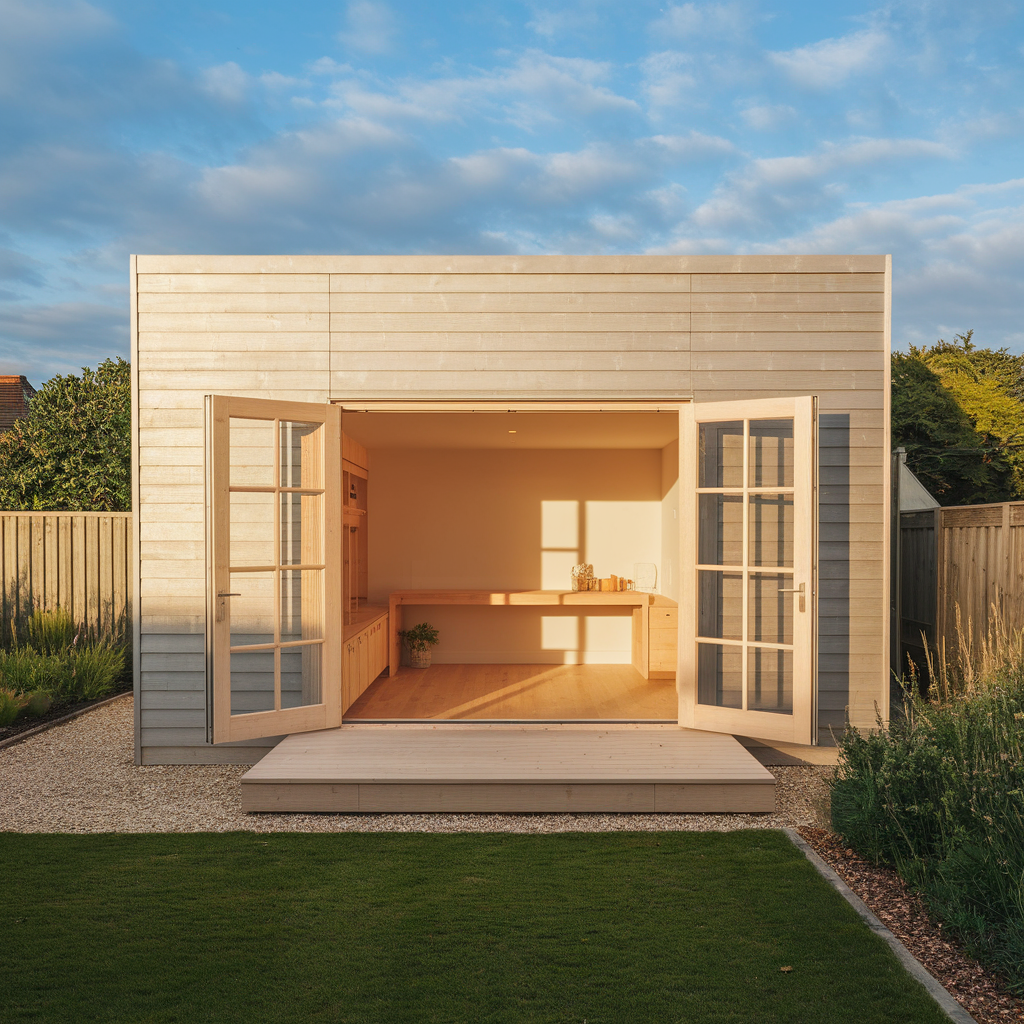
In our case, the building is oriented to face south-west, which maximises afternoon light through the double doors and large window. The external cladding is the same thermally modified timber used for the structure, left to silver naturally over time. A simple mono-pitch roof rises toward the house end, which keeps it below the fence line at the far end while allowing a reasonable internal ceiling height of just over 2.5 metres at the high point.
Inside, we kept it simple: white walls, pale oak engineered floor, a long desk under the window, a sofa along one wall. The decisions that might have been complex — colour, materiality, furniture layout — resolved easily because the space itself, once built properly, had a clear character of its own. It wanted to be calm and quiet and light. We followed that rather than fighting it.
The result gets used every single day. That’s the metric that matters.
What It Costs and Whether It’s Worth It
Garden room costs vary significantly depending on size, specification, and whether you’re going with a specialist supplier, a bespoke build, or a kit from a manufacturer. Broadly, a well-specified, genuinely habitable garden room of 15-20 square metres will cost somewhere between £15,000 and £30,000 in England, with London pricing typically at the higher end. This includes the base, structure, insulation, cladding, roofing, windows and doors, internal lining and finishing, electrics, and heating. Furniture, decoration, and connectivity are additional.
Budget garden rooms at lower price points exist, and some of them are adequate. The ones we’d be cautious about are those where the specification is thin on the fundamentals — insulation, weatherproofing, window quality — to hit a price. Those savings tend to produce a space that’s usable for a season or two and then slowly, expensively, becomes a problem.
On whether it’s worth it: a garden room adds usable space to a property in a way that’s quicker, less disruptive, and often cheaper than a conventional extension. It adds value to the property — the extent varies, but a well-built garden room in most markets adds more than it cost. And it produces a space that, in the right situation, changes how a household functions — giving the working-from-home adult a genuine separation between work and home life, or giving teenagers somewhere to be that isn’t the family living room.
Those are practical benefits. The less practical but equally real one: a well-built garden room at the bottom of a good garden, with good light and good insulation and a door that seals properly against the weather, is a genuinely pleasant place to spend time. That’s worth something that’s difficult to put a number on.