Table of Contents
There’s a particular quality that an antique fireplace mantel brings to a room that nothing else quite replicates. It’s not just the appearance — though the appearance, in most cases, is extraordinary — it’s the sense of accumulated time that a genuinely old piece carries with it. The wear at the edges where generations of hands have rested, the slight variation in the marble veining that no two pieces share, the carved ornament that represents real skill applied to real material by someone who knew exactly what they were doing. An antique fireplace mantel is, in the most literal sense, irreplaceable — because the specific piece you’re looking at exists once, and when it’s gone it’s gone.
This is quite different from a reproduction mantel, however well made. Reproductions are available at every price point and in every period style, and the best of them are genuinely good. But they don’t carry the quality that comes from age and original craftsmanship, and the experienced eye distinguishes them without difficulty. For a room that’s being refurbished to any level of ambition — particularly in a period property — the case for sourcing and installing an antique fireplace mantel rather than a reproduction is strong and, in our view, usually compelling.
What the Antique Fireplace Mantel Market Looks Like
The market for antique fireplace mantels is more accessible than people assume. Architectural salvage dealers across the UK hold substantial stocks of period mantels in a wide range of styles, periods, and materials — from Georgian marble surrounds of considerable grandeur through to Edwardian painted timber mantels of more modest character. Specialist dealers in period fireplaces curate their stock more carefully and tend to have better-restored examples at higher prices; general salvage yards offer a wider range of conditions and more scope for negotiation.
The styles most commonly encountered reflect the periods that produced the most housing stock in the UK. Georgian marble surrounds — the white Carrara, the black Belgian marble, the coloured Italian marbles — are well represented in the market, particularly the later neoclassical style with its slim proportions and delicate carved ornament. Victorian timber and marble surrounds dominate numerically, simply because the Victorian period produced more housing than any other. Edwardian mantels are plentiful and often offer excellent value because they tend to be slightly less sought-after than their Victorian predecessors.
Prices vary enormously depending on material, period, condition, and the seller. A simple late Victorian pine mantel in reasonable condition might cost a few hundred pounds from a general salvage yard. A fine Georgian marble surround in excellent condition from a specialist dealer might cost several thousand. Between these extremes, there’s a huge range, and patience in the search almost always produces something better at a given price point than the first available option.
Matching the Mantel to the Room
The most common mistake when sourcing an antique fireplace mantel is falling in love with a piece without sufficiently checking whether it’s right for the room it’s going into. The fit question has several dimensions.
Period compatibility. An antique fireplace mantel should broadly relate to the period of the house, or at least to the design language of the room. A grand early Georgian marble surround in a modest 1930s semi-detached house creates a clash of scale and style that serves neither the house nor the mantel well. A simple Edwardian timber mantel in a Georgian townhouse is a period mismatch that the observant eye will always catch. This doesn’t mean the fireplace and the house have to be contemporaneous — a carefully chosen Georgian mantel in a Victorian house can work very well if the room proportions support it — but the design language should be considered rather than ignored.
Proportional fit. The proportions of the mantel need to relate correctly to the room’s ceiling height, the size of the fireplace opening, and the overall scale of the space. A mantel that’s too small for its room looks like a token gesture. One that’s too large crowds everything around it and makes the room feel oppressive. The general principle is that the mantel height — from the hearth to the top of the shelf — should be approximately half the ceiling height, give or take depending on the style and period. This is a starting point rather than a rule, but it produces proportions that have been used successfully in period interiors for centuries.
Opening size. The fireplace opening — the actual hole in the chimney breast — determines the inner dimensions that the grate and fire surround must fit. The mantel surround sits outside the opening and can accommodate a range of opening sizes, but the relationship between the opening and the inner aperture of the surround needs to be correct. Take the opening measurements before going to look at mantels, and check the inner aperture of any piece you’re considering against these measurements.
Material and colour. The material of the mantel — white marble, coloured marble, timber, slate, stone — needs to relate to the other materials in the room. A white marble mantel in a room with warm timber floors and earthy wall colours can look slightly cold and disconnected unless the room palette is adjusted to bring it in. A dark slate mantel in a predominantly light and airy room works well as a grounding anchor. These are design judgements rather than rules, but they matter to the quality of the finished result.
Sourcing: Where to Look and What to Ask
Finding the right antique fireplace mantel takes more time than buying a reproduction, and the search process is part of what makes the eventual find satisfying. A few practical points on where to look and how to approach it.
Specialist period fireplace dealers hold curated, often restored stock, with good provenance information where it exists. They tend to know what they have and can give useful advice on period, material, and installation requirements. Prices reflect the restoration work done and the knowledge that comes with them. For someone who wants a specific period or material and doesn’t want to spend time sorting through general salvage, this is the most efficient route.
General architectural salvage yards are where the patient searcher finds the best value. Stock turns over irregularly, condition varies, and the knowledge of staff about specific pieces may be limited. But the prices are typically lower and the range broader. Regular visits to the same yards — or online browsing of stock updates — is the way to use them effectively.
Online salvage and antiques platforms have expanded the searchable market considerably. Items that previously required physically visiting dealers across the country are now searchable from a laptop, which broadens the options substantially. The risk with online sourcing is that photographs are imperfect representations of condition — always arrange an in-person inspection before committing to anything significant, and ask specific questions about dimensions, condition of the back face, and any damage or repair.
Period property sales and house clearances occasionally produce antique mantels from their original installation context — which means knowing their full history and, sometimes, getting them at prices below the dealer market. These opportunities are harder to find but worth pursuing through specialist house clearance companies and period property sales agents.
Things to ask about any piece: What material is it exactly? Has it been repaired, and where? What are the full external dimensions and the inner aperture dimensions? What is the condition of the back face — the surface that will sit against the chimney breast wall? Is there a matching grate or surround that goes with it?
Installation: What It Involves
Installing an antique fireplace mantel in a room refurbishment is more involved than hanging a mirror, but less complicated than many people assume. The sequence of work depends on whether there’s an existing fireplace in the room and what condition it’s in.
Where an existing fireplace opening survives — even if the previous surround has been removed — the basic structure is already there. The chimney breast is built, the opening is established, and the installation is primarily about fitting the new mantel to the existing opening correctly, making any necessary adjustments to the hearth, and connecting any grate or fire appliance.
The mantel is typically secured to the chimney breast wall with fixing bolts or screws through the back legs of the surround, concealed by the front face of the installation. For marble mantels, the fixings go through the timber backing that most marble surrounds have on their inner face. The surround is levelled carefully — a mantel shelf that isn’t level is immediately visible and endlessly irritating — and the joints between the surround and the wall are filled and finished.
Where the fireplace has been blocked and the surround removed, re-opening the fireplace is structural masonry work that needs a builder competent in this area. The blocked opening is carefully opened, the throat condition is assessed, and the lintel over the opening is checked for adequacy. If the chimney is to be used, the flue needs inspection and probably lining. The hearth — if the original has been removed or covered — needs to be reinstated in an appropriate material.
Marble mantels are heavy — a full marble surround from the Georgian period can weigh several hundred kilograms — and require at least two people and appropriate lifting equipment for installation. The hearth beneath needs to be capable of supporting the weight. For upper-floor installations, the floor structure below needs to be assessed for adequacy. These aren’t reasons to avoid marble; they’re considerations that need to be part of the planning.
Timber mantels are considerably lighter and more forgiving in installation terms. The main consideration is ensuring the timber surround is kept at the correct distance from the fire opening to meet Building Regulations clearance requirements — typically a minimum of 150mm from any flame to any combustible material, though the exact requirement depends on the heat output of the appliance being used.
Making the Antique Mantel the Room’s Focal Point
An antique fireplace mantel is capable of being the best thing in a room — the element that makes everything else make sense. But it doesn’t happen automatically. The room around it needs to be designed in conversation with the mantel, not independently of it.
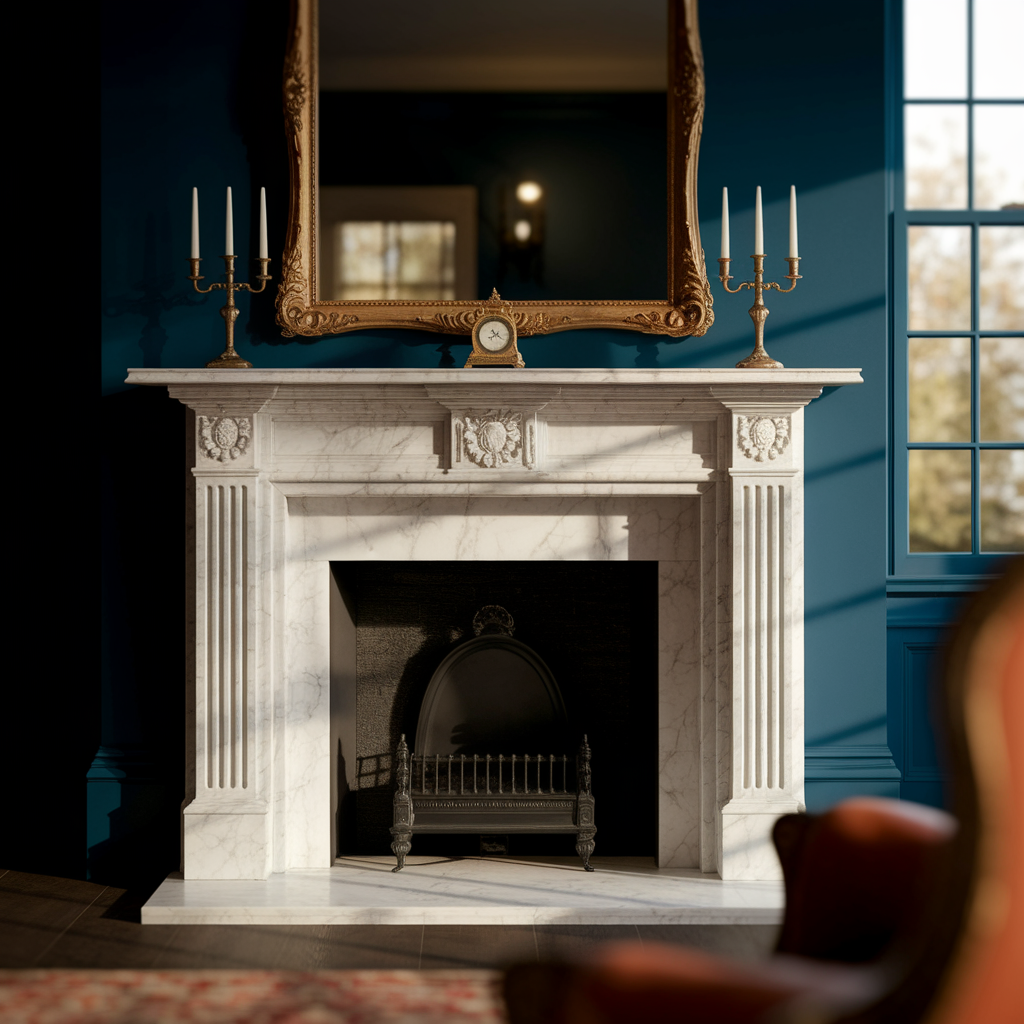
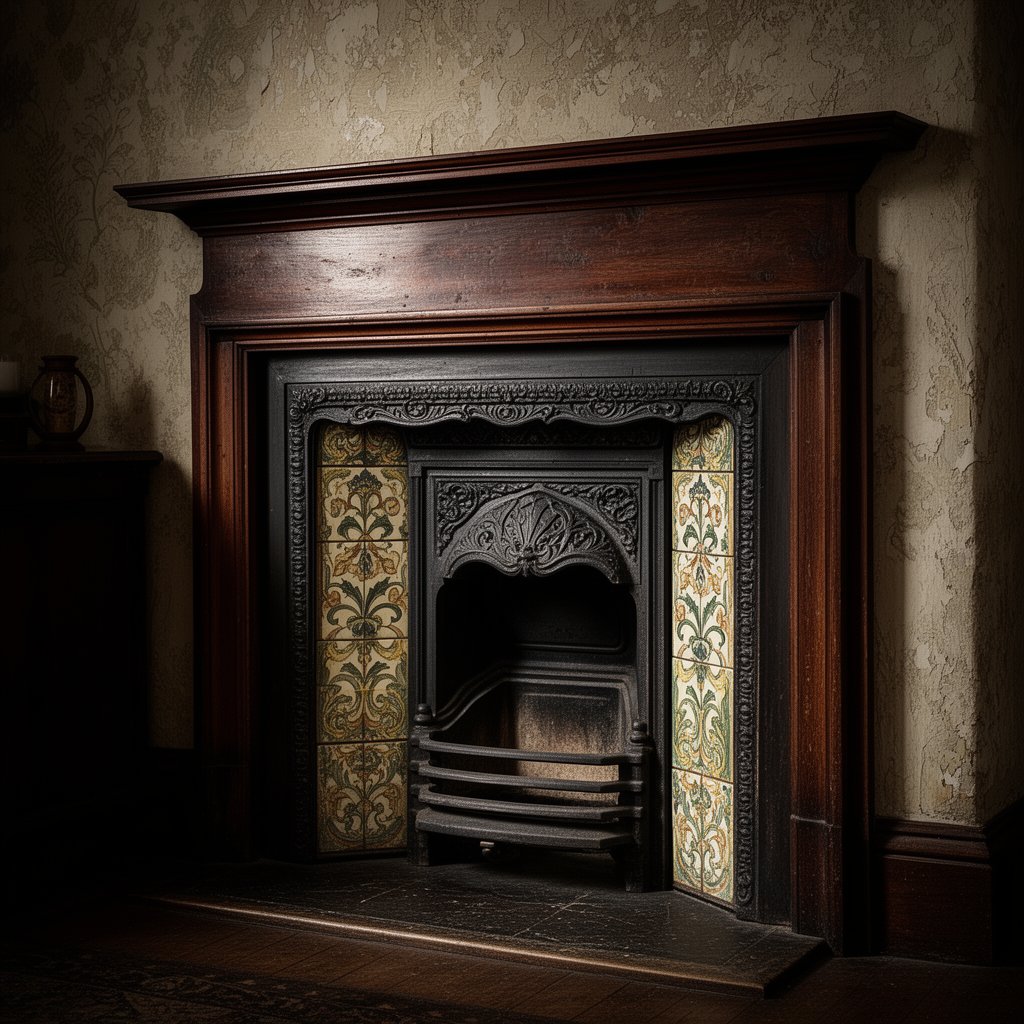
The wall behind. The chimney breast wall, and the wall on either side of it, forms the backdrop against which the mantel is read. A pale neutral wall makes most mantels look somewhat stranded. A deeper colour — one that creates contrast with the material of the surround and gives it a background to sit against — allows the mantel to read as the focal point it is. A Georgian white marble surround against a deep prussian blue or a near-black reads with extraordinary authority. A Victorian timber mantel in mahogany-toned wood against a deep green or terracotta has a warmth and richness that both materials amplify in each other.
Above the mantel shelf. The space between the shelf and the cornice above is part of the composition. A well-chosen mirror in a frame that complements the period and material of the mantel, hung at the correct height, completes the chimney breast as an architectural statement. Artwork works equally well — one significant piece rather than an arrangement that competes with the surround’s own ornament. A mantel shelf left entirely bare looks unresolved; one with a thoughtfully edited collection of objects — a clock, a pair of candlesticks, a piece of sculpture — looks curated in a way that suits the materiality of a period piece.
The hearth floor. The material at the foot of the mantel — whether original tiles, stone, or a new hearth in an appropriate material — completes the picture. An antique marble mantel sitting on a modern tiled hearth in an inappropriate material reads as unfinished. Sourcing a hearth in a compatible material — stone flags, encaustic tiles, York stone, appropriate marble — as part of the same project completes the installation correctly.
Why It’s Worth the Effort
The search takes longer. The installation is more involved. The sourcing requires patience and some specialist knowledge. All of this is true, and all of it is worth it. An antique fireplace mantel in a room that’s been refurbished around it with care is not simply a good-looking piece of furniture. It’s a room anchor that gives the whole space a quality of permanence and authenticity that nothing else in the decorator’s repertoire provides.
Rooms with genuinely good period mantels feel different from rooms without them. They feel finished in a way that takes years off the need for any further intervention. They provide the thing that contemporary interiors most often lack — a piece with genuine history, genuine craft, and genuine irreplaceability. For a room refurbishment done with any ambition, the antique fireplace mantel is where that ambition is most visibly rewarded.