Table of Contents
When we talk about restoring period ceilings to bring back original craftsmanship, we’re really talking about one of the most overlooked acts of preservation in a heritage home. Walls get repainted, floors get sanded, kitchens get updated — but the ceiling, literally above everything, tends to get scraped, skimmed flat, and forgotten. Which is a shame, because original plasterwork is often some of the most accomplished decorative work in a period property. And once it’s gone — buried under successive coats of emulsion or stripped back by someone who thought a smooth flat ceiling looked modern — recovering it is a slow, expensive, skilled undertaking.
The good news is that a surprising amount of original ceiling plasterwork survives beneath the damage. The accumulation of paint, the obscured detail, the cracked and sagging sections — these don’t always mean the original work is lost. They often mean it’s waiting to be uncovered and properly conserved.
Understanding What You’ve Got
Before any restoration work begins, the first job is assessment. Period ceilings in England span a wide range of types and ages, and the right approach depends entirely on what you’re dealing with.
The oldest plasterwork — pre-Victorian, typically found in Georgian and earlier houses — is lime-based, applied in multiple coats over riven lath. It’s flexible by the standards of modern plaster, breathes with the building, and when it’s survived two centuries in reasonable condition, it has a resilience that shouldn’t be underestimated. The failure modes of old lime plasterwork are usually mechanical — the keys that attach the plaster to the lath break as the lath dries and shrinks — rather than chemical. Sections that have lost their key and are hanging loose need immediate attention, but sections that are stable, however crazed or cracked on the surface, are often fine to leave and repair rather than replace.
Victorian plasterwork is the most commonly encountered type in the UK housing stock. By the mid-nineteenth century, plasterers were producing increasingly elaborate decorative work — deep cornices with complex profiles, ceiling roses of considerable scale, frieze panels, and run and cast ornament of real quality. The craftsmanship embedded in a well-preserved Victorian ceiling is genuinely significant, and its loss — when ceilings are lowered, stripped, or replaced with plasterboard — represents an irreversible removal of part of the building’s character.
Edwardian and interwar plasterwork is typically simpler in profile but still produced by skilled tradespeople using traditional methods and materials. The cornices are often elegant and well-proportioned even if less flamboyant than their Victorian predecessors. These are worth preserving just as carefully.
The Paint Problem: Decades of Obscured Detail
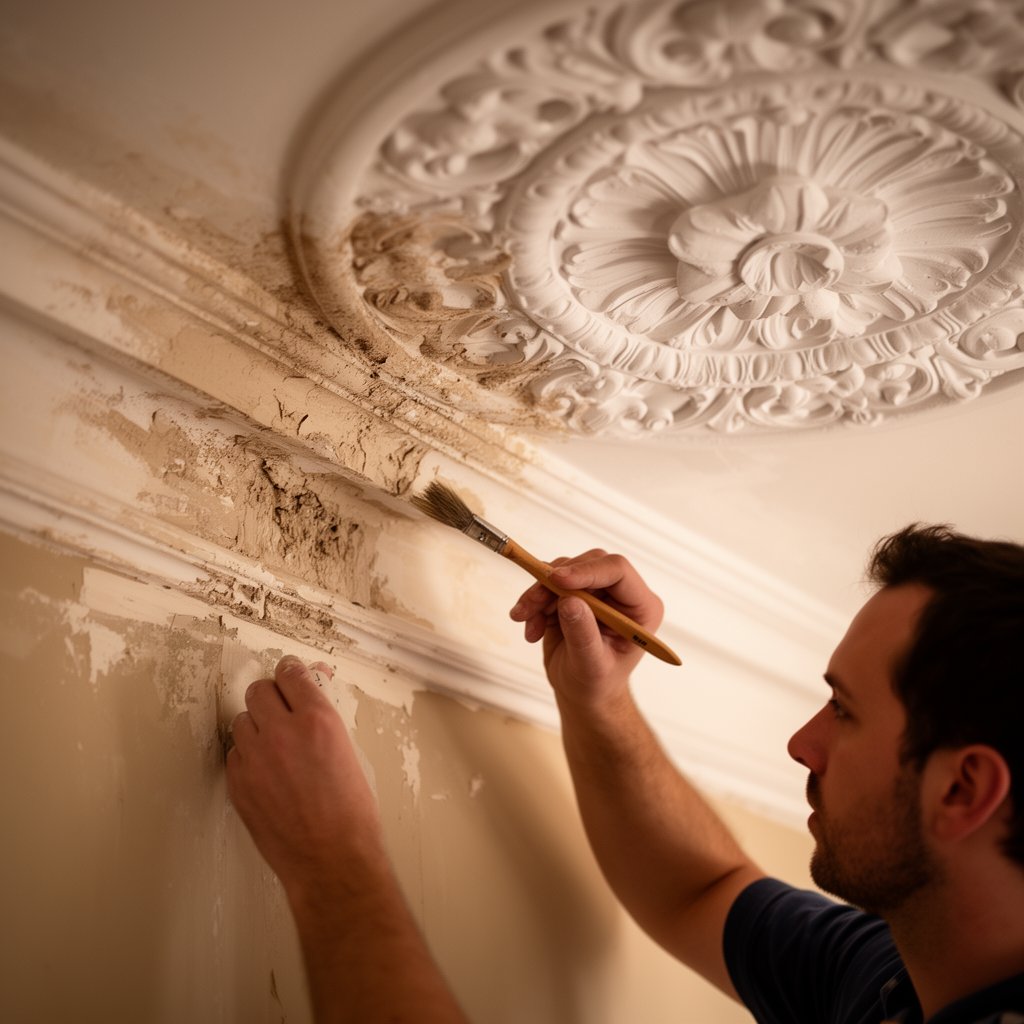
The single most common issue with original plasterwork is paint accumulation. A Victorian cornice applied in the 1880s has, in most cases, been repainted every five to ten years since. After twelve or fifteen coats of paint — some oil-based, some water-based, some applied over unprimed plaster, some over previous paint that was itself failing — the original profile is blurred, the crisp transitions between elements are softened, and the shadow lines that give plasterwork its character are partially or entirely filled.
The solution is paint removal, which is one of the more painstaking jobs in a period property restoration. Several approaches are used depending on the paint types involved, the depth of build-up, and the fragility of the underlying plasterwork.
Steam stripping is effective on many paint types and avoids chemical softening of the plaster substrate — the steam softens the paint layers without significantly wetting the plasterwork beneath. It requires patience, the right equipment, and careful technique; forcing the tool into delicate profiles causes damage that takes longer to repair than the paint removal would have taken.
Chemical strippers work well on stubborn paint types, particularly old oil-based paint that doesn’t respond to steam. The key is choosing a product that remains workable for long enough to penetrate the full paint build-up, and ensuring that the chemical is fully neutralised and removed before any new paint or consolidant is applied. Residual chemical left in the plaster voids will cause new finishes to fail.
The finest profiles — the smallest beads, quirks, and fillets in a complex cornice — sometimes have to be cleared by hand with wooden tools and very fine bristle brushes. This is slow work, but it’s less risky than mechanical or chemical methods on delicate details, and it’s the approach that produces the cleanest result.
Consolidation: Stabilising What’s There
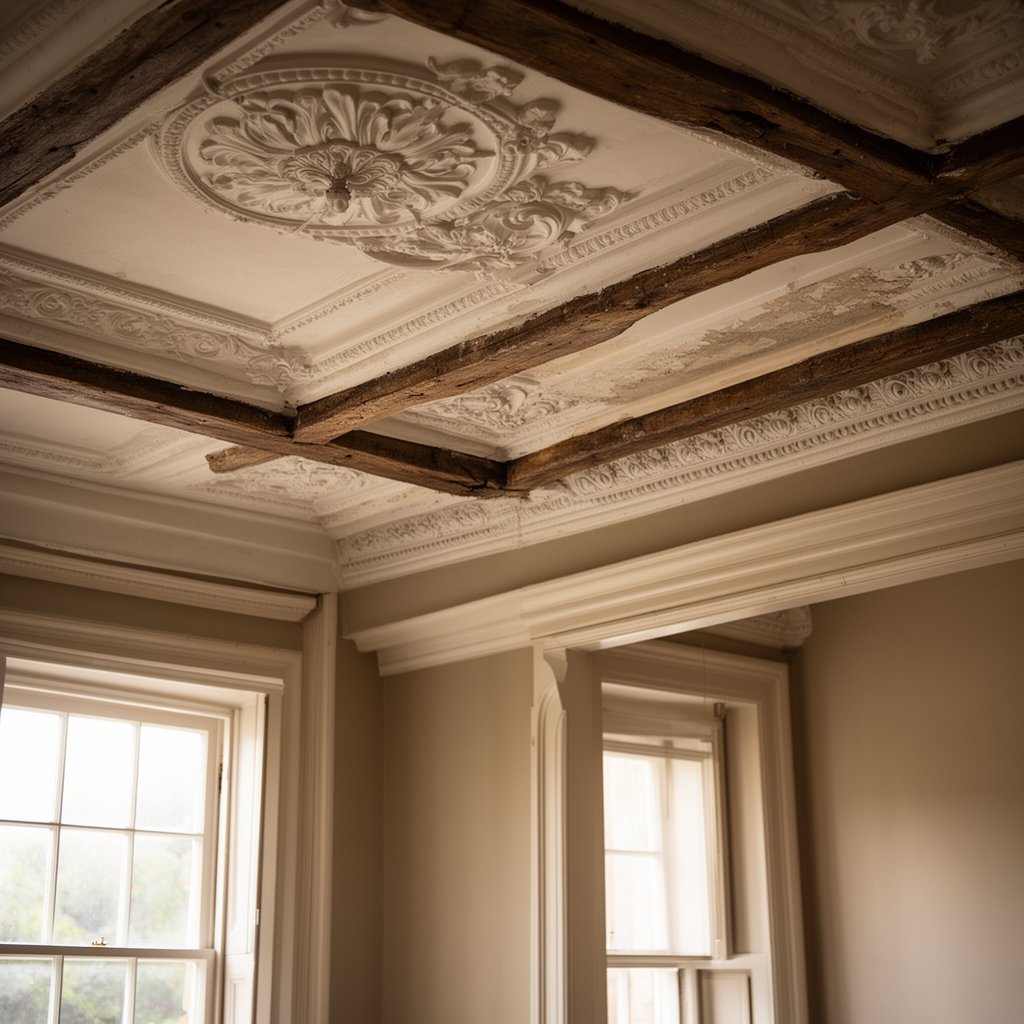
Loose, cracked, or friable plasterwork needs to be stabilised before any repair work begins. Attempting to patch or fill plasterwork that isn’t properly secured to its substrate produces repairs that fail along with the surrounding area.
For lime-based plasterwork that has lost its key — the sections that move when pressed, or that produce a hollow sound when tapped — consolidation is possible using a technique of injecting lime-based grout or a proprietary consolidant through small drilled holes. The grout fills the void between the plaster and the lath, re-establishing the mechanical connection. Done well, by someone who understands the material, it’s a conservation technique that stabilises original plasterwork without replacement. Done poorly — wrong material, wrong pressure, insufficient attention to the void geometry — it can add weight that makes the problem worse rather than better.
Friable or powdering surfaces — typically the result of moisture damage, rising damp, or condensation — need a different approach. The source of the moisture has to be addressed before any consolidation is attempted. Treating the symptom without addressing the cause produces conservation work that deteriorates again within a few years.
Repair: Matching the Original
Where sections of plasterwork are missing or beyond consolidation, repair work needs to match the original as closely as possible in profile, texture, and material. This is where skill and knowledge of traditional materials makes the difference between a repair that disappears into the original and one that announces itself every time the light catches it.
Profile matching for cornices and mouldings traditionally involves running a zinc template cut to the profile of the original against a setting coat of lime plaster. The template — shaped to the negative of the cornice profile and fitted to a running mule that travels along a screed fixed to the wall and ceiling — produces a continuous moulded surface that matches the original exactly. This running-in-situ technique is the right approach for long continuous cornice runs. For isolated sections that need to match an existing run, casting in the original material and then cutting and mitring to fit is an alternative.
Lime putty is the traditional repair material for historic plasterwork, and in most cases it’s the right one. Modern gypsum-based plasters have different setting times, different flexibility, and different moisture behaviour from the original lime. They can introduce differential movement that causes cracking at the repair boundaries. A skilled conservator working on original lime plasterwork will use a lime-compatible material throughout.
Ceiling roses and other cast enrichments are typically repaired by making a mould from an intact section and casting replacement elements. Where the original is intact somewhere on the ceiling or in another room, a silicone rubber mould taken directly from the original produces a cast that’s as close to the original as any other method. Where no original survives, historical references — pattern books, surviving examples in similar properties — can provide the basis for a sympathetic replacement.
Working With Specialist Craftspeople
Restoring period ceilings to bring back original craftsmanship is not a project for general builders or decorators, however competent they may be in other areas. It requires specific skills in lime plaster and traditional plastering techniques that are becoming genuinely rare.
The Guild of Master Craftsmen and the Society for the Protection of Ancient Buildings both maintain directories of specialists with relevant skills. For listed buildings, Historic England’s guidance on traditional building materials is the appropriate technical reference, and their Conservation Register includes accredited conservators working with historic plasterwork.
On a listed building, any work to original fabric — including repairs to ceilings — requires Listed Building Consent before it starts. The local planning authority’s conservation officer should be consulted at the planning stage, not just at the point of application.
The Result
When it’s done well — when the paint is removed, the loose sections consolidated, the missing elements reinstated in matching materials, and the whole ceiling cleaned and prepared for a single coat of limewash or breathable distemper — an original period ceiling is a genuinely extraordinary thing. The quality of the ornamental work, the depth of the profiles, the way the light catches the shadows in a way that a modern ceiling never quite replicates. It’s not just decorative detail. It’s evidence of what skilled craftspeople could produce with simple tools and trained hands. Bringing that back is worth the effort it requires.