Table of Contents
Knowing how to preserve and highlight original fireplaces in heritage homes is one of those skills that sits at the intersection of conservation work and interior design — and it matters more than people often realise. An original fireplace is rarely just a functional object. In a Victorian terrace, an Edwardian villa, or a Georgian townhouse, the fireplace was the formal focal point of the room — the centre of social life, the principal decorative statement, the thing that every chair faced and every conversation referenced. Restoring one properly, or highlighting one that’s been neglected, transforms a room in a way that almost nothing else can.
The problems, when you encounter them, are fairly consistent. Fireplaces get boarded over in the 1960s and 70s by people who thought them draughty and old-fashioned. Surrounds get painted — sometimes in colours that do the material no favours. Grates get removed. Tiles get cracked and replaced with something more convenient. And occasionally, the whole assembly gets ripped out and replaced with a modern gas fire in an inappropriate surround that has no relationship to the building’s age or character.
Undoing these interventions, where the original survives, is one of the more satisfying projects in a heritage renovation.
Finding What’s There
If your room has a blocked-up fireplace, the first question is whether the original surround, grate, and any tiled elements survive behind the boarding. The answer is often yes — particularly in houses where the 1960s treatment was to board over rather than remove, which was common because it was faster and cheaper. The original fireplace is still there, protected behind a sheet of hardboard or plasterboard that was never meant to be permanent.
Investigating is simple: remove a section of the boarding carefully at one corner and look. If the surround is there in reasonable condition, the boarding comes off and the fireplace comes back. If someone removed the surround but the opening and the basic chimney structure survives, you’re looking at a reinstatement project rather than a conservation one.
Where the fireplace has been completely removed — surround, grate, mantel and all — the chimney breast usually remains, and the opening has been infilled with brick or block and plastered over. Reinstating a fireplace in this situation is entirely possible; it just requires sourcing appropriate period fittings and a builder with the masonry skills to re-open the fireplace throat correctly.
Cleaning and Restoring Stone and Marble Surrounds
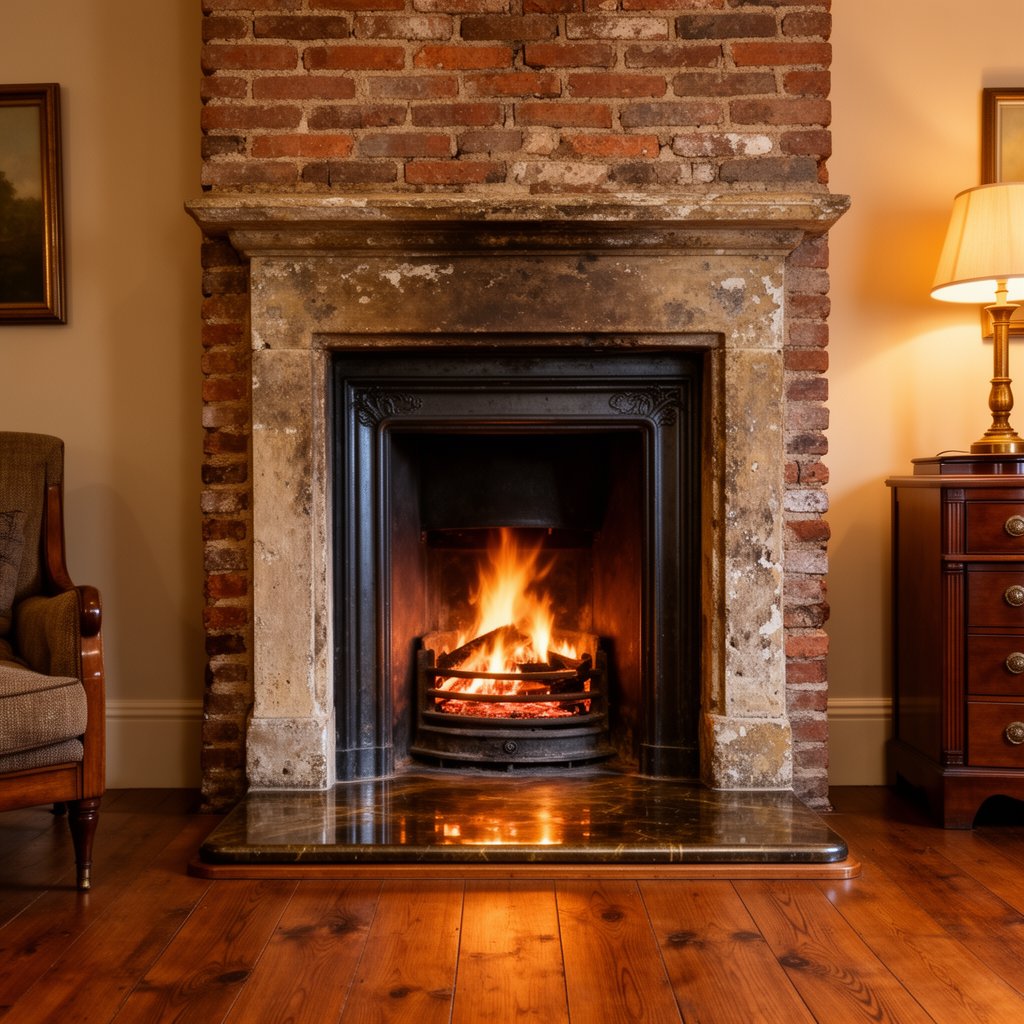
Stone and marble surrounds are common in Georgian and early Victorian properties, and they can be in remarkable condition once they’re cleaned back. The most common issue is paint — one or more coats applied over the original surface at some point, which obscures the material’s natural character.
Removing paint from stone and marble is a job that requires the right product and patience rather than force. Chemical paint strippers safe for use on stone — specifically formulated not to etch or stain the surface — are the first approach. Multiple applications may be needed for heavy paint build-up. Poultices — absorbent material mixed with a stripping agent, applied to the surface and left to draw out the paint as it dries — work well on intricate moulded sections where liquid strippers would run off before they could act.
For Carrara marble in particular, be cautious of any acid-based products — including some proprietary stone cleaners — that will permanently etch the polished surface. Test any chemical product on an inconspicuous area first, wait twenty-four hours, and check for staining or etching before proceeding.
Once cleaned, marble can be re-polished to recover something close to its original surface. This is specialist work — marble polishing involves a sequence of increasingly fine abrasive papers and polishing compounds that produces a result quite different from anything achievable with standard cleaning products. It’s worth finding a stone restoration specialist rather than attempting it without specific experience.
Staining on marble — from water, from rust from iron fittings, from years of coal smoke — can sometimes be drawn out with specialist stone poultices. Not always, and not completely, but significant improvements are often achievable.
Cast Iron Fireplaces: Cleaning, De-rusting, and Blacking
Cast iron fireplaces — the standard fitting in Victorian and Edwardian properties, found in virtually every bedroom and secondary room as well as many principal rooms — are robust but need specific treatment to look their best.
Rust is the main enemy. Surface rust on cast iron, where the metal hasn’t pitted deeply, is removable. Wire brushing by hand or with a drill-mounted wire wheel removes loose rust and scale. More persistent rust requires a rust converter — a phosphoric acid-based product that chemically converts red iron oxide to black iron phosphate, which then forms a stable surface for subsequent treatment. This isn’t a substitute for proper surface preparation, but it’s a practical tool for sections that can’t be fully mechanically cleaned.
Grate polish — traditional black lead or a modern equivalent — applied to clean, dry cast iron and then buffed produces the characteristic black lustre of a well-maintained Victorian grate. It needs reapplication periodically, but the process is straightforward and the result is exactly correct for the period. Proprietary cast iron paint is an alternative where the surface is too corroded for a polished finish, but the appearance is different — flatter, less reflective — and less authentic.
Damaged or missing cast iron elements — cracked grates, missing bars, broken hood sections — can often be repaired or replaced. There’s a substantial market in reclaimed Victorian and Edwardian cast iron grates and fireplaces, and matching pieces are frequently findable through architectural salvage dealers. Measurement is everything: cast iron fireplaces were made in standard sizes, and having the correct dimensions before searching salvage dealers saves considerable time.
Period Tiles: Conservation and Replacement
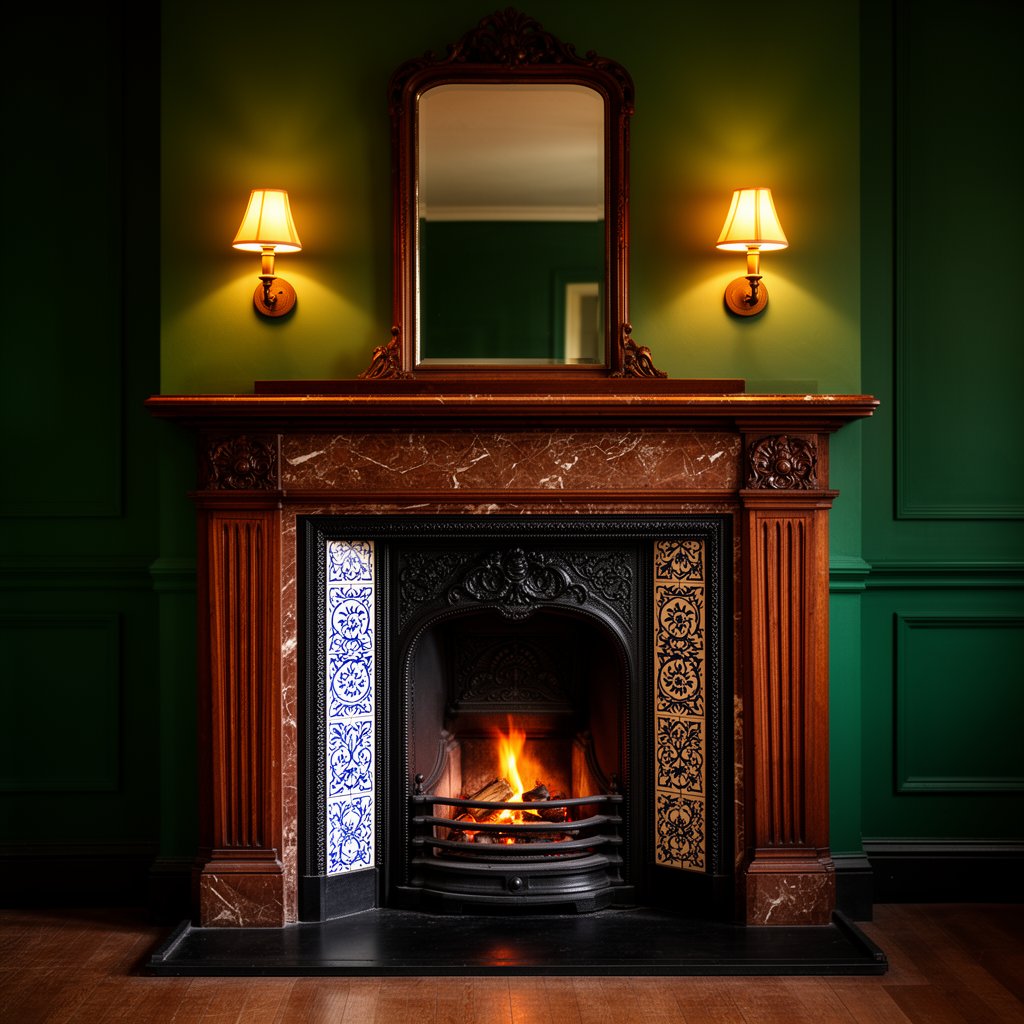
Victorian and Edwardian fireplace tiles are among the most distinctive elements of period interiors — the hand-painted or transfer-printed tiles in geometric or floral patterns that line the cheeks of the fireplace opening are part of what makes these fireplaces immediately recognisable as belonging to their era.
Where original tiles survive, even those cracked or slightly damaged, conservation should be the first approach. A cracked tile that’s still in situ contributes to the authentic character of the fireplace in a way that a perfect reproduction replacement doesn’t. Loose tiles can often be re-bedded using an appropriate lime-based adhesive or a heat-resistant adhesive where the position is close to the fire opening.
Where tiles are missing or beyond repair, replacement requires care in matching. Several manufacturers produce period-style reproduction tiles in original Victorian and Edwardian designs. The key things to match are: the size (Victorian tiles were typically 6-inch or 152mm square, though some fireplaces used 4.5-inch), the thickness, the glaze type (transfer printed, hand painted, or embossed), and the colour palette. Period tile matching is an area where spending time looking at the originals and comparing carefully pays dividends — a slightly wrong replacement tile in a prominent position will catch the eye every time.
For fireplaces where all the tiles are missing, architectural salvage is the better route than reproduction if budget allows. Original tiles have a quality and variation that reproductions approximate but rarely match exactly.
Highlighting Rather Than Just Preserving
Conservation is about maintaining what’s there. Highlighting is about making it the best it can be within its setting — and that’s a design question as much as a conservation one.
The most effective way to make an original fireplace the focal point it was designed to be is almost always to make the surrounding wall recede. A deep, saturated wall colour behind and around the fireplace — something that creates contrast with the material of the surround without competing with it — focuses attention on the fireplace and gives it the visual weight it deserves. The trend for painting everything in the same neutral and hoping for the best produces rooms where the fireplace is present but not prominent.
Lighting is the other tool. A pair of wall lights or table lamps either side of the chimney breast, positioned to wash light onto the surround rather than into the room, creates a quality of illumination that makes good plasterwork and stone glow in the evening in a way that overhead lighting never achieves.
The hearth itself matters more than people tend to realise. An original cast iron grate with clean blacking, a properly fitted fireback, and a hearth surround in the right stone or tile completes the picture in a way that a surround sitting over a blank opening doesn’t.
If the fireplace is to be used — for solid fuel, wood, or gas — a HETAS-registered engineer should inspect and commission the installation. For decorative use only, ensuring the chimney is capped against birds and rain, and the opening is adequately ventilated, is the practical minimum.
The Room Around It
Restoring and highlighting an original fireplace makes demands on the rest of the room that it’s worth thinking through from the start. A beautiful Victorian cast iron fire surround in a room furnished otherwise without reference to the period works fine — period and contemporary mix well when both are done with confidence. What doesn’t work is a beautifully restored fireplace in a room that’s otherwise been stripped of all its original character. The fireplace then looks like a retained exhibit rather than a functioning part of a coherent space.
The original cornice, picture rail, skirting boards, and door architraves — if they survive — should be restored alongside the fireplace. The floor should be considered in the same conversation. These elements are related to each other in a way that makes each one look better in the presence of the others, and restoring the fireplace in isolation from the room it inhabits is a missed opportunity.
Done as part of a coherent approach to the whole room, an original fireplace restored and properly highlighted is one of the most powerful interior design statements available in a heritage property. It doesn’t require much furniture or decoration around it to make the room feel exceptional — it carries that quality itself, provided it’s been given the care it deserves.