Table of Contents
The garden room market has expanded considerably over the past decade, and one of the most significant developments within it has been the rise of the kit-form garden room. Where previously the only realistic route to a quality garden building was either a bespoke build through a specialist contractor or a fairly basic off-the-shelf shed-style structure, there’s now a substantial middle ground occupied by garden room kits — pre-engineered, factory-produced systems that you either self-build or have assembled by an installation team.
The appeal is obvious. Kit garden rooms promise the quality and specification of a proper habitable building at a lower price than bespoke, with shorter lead times and a more predictable process. And in many cases, they deliver on that promise. But they’re not right for every situation, and the differences between a well-specified kit and a poorly specified one are significant enough to matter enormously to how the finished room performs over time.
This is everything we know about garden room kits — how they work, what the genuine advantages are, where the compromises tend to sit, and what to look for when you’re trying to separate the good from the disappointing.
What a Garden Room Kit Actually Is
The term covers a fairly wide range of products, and understanding the variation is important before making any decisions.
At the basic end, a garden room kit is essentially a glorified flat-pack building — pre-cut timber components, standardised panels, and a set of instructions. This category overlaps significantly with premium sheds and summer houses. The components are designed for self-assembly by a reasonably competent DIYer, the specification is modest, and the price reflects that. These buildings can be adequate for seasonal use or for light-duty purposes. They are generally not adequate for year-round habitable use without significant additional work on insulation and weatherproofing.
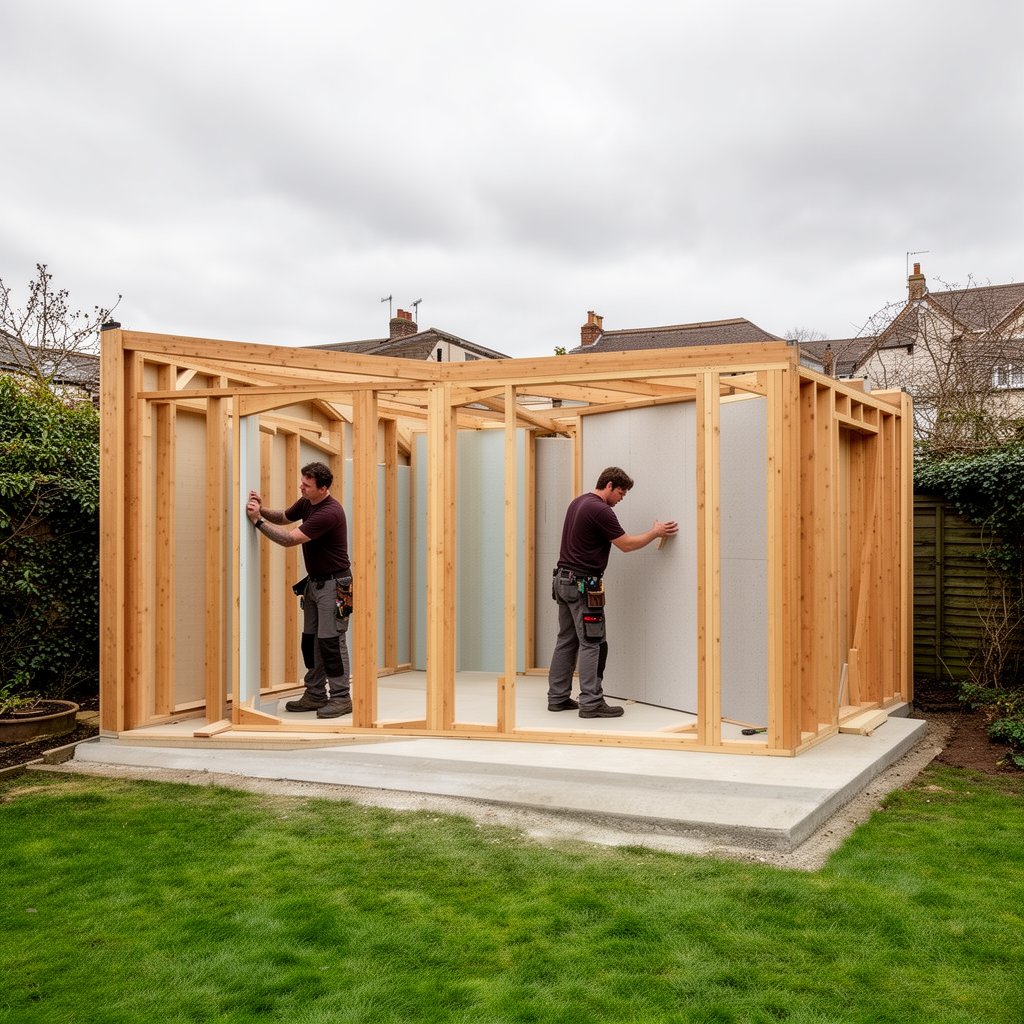
At the better end of the market, a garden room kit is a pre-engineered structural system with a specific, thought-through specification: factory-machined SIP (Structural Insulated Panels) or engineered timber frame with pre-cut components, specified insulation values, pre-fitted window and door frames, and either a self-build or professional installation option. These are genuine buildings designed for year-round habitable use, and the best of them compete directly with bespoke builds in terms of performance.
The distinction between these two ends of the market is large, and the price difference reflects it — but not always in the way you’d expect. There are kit products at relatively modest prices that are well-engineered and perform well, and there are more expensive kit products where the price is driven by marketing and branding rather than specification quality. Understanding what you’re actually buying requires looking past the headline price and the CGI renders.
The Genuine Advantages of Garden Room Kits
Starting with the honest case for kits, because there are real advantages that shouldn’t be dismissed.
Price is the most obvious. A well-specified kit garden room will typically cost less than an equivalent bespoke build for the simple reason that factory production is more efficient than site construction. Repetitive processes done in a controlled environment with consistent materials produce cost savings that a site-built structure can’t match. For a comparable specification, a kit is genuinely likely to be cheaper, sometimes significantly so.
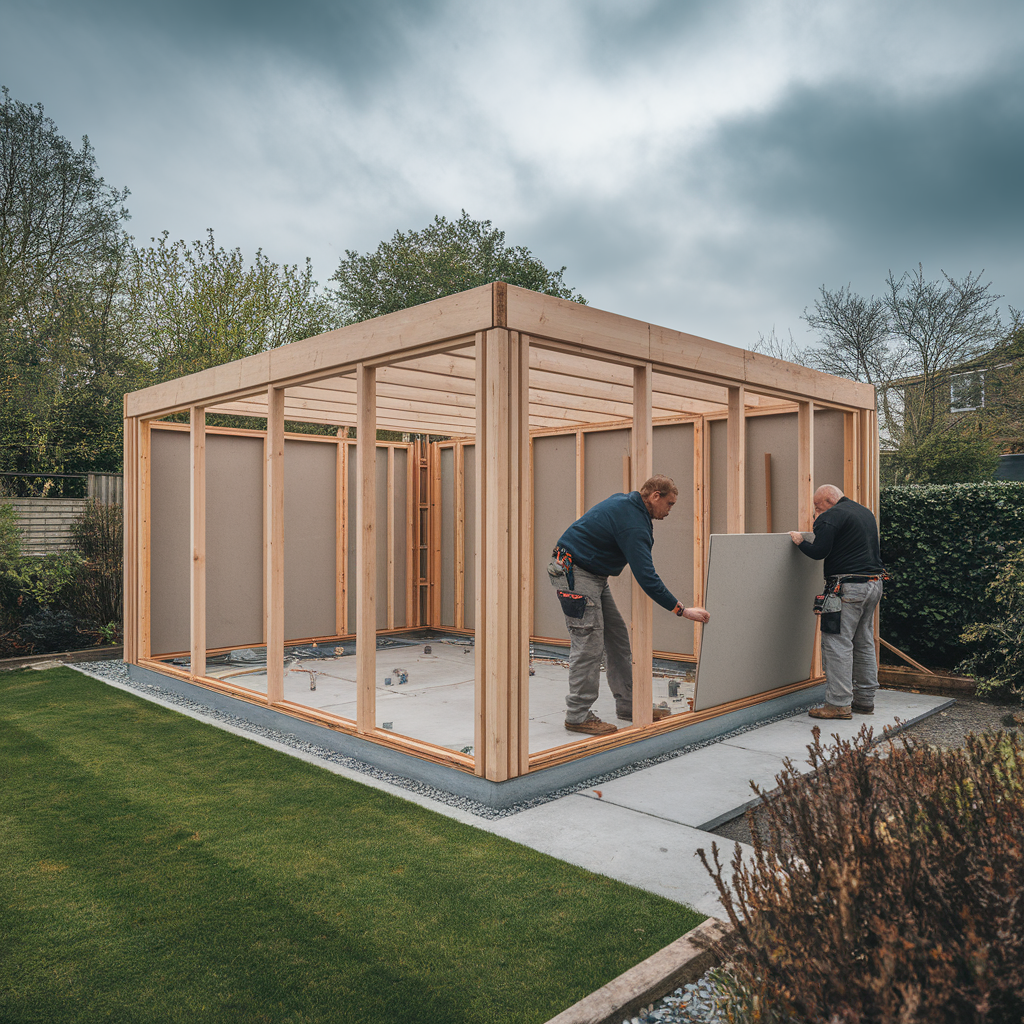
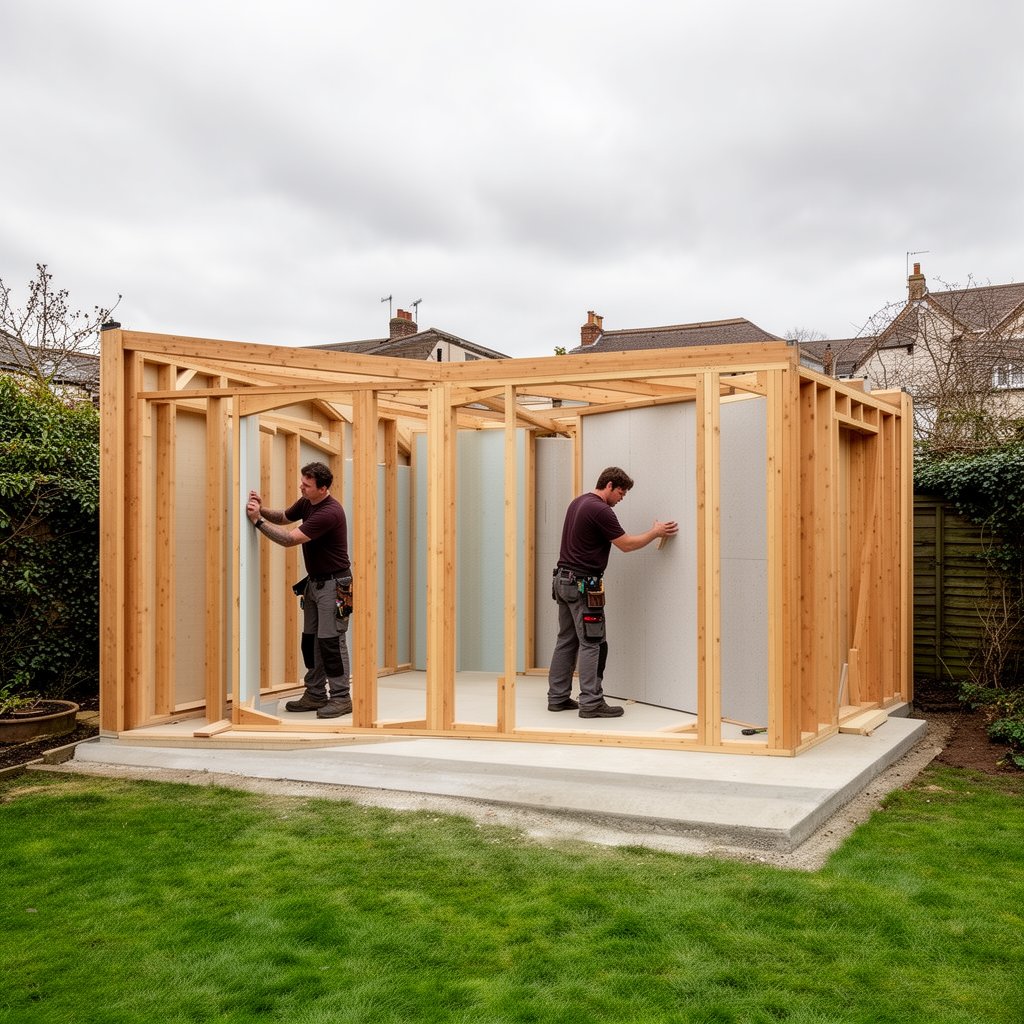
Speed is another real advantage. Bespoke garden room builders typically have lead times of eight to sixteen weeks or longer, depending on demand. Many kit manufacturers can deliver within four to eight weeks of order, and once the base is prepared and the components arrive, the assembly can be completed in a matter of days rather than weeks. For someone who needs a usable space relatively quickly, this matters.
Consistency is perhaps the most underappreciated advantage. Factory production means every component has been made to the same specification, cut to the same tolerances, and checked before it leaves the factory. Site-built structures are subject to the variability of individual tradesperson skill, weather conditions during construction, and on-site problem-solving that occasionally produces compromises. A factory-engineered kit, well-specified from the outset, will perform consistently in a way that depends less on the individual skill of whoever puts it together.
Self-build potential is a genuine option with some kit systems and none with bespoke. For someone with good practical skills, a willingness to invest the time, and a modest but well-specified kit system, self-building a garden room is achievable. It reduces the total cost substantially and produces a real sense of ownership over the finished space. It requires realistic self-assessment of skills and time, and it’s not for everyone — but the option exists in a way it doesn’t with a custom-designed structure.
Design clarity is a slightly subtler advantage. Kit systems come with defined parameters — standard sizes, standard configurations, a relatively limited set of options. For some people, having fewer variables to decide between produces better outcomes than the open-ended possibilities of a fully bespoke brief. The paradox of choice is real; a constrained set of good options can be easier to work with than unlimited freedom.
The Honest Disadvantages
The advantages are real. So are the disadvantages, and being clear about them is what separates a good buying decision from a disappointing one.
Standardised dimensions are the most significant limitation. Kit systems are designed around standard panel sizes, which means the available room dimensions are fixed or constrained within a relatively narrow range. If your garden has an irregular shape, a specific access constraint, or a planning situation that requires a particular footprint, the standard kit sizes may not fit. Bespoke builds accommodate any footprint; most kits don’t.
Specification variation is hard to assess from marketing materials. Kit manufacturers describe their products in terms that sound impressive — “super-insulated,” “year-round habitable,” “commercial-grade construction” — without always providing the specific technical data that would allow meaningful comparison. What is the U-value of the wall construction? What is the specification of the floor insulation? What is the window glazing specification and what is the frame material? These are the questions that determine whether the building actually performs as described, and they’re not always easy to get clear answers to from the sales process.
Cheap kits are a false economy. The lower end of the kit market produces buildings that look like garden rooms and perform like sheds. The insulation is inadequate, the windows seal poorly, the cladding is thin and prone to movement, and within a few winters the space is damp, cold, and deteriorating. The headline price is lower. The total cost of ownership — factoring in the heating bills, the remedial work, and eventually the replacement — is higher. This is the most common source of disappointment in the garden room kit market.
Installation quality varies enormously when the kit manufacturer’s own team isn’t doing it. Some manufacturers offer installation as a service and take responsibility for the quality of the build. Others sell the kit and leave the installation to the customer or a third-party contractor. When the installation is done well by a team familiar with the system, it’s fine. When it’s done by a general builder encountering the system for the first time, the quality can suffer in ways that aren’t immediately visible but become apparent over time — inadequate sealing at junctions, insulation installed without vapour control, details at the base of the cladding that allow water ingress.
Design flexibility is limited at both ends of the project. The exterior design of a kit garden room is largely determined by the system — the cladding options, the roof form, the standard window and door positions. Within the system you can usually choose from a range of options, but you can’t fundamentally change the architectural character of the building the way you can with a bespoke design.
If you have a strong aesthetic vision, or if the building needs to respond to specific architectural context, a kit may not give you enough flexibility. Internally, the constraints are fewer — once the shell is up, the interior is largely as free as any other room — but the fixed positions of windows, doors, and structural elements still constrain the interior layout.
SIP Systems vs Timber Frame Kits
The two main structural approaches used in garden room kits are worth understanding, because they produce different buildings with different characteristics.
Structural Insulated Panels (SIPs) are composite panels consisting of an insulating foam core bonded between two structural boards, typically OSB. They’re manufactured to precise dimensions and used as the walls, roof, and sometimes floor of the building. SIP construction is fast on site — large panels cover a lot of area quickly — and the insulation is integral to the structure rather than separate, which produces consistent performance without the risk of gaps in the insulation layer. The disadvantage is that SIP buildings are more expensive to modify or repair after construction; cutting into a SIP panel is more involved than opening up a timber frame wall.
Engineered timber frame kits use a traditional frame-and-fill approach, with structural timber studwork and separate insulation installed in the cavities. The best timber frame kits use pre-machined components with high dimensional accuracy, making site assembly straightforward. The approach is more familiar to most builders, easier to modify, and allows more flexibility in how services are routed through the walls. The performance depends heavily on the insulation specification and installation quality — a well-specified and well-installed timber frame kit can equal or exceed a SIP build; a poorly specified or poorly installed one won’t.
For most buyers, the distinction matters less than the specification within each category. A well-specified SIP kit and a well-specified timber frame kit will both produce a good building. What matters is what the insulation values actually are, not what structural system delivers them.
What to Look for When Comparing Kits
The criteria that genuinely determine quality, as opposed to the marketing signals that merely suggest it.
U-values, stated explicitly. A good kit garden room should be able to give you the U-value of the wall construction, the roof construction, and the floor. These are measures of thermal performance — lower is better. Walls of 0.20 W/m²K or below, roof of 0.15 W/m²K or below, and floor of 0.20 W/m²K or below represent a genuinely well-insulated building. Any manufacturer that can’t or won’t provide these numbers should be treated with scepticism.
Window specification. Double glazing is the minimum; the question is what specification of double glazing. Low-E glass coatings, argon-filled cavities, and warm-edge spacer bars all improve thermal performance over basic double glazing. The frame material matters too — uPVC frames are thermally adequate, timber frames perform well if maintained, aluminium frames need a thermal break to perform well.
Cladding quality and fixing method. The cladding is the building’s first line of defence against the weather and also determines how it looks over time. Thermally modified timber (Accoya, thermowood) is more dimensionally stable and decay-resistant than standard softwood. The fixing method and the detailing at the base of the cladding — how the bottom course is detailed to prevent water sitting against the timber — are as important as the material choice.
Base requirements and whether they’re provided. Most kit manufacturers require a prepared base before installation — typically a concrete slab or a ground-screw system. Some include the base in the package; most don’t. Understanding exactly what’s included and what isn’t is essential for accurate cost comparison between different suppliers.
Warranty and after-sales support. A manufacturer that offers a meaningful structural warranty — ten years is a reasonable minimum — and has a track record of honouring it is meaningfully different from one that offers a warranty as a marketing point and is difficult to engage with when things go wrong. Reviews from actual customers, found on independent platforms rather than the manufacturer’s own website, are the most reliable guide to this.
The Self-Build Question
For those considering assembling a garden room kit themselves, the honest assessment is: it’s achievable for the right person with the right kit, and genuinely inadvisable for everyone else.
The right person has competent carpentry skills, experience with timber construction, access to appropriate tools, and enough time to do the job properly rather than rushing it. The right kit is one designed with self-build in mind, with clear instructions, well-machined components that fit together accurately, and a technical support line that actually answers the phone when you have a question midway through installation.
The jobs that are most critical to get right and where self-builders most often struggle: the base preparation (must be level, must be square, must be at the right level relative to the surrounding ground); the vapour control layer (must be continuous and correctly lapped at all joints to prevent interstitial condensation); the cladding base detail (must prevent water ingress at the lowest course); and the roof weatherproofing at all penetrations and junctions.
Getting a friend who’s a builder to look over the work at each critical stage, even if the rest of the build is self-managed, is a sensible insurance policy. These are the stages where errors produce problems that aren’t immediately visible but become apparent months or years later.
Is a Kit Right for You?
The decision comes down to a fairly simple set of questions.
Does your site suit the available standard dimensions? If the answer is broadly yes, a kit is viable. If the footprint you need is irregular or specific in ways that standard panels can’t accommodate, bespoke is probably the right route.
Is the total cost genuinely competitive once the base, installation, electrics, and any finishing work are properly costed? Kit prices as advertised frequently don’t include everything. Build a complete cost comparison before assuming a kit is cheaper than a comparable bespoke build.
Do the manufacturers you’re considering provide specific, verifiable technical specifications? If the answer is yes and the specs are good, you likely have a quality product. If the answer is vague language about quality construction and premium materials without numbers, look elsewhere.
Are you prepared to invest in a well-specified kit rather than the cheapest available? The difference between a garden room kit that performs well for twenty years and one that disappoints within five is almost entirely about specification. The saving on the cheap kit is not a saving if the building doesn’t do what you need it to do.
Answer those questions honestly and the right decision usually becomes clear.