Table of Contents
A farmhouse kitchen island with seating is one of those design decisions that looks obvious in retrospect and feels complicated in the planning. The island itself is straightforward enough — a freestanding or built-in unit in the centre of the kitchen, providing additional worksurface and storage. The seating is where it gets interesting, because seating at a kitchen island isn’t just about adding stools. It’s about changing how the kitchen works as a social space, and getting the geometry, the height, the proportions, and the character right requires more thought than most people anticipate before they start.
This is the account of a project we completed earlier this year — a farmhouse kitchen in a barn conversion in Shropshire, where the island was the centrepiece of a larger kitchen redesign and the seating for four people was a specific, non-negotiable part of the brief. The clients wanted somewhere for the family to sit at the kitchen island while meals were being prepared, where people could eat breakfast without the formality of the dining table, where teenagers could do homework while a parent cooked. The multiple functions were the design challenge.
The Kitchen and the Context
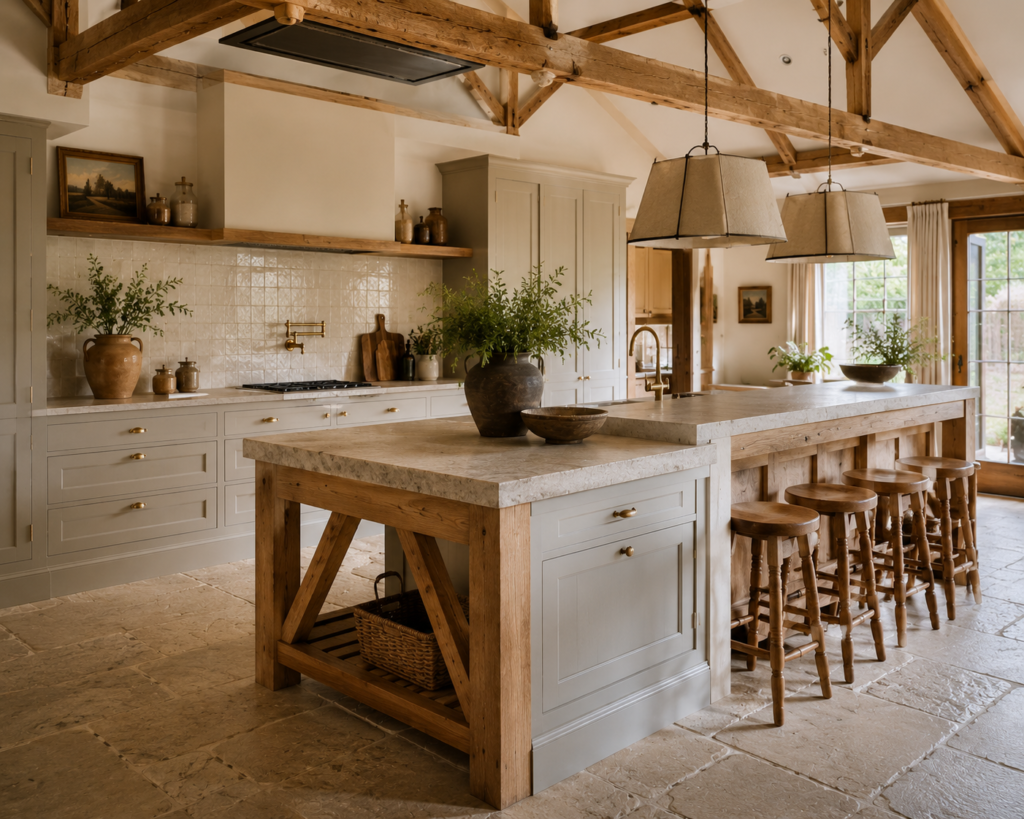
The barn conversion gave us a kitchen with exceptional proportions — a large, double-height space at one end with exposed timber trusses, stone flag floors, and the particular quality of light that north-facing windows in agricultural buildings often produce: diffuse, consistent, genuinely beautiful. The existing kitchen cabinets were running along one long wall — a well-specified shaker range in a painted finish — with the opposite long wall largely open to the room.
The floor plan gave us approximately 2.8 metres of clearance between the cabinet run and the opposite wall — enough for a substantial island with comfortable circulation on all sides, which is the minimum you need. Less than 900mm of circulation around an island is too tight for two people to work past each other; 1.0 to 1.2 metres is comfortable; more than that and the island starts to feel adrift in the room. At 2.8 metres total clearance, we had approximately 1.1 metres on the cabinet side of the island and 900mm on the window side — workable, and correctly allocating more space to the main working zone.
The island needed to be anchored to the room’s character — the exposed stone, the heavy timber, the honest agricultural materiality of the conversion. An island in painted MDF would have been technically adequate and aesthetically wrong. The farmhouse character of the room required something with more material presence.
The Design
The island measures 2.4 metres long by 900mm wide — proportions that give a generous working surface without making the island so dominant that it becomes difficult to work around. At these dimensions, four people can sit comfortably at the seating end with appropriate elbow room, and the remaining length of the worktop provides adequate preparation space.
The design incorporates a deliberate split: one end of the island is the working zone, the other is the seating zone. These zones are differentiated by the height of the worktop. The working zone sits at standard kitchen height — 900mm — which is the correct height for food preparation and for the integrated elements on that side of the island. The seating zone steps up to 1050mm — bar height rather than table height — which allows standard-height bar stools to provide comfortable seating with knees under the counter and elbows at a natural resting height.
This split-height approach is specific to islands where both preparation and seating are genuine functions. A uniform-height island at standard kitchen height requires lower seating — typically a 45cm stool — which is less comfortable for extended sitting and places seated people at a height where they’re looking directly at the worktop surface rather than at the people on the other side of it. The bar-height seating zone at 1050mm places seated people at approximately the right eye level to have a conversation across the island with someone standing at the preparation zone on the other side, which is exactly the social dynamic the clients wanted.
The split height is articulated by a step in the worktop profile — a visible structural ledge where the lower preparation surface meets the higher seating surface — and a corresponding change in the apron panel below, which creates a small shelf area at the base of the step on the seating side. This shelf is used for cookbooks, for the children’s tablets when homework is happening in the kitchen, and for the general accretion of objects that kitchen surfaces inevitably attract.
The Construction
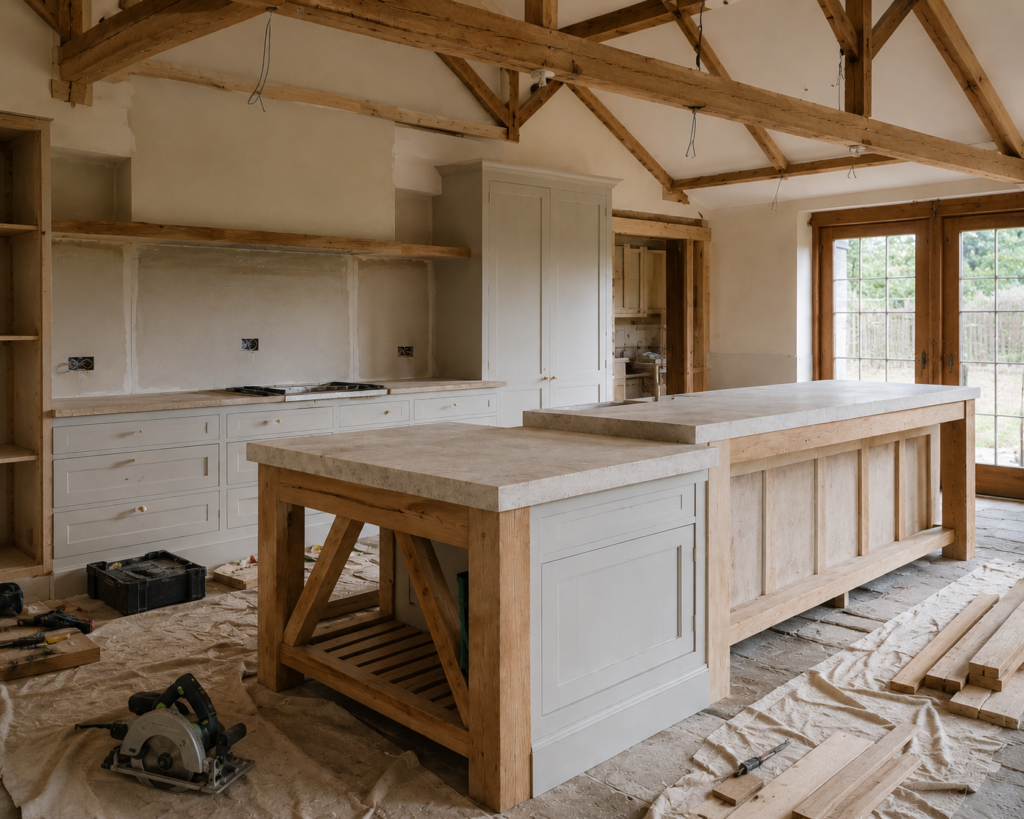
The base is a timber frame construction — structural oak rather than softwood, which is both a practical and aesthetic choice. The oak frame is visible in sections where the island apron panel is open rather than boarded — a design decision that references the exposed structural timber in the roof above and anchors the island to the character of the building. Where the frame is exposed, it’s been lightly sanded and oiled, not painted over, so the structural material reads as part of the design rather than hidden behind it.
The carcasses within the frame are birch-faced plywood — the correct specification for a kitchen island that will be used as hard as this one — housing deep drawers on the main preparation side, a large open shelf for the mixing bowls and casserole dishes that get used frequently enough to warrant accessibility over containment, and a pull-out bottle rack in the corner section.
The opposite side — the seating side — has a clean apron panel rather than functional storage, because drawers on the seating side create an ergonomic conflict between the people sitting and the drawers opening toward them. The apron panel on the seating side is painted in the same finish as the kitchen cabinets, which creates continuity between the island and the run of units along the wall.
The internal infrastructure required specific planning because of the island’s freestanding positioning in the room. Power was required for the induction hob integrated into the preparation side of the island — which determined the location of a sub-floor cable run during the restoration of the stone flag floor, where the screed was being relaid and the cable could be incorporated without subsequent disruption. Extraction for the hob is via a ceiling-mounted extractor above the island — the appropriate solution for an island hob in a double-height space, and one that worked well with the exposed truss structure above.
The Worktop
The worktop is the material decision that determined the character of the island more than any other single element, and it was the decision that took longest to make.
The clients considered and rejected quartz — too consistent, too contemporary for the agricultural character of the barn. They considered and rejected oak — appropriate in character but demanding in maintenance for a heavily used preparation surface. The decision arrived at is a reclaimed and re-profiled limestone slab — a piece of French limestone with considerable age and character, sourced from an architectural salvage yard in the Dordogne region, that had previously been a window surround in a château and carries the shallow wear marks of several centuries of handling.
The limestone is 80mm thick, significantly more substantial than a standard worktop, and its thickness contributes to the island’s sense of physical weight and permanence. The surface has been honed rather than polished, which gives it the soft matte finish appropriate to its age and to the farmhouse aesthetic. The edges are simply square-profiled, which lets the thickness speak for itself rather than adding decorative profiling that would compete with the natural character of the stone.
Limestone requires sealing and some ongoing maintenance. The clients were informed explicitly of this before any commitment was made. Their response — that they’d rather have a material with character that required occasional attention than a maintenance-free material that had no soul — is the right answer for a farmhouse kitchen and entirely the wrong answer for a household that wants to ignore the worktop for twenty years. The material is appropriate for the people as well as for the kitchen.
The seating zone uses the same limestone but in a slightly different application — a narrower overhang of 380mm on the seating side, providing the knee clearance for the bar stools while maintaining visual continuity with the preparation side.
The Stool Selection
Bar stools for a farmhouse kitchen island with seating require more thought than they typically receive. Four stools at this island are visible from every angle of the kitchen, from the dining area beyond, and from the entrance to the room. They’re the furniture element most likely to make or break the overall aesthetic.
The requirements for this specific island: appropriate height for 1050mm bar seating — which means a seat height of approximately 650mm to 700mm; a character consistent with the agricultural, honest materiality of the barn conversion; genuine comfort for extended sitting; and a robustness that can accommodate daily use by teenagers without deteriorating.
The stools chosen are solid oak — turned legs, slightly splayed for stability, with a shaped seat that provides more comfort than a flat board without introducing upholstery that would require ongoing maintenance in a kitchen environment. The seat is left in natural oiled oak rather than stained, which connects to the oak frame elements of the island below. No footrest on the front rail — the island apron itself serves this function, with a discrete foot rail fixed at the appropriate height on the seating apron.
Four stools at this height, in this material, against the reclaimed limestone and the painted oak apron, look like they were always going to be exactly there. That quality of inevitability — the feeling that nothing else could have been right — is the aim of every design decision in a project like this, and the stools achieve it.
The Lighting
The island required dedicated lighting — both for the preparation zone and for the ambience of the seating zone. The solution is a pair of pendant lights — natural linen shades on a black-powder-coated stem, hung at 500mm above the worktop surface at the seating end of the island — which provides the pool of warm, focused light that the seating zone needs in the evening and gives the island a visual anchor point from across the room.
The preparation end of the island is lit by the ceiling-mounted extractor, which incorporates an LED ring in its underside providing direct task illumination on the hob and the adjacent worksurface. The two lighting functions — ambient pendant for the social zone, integrated task lighting for the preparation zone — are on separate circuits and separate dimmers, which allows the island to be lit for cooking, for eating, for early morning coffee, or for late evening homework without one function compromising the others.
How It’s Used
The island has been in use for approximately six months. The clients report that it functions as a hub in a way the kitchen had never previously had. The practical functions are all operating as designed — the hob placement is good, the drawer storage is well-used, the bar stools work correctly for the specified height.
The social function is the one that has exceeded the brief. What the clients described as “somewhere for the family to sit while meals were being prepared” has become the default gathering point for the household across the day. Breakfast happens here. Coffee happens here. The eldest does homework here four evenings a week. Guests gravitate to the island rather than to the dining area when meals are being finished because it’s where the action is.
That’s what a well-designed farmhouse kitchen island with seating actually does. It doesn’t just add a surface. It adds a centre of gravity to the room — a place that has enough practical value and enough physical presence to reorganise the social life of the kitchen around itself.
What We’d Tell Anyone Planning the Same
The height split between preparation and seating is essential. Do not compromise it for visual simplicity. A uniform-height island is a simpler design; a split-height island is the right design if seated social use is genuinely part of the brief.
The stool selection matters more than it seems when you’re looking at a bare island in an empty kitchen. Four stools occupy significant visual space. Choose them in the room, in relation to the materials and finishes, rather than from a website after the island is complete.
Allow adequate clearance. The 900mm minimum on the seating side is a minimum, not a target. If the room allows 1.0 to 1.2 metres, take it.
The worktop material sets the character of the entire island. If the island is the centrepiece of the kitchen — and in a farmhouse kitchen it usually is — the worktop is the most important material decision in the project. Choose accordingly rather than defaulting to what’s convenient or cost-efficient. Choose a colour to suit the style of the room.
And build it to last. An island that’s used as heavily as this one will be in daily contact with everything the kitchen produces for decades. The construction quality needs to be proportionate to that commitment.