
Table of Contents
It’s one of those questions that sounds deceptively simple. You ask it, and you expect a number — and then somebody tells you it depends, and you realise you’ve walked into a conversation that requires a little more unpacking than you’d bargained for.
The short answer is that most modern UK homes have ceiling heights somewhere between 2.4 metres and 2.6 metres on the ground floor. But the longer answer — the one that’s actually useful if you’re renovating, extending, converting, or just trying to understand why your Victorian terrace feels so different from your friend’s 1970s semi — is a bit more interesting than that.
Ceiling height is one of those quiet, structural factors that shapes how a space feels without most people ever consciously registering it. Get it right and a room feels generous and easy to be in. Get it wrong — or just accept whatever the builder default was — and you end up with something that works on paper but feels slightly airless in practice. So it’s worth knowing where the numbers come from, what the rules actually say, and when you have the freedom to do something different.
What “Standard” Actually Means in Practice
There’s no single, universal standard ceiling height enshrined in UK law for residential properties. What there is instead is a combination of Building Regulations guidance, historic convention, and the practicalities of how different eras of house were built.
For new-build homes, the most commonly used figure is 2.4 metres — that’s the minimum that most developers work to on habitable rooms. It’s not a hard legal floor for every situation (more on that shortly), but it’s become the de facto baseline because it’s workable, it keeps build costs reasonable, and it passes Building Control without drama.
Better-specified new builds, self-builds, and anything with a bit more ambition in the design brief will typically go to 2.5 or 2.6 metres on the ground floor, sometimes higher. There’s been a gradual upward creep over the past couple of decades as buyers have come to associate ceiling height with quality — which isn’t unreasonable; it does make a tangible difference to how a room reads.
Upper floors in new builds tend to sit slightly lower, often around 2.3 to 2.4 metres. Part of this is structural — the floor-to-ceiling measurement is squeezed slightly by the floor build-up above — and part of it is simply that bedrooms feel less cavernous than living spaces and the height matters less.
What Building Regulations Actually Say
The honest answer here is that Building Regulations Approved Document A (Structure) and the other relevant documents don’t specify a minimum habitable ceiling height in quite the prescriptive way people expect. What they do specify are minimums for particular types of conversion and alteration.
The one figure that comes up most consistently — and matters most in practice for renovation work — is 2.2 metres. This is the height that appears in guidance around loft conversions and basement conversions as the minimum for a space to be considered habitable. If you’re converting an attic and your ridge height gives you less than 2.2 metres at the highest point of the room, Building Control won’t sign it off as a bedroom or living space.
For extensions and new builds, the approach is more about meeting the overall structural and thermal requirements within Approved Documents rather than hitting a specific height number. In practice, 2.4 metres has become the professional consensus, and most architects and builders work to this or above without it being a fight.
The Planning Portal — the government’s central resource for planning and Building Regulations guidance — is the right place to check current requirements for any specific project: www.planningportal.co.uk. It’s also worth noting that if your property is listed, permitted development rights don’t apply and any internal alterations affecting ceiling height will require listed building consent from your local authority.
How Period Homes Changed Everything
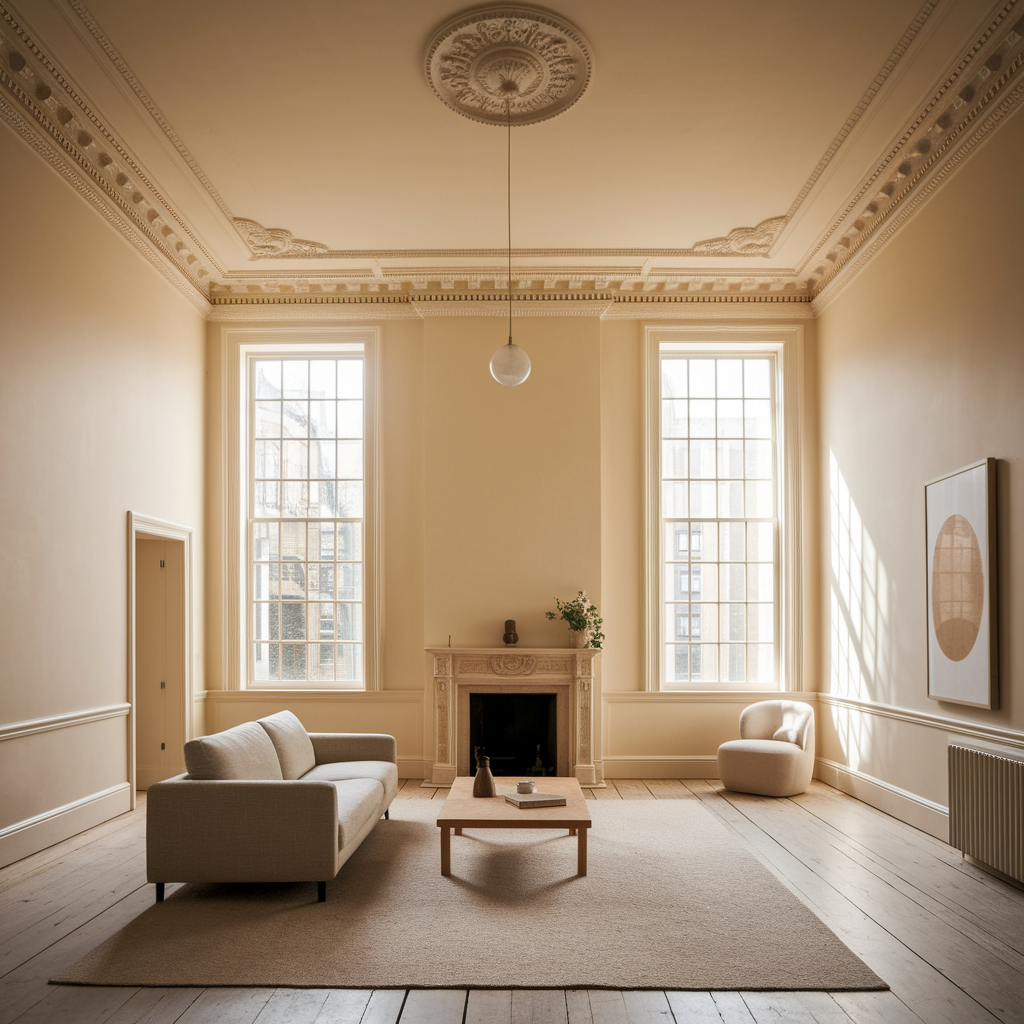
If you live in a Victorian or Edwardian house, you’ll know that the ceiling height question takes on a slightly different character. These properties weren’t built to any modern standard — they were built to the aesthetic and social conventions of their era, and those conventions involved ceilings that were, frankly, extravagant by today’s standards.
A typical Victorian terraced house from the 1860s to 1890s will have ground floor ceilings somewhere between 2.7 and 3.0 metres, sometimes higher in larger properties. The first floor is usually a touch lower, but still generous. The reasons are partly about ventilation — before central heating, high ceilings helped manage the stuffiness of coal fires and large numbers of people in a room — and partly about status. Ceiling height was a legible signal of prosperity. Grander houses had grander proportions.
The interwar period — roughly 1920 to 1940 — saw a marked drop. The semi-detached suburbs that spread out around most British towns during this era were designed for efficiency as much as comfort, and ceilings came down to around 2.4 to 2.6 metres. Still perfectly liveable, but noticeably more modest than their Victorian predecessors.
Post-war housing — the council estates and private developments of the 1950s and 60s — often went lower still. Some post-war properties have ceiling heights of 2.3 metres or below, particularly on upper floors, which can feel oppressive in smaller rooms but tends to bother people less in practice than you’d expect.
The 1970s and 80s were arguably the low point, with some developments hitting 2.3 metres on ground floors. There was a recovery from the 1990s onwards, and the new-build market now generally targets 2.4 metres as the floor.
Why Ceiling Height Matters More Than People Think
It’s one of those things where the numbers don’t fully convey the experiential difference. Going from 2.4 metres to 2.6 metres is twenty centimetres — less than the height of a standard mug. But the effect on how a room feels is disproportionate to that measurement. Light behaves differently. Furniture feels less crowded. You can hang a proper ceiling light rather than a flush fitting. The room breathes.
There’s a reason that renovation projects in Victorian houses almost universally leave the ceiling heights alone, even when everything else gets ripped out and reconfigured. Those proportions are part of what makes the spaces feel good. Lowering them — to hide pipework, to insert a bathroom above, to simplify a complicated ceiling void — is always a trade-off, and it’s rarely one you make without later regret.
The reverse is also true. Raising a ceiling — by removing a false ceiling, by opening into the roof void, or by stripping back a suspended tile grid in an older property — can be transformative. We’ve done this in two rooms now, and both times the result was an immediate, visible improvement in how the space felt. The room didn’t get any bigger in floor area. But it got bigger in a way that actually matters.
False Ceilings and What Hides Behind Them
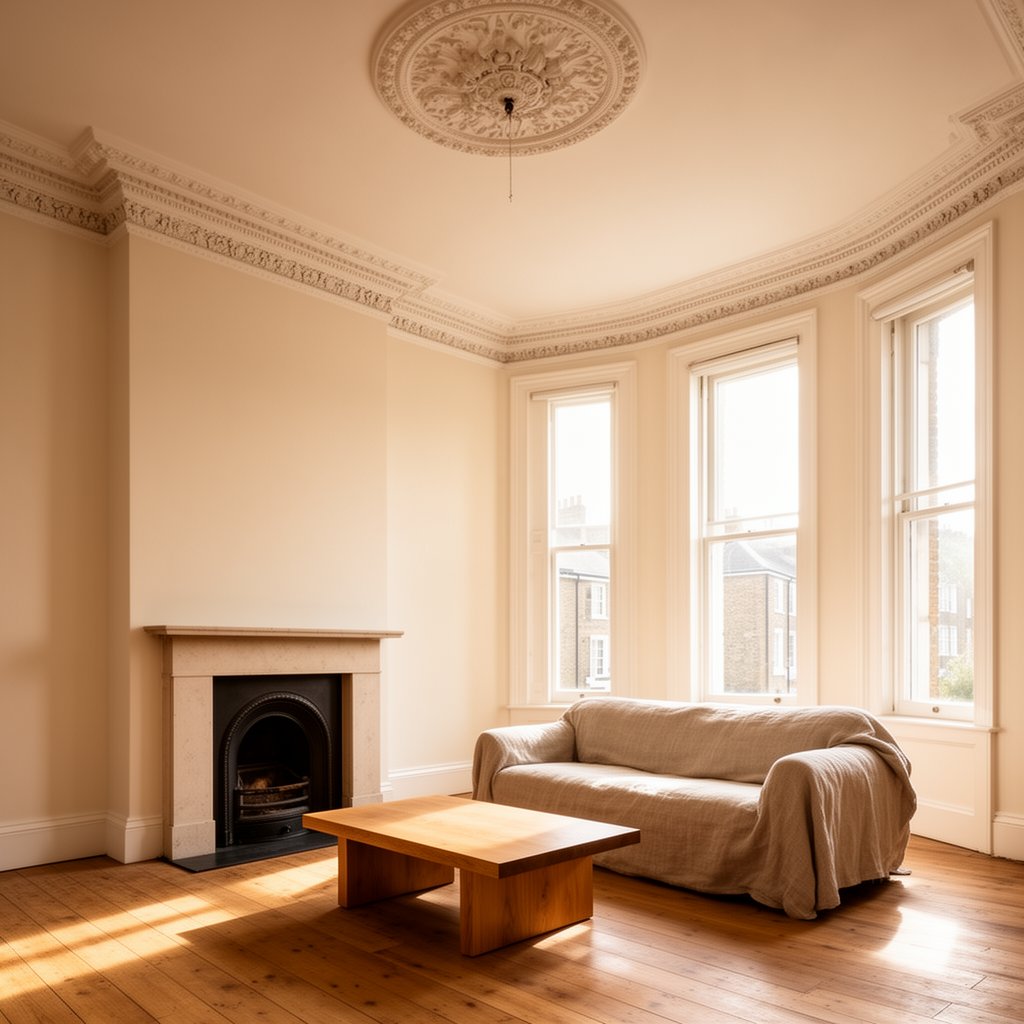
A significant number of UK homes — particularly those from the 1970s and 80s — have false or suspended ceilings installed at some point in their history. In period properties, this was often done to reduce heating costs or to conceal old plasterwork in poor condition. In commercial-to-residential conversions, suspended ceilings were almost always left from the original office fit-out.
If you suspect a false ceiling, it’s worth investigating what’s above it before you make any decisions. We’ve seen cases where a 2.35-metre room turned out to have 2.75 metres of original ceiling above a suspended grid — an enormous amount of height sitting there wasted. Removal isn’t always straightforward (there may be services running through the void, or the original ceiling above may be in poor condition), but it’s almost always worth understanding what you’ve got.
The process for checking is fairly simple: find an access point, or have one made, and look. A torch and a head in the ceiling void for five minutes can tell you a great deal. If there’s original plasterwork up there in reasonable condition and a decent amount of height, you have options.
Ceiling Height in Extensions and New Rooms
If you’re planning an extension, you have the opportunity to make a deliberate choice about ceiling height rather than inheriting whatever the existing house offers. This is worth spending some time on.
The default from most builders quoting at the budget end of the market will be 2.4 metres. It’s fine. It works. But if your existing ground floor is higher — as it will be in most Victorian or Edwardian homes — a 2.4-metre extension will feel noticeably lower than the room it connects to, which can be jarring in open-plan arrangements.
The practical fix is either to match the existing ceiling height (which costs more in materials and labour but produces a better result) or to use the ceiling height difference deliberately — stepping down as you move from one space to another, perhaps with a change in ceiling material or colour to mark the transition.
Some architects use a dropped section intentionally as a device: a lower, more intimate dining or kitchen area flowing into a taller living space, for example. Done well, it can be genuinely clever. Done without thought, it just reads as a budget constraint that wasn’t resolved.
For single-storey extensions where the roof is fully within your control, you also have the option of going higher than the house itself — a vaulted or pitched ceiling within the extension that exceeds the height of the rooms on either side. This works particularly well in kitchen extensions that open to a garden. The volume of light and space you gain is significant, and the cost premium over a flat ceiling isn’t as large as people expect.
A Note on Rooms in the Roof
The 2.2 metre rule comes back here. When you’re working with a room in the roof — whether that’s a loft conversion or an original attic room in a period property — the ceiling height is a function of the roof pitch and the dimensions of the structural space available. You can’t simply choose a number.
What you can choose is how you deal with the areas where the ceiling drops below comfortable standing height. The standard approach is to bring the ceiling down to wall plate level and use the triangular voids on either side as dead storage space. More interesting architecturally is to follow the roof pitch with the ceiling, which gives you a dramatic apex but limits usable floor area. In practice, most loft rooms use a combination: a flat section over the habitable area, sloping sections as you approach the eaves, and knee walls of around 1.0 to 1.2 metres before the slope begins.
The finished ceiling height over the flat section should, if at all possible, be 2.4 metres or above. Anything lower starts to feel constrained, particularly in bedrooms where you spend time standing and moving around.
Practical Takeaways
Ceiling height is rarely the first thing on anyone’s renovation list, but it tends to be one of the things people remember later — either with satisfaction or mild regret. A few principles that have served us well:
Don’t lower a ceiling unless you have to. The space above has value even if it’s currently full of pipework and cables. Find another way.
If you’re extending, specify the ceiling height explicitly rather than leaving it to the builder’s default. Have a conversation about what it would cost to go from 2.4 to 2.5 or 2.6. The answer might surprise you.
In period properties, respect what the original builders gave you. Those proportions are part of why people want to live in those houses. Changing them is rarely an improvement.
And if you’re buying a property and the ceilings feel a bit low — check for false ceilings before you write it off. You might be looking at a room that’s a skip and a plasterer away from being something quite special.