Table of Contents
It’s one of the questions we get asked most often when people are in the early stages of planning a garden room. They’ve done enough research to know that a bespoke build from a specialist contractor is going to cost more than they’d initially hoped, they’ve found the kit market, and they’ve seen that self build options exist at price points that look considerably more appealing. And then the question becomes: is this actually something I can do? And is it actually worth doing?
The honest answer is: sometimes yes, sometimes no, and the difference between those two outcomes is almost entirely determined by who’s asking rather than by the kit itself.
This isn’t a question with a universal answer. A self build garden room kit is a genuinely good option for a specific type of person in a specific set of circumstances — and a potentially expensive mistake for everyone else. Working out which category you fall into before committing any money is the most useful thing this article can do.
What Self Build Actually Means Here
Worth being clear on this upfront, because “self build” covers a range of involvement levels and the distinction matters.
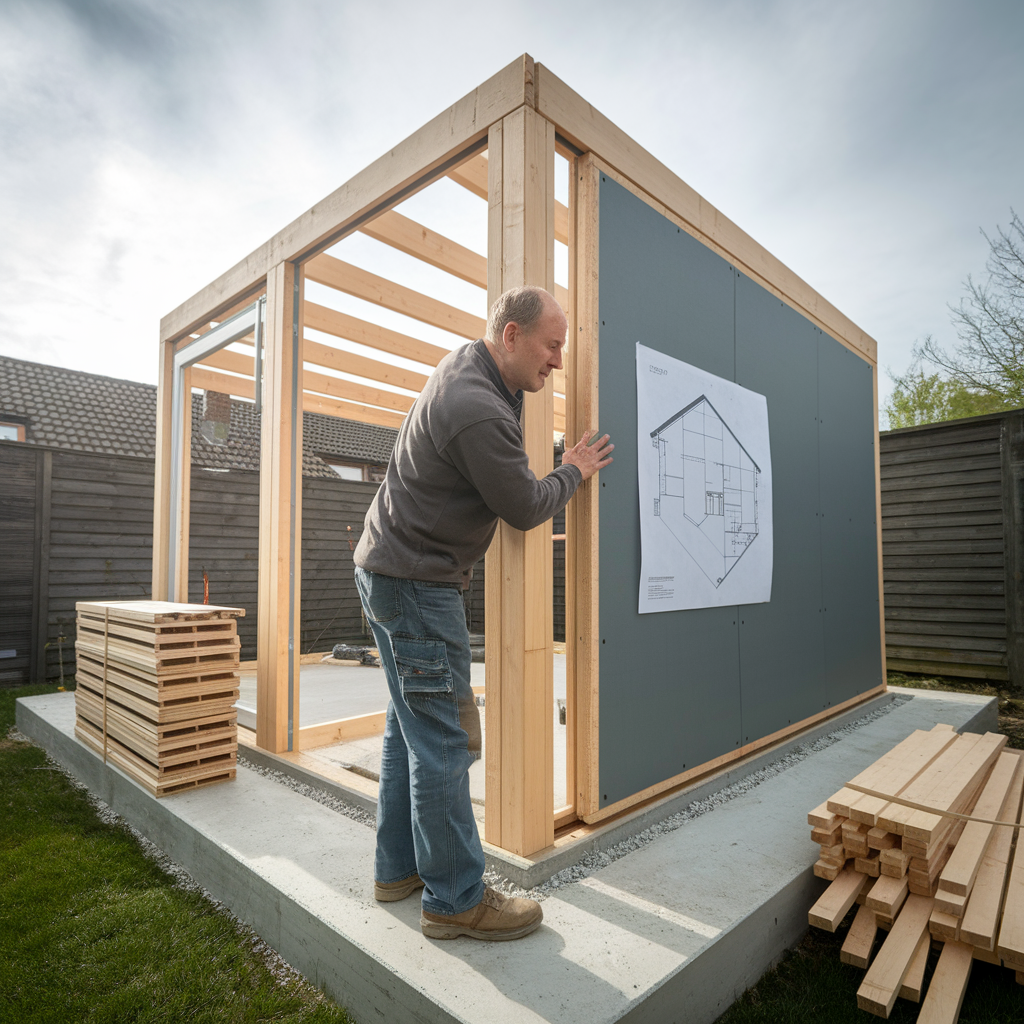
At one end, self build means doing everything yourself: preparing the base, assembling the structural components, installing insulation, fixing the external cladding, fitting windows and doors, lining the interior, and finishing. This is the version that produces the maximum cost saving and requires the highest level of skill and time investment.
At the other end, some kit suppliers offer a hybrid model where the structural shell is erected by a professional installation team and the buyer completes the fit-out — internal lining, decorating, flooring, electrics if they’re a qualified electrician. This reduces the complexity of the self-build element considerably while still producing meaningful cost savings over a fully installed building.
And somewhere in between there’s the option of doing the bulk of the work yourself while bringing in specific trades for the parts that require professional qualification or certification — a groundworker for the base, an electrician for the wiring, a roofer to sign off the weatherproofing detail. This is the model that works best for many self-builders who have good general practical skills but aren’t claiming expertise in every discipline.
Understanding which version of self build you’re actually planning is the starting point for any realistic assessment of whether it’s right for you.
The Honest Financial Calculation
The financial case for self building is real, but it requires an honest calculation rather than a headline price comparison.
A fully installed garden room from a quality specialist contractor — including base, structure, insulation, cladding, windows, doors, interior lining, electrics, and heating — will typically cost somewhere between £15,000 and £35,000 for a room in the 12-20 square metre range, depending on specification and location. London and the South East sit at the top of that range or above it; the Midlands and North sit lower.
A quality self build kit for a comparable room size might cost £6,000 to £15,000 for the kit itself. Add the base (groundworker, concrete, materials: typically £2,000 to £4,000 depending on site conditions), electrical installation (registered electrician: £1,000 to £2,500), and any other trades involved, and the total cost of a self-built room might land at £10,000 to £20,000 for something genuinely well-specified.
That’s a real saving. For some people it’s enough saving to be the difference between having a garden room and not having one. But the calculation has to include an honest valuation of your own time. A self build garden room, done properly, involves multiple weekends and potentially some weekday time spread over several weeks. For someone who enjoys building and would find the project satisfying, that time has a positive value. For someone who finds it stressful, who underestimates the time involved, or who has to take time away from higher-value work to do it, the saving starts to look less compelling.
There’s also the cost of errors to factor in. A professional installer has done this many times. They know where things go wrong and they prevent it. A first-time self-builder makes mistakes — sometimes minor ones that cost time to fix, occasionally significant ones that cost money. Budgeting a contingency of 15-20% over the kit cost is prudent, and the contingency should be cash you can actually access rather than a theoretical buffer.
The Skills Question: Being Completely Honest With Yourself
This is where most self-build assessment conversations go wrong. People consistently overestimate their practical skills, particularly in the abstract, before they’re holding an unfamiliar component and trying to work out what connects to what.
The skills required to self-build a garden room kit to a good standard include: reading and following technical drawings accurately; carpentry to a reasonable standard, including cutting timber accurately, fixing at the correct centres, and understanding how frame components relate to each other structurally; an understanding of how insulation, vapour control, and breathable membranes work and why they matter; cladding installation including the critical detailing at the base; window and door fitting including correct sealing; and internal lining including achieving flat, square walls and ceilings that will take a paint finish well.
You don’t have to be a professional builder. But you do need to be someone who has done practical building work before, who is genuinely comfortable with tools and timber, and who approaches unfamiliar technical challenges by reading the instructions carefully and solving problems methodically rather than improvising and hoping for the best.
The honest test is whether you’ve completed a project of comparable complexity before and been happy with the result. Building a deck, fitting a kitchen, constructing a timber-framed shed to a good standard — these are reasonable indicators of the skills and temperament required. If your previous DIY experience is more limited than that, the gap between where you are and where you need to be for a self-build garden room is significant.
None of this is a judgment. It’s just a realistic assessment. The worst outcome in a self-build garden room is a building that performs poorly because critical details — the vapour control layer, the cladding base detail, the window sealing — weren’t done correctly. These are mostly invisible once the building is complete, and their failure takes time to manifest, which means the connection between the error and the consequence is delayed in a way that makes it easy to miss the cause.
Time: The Variable Most People Underestimate
The kit suppliers’ literature for a self-build garden room often references assembly times that sound achievable in a weekend or two. These figures deserve scrutiny.
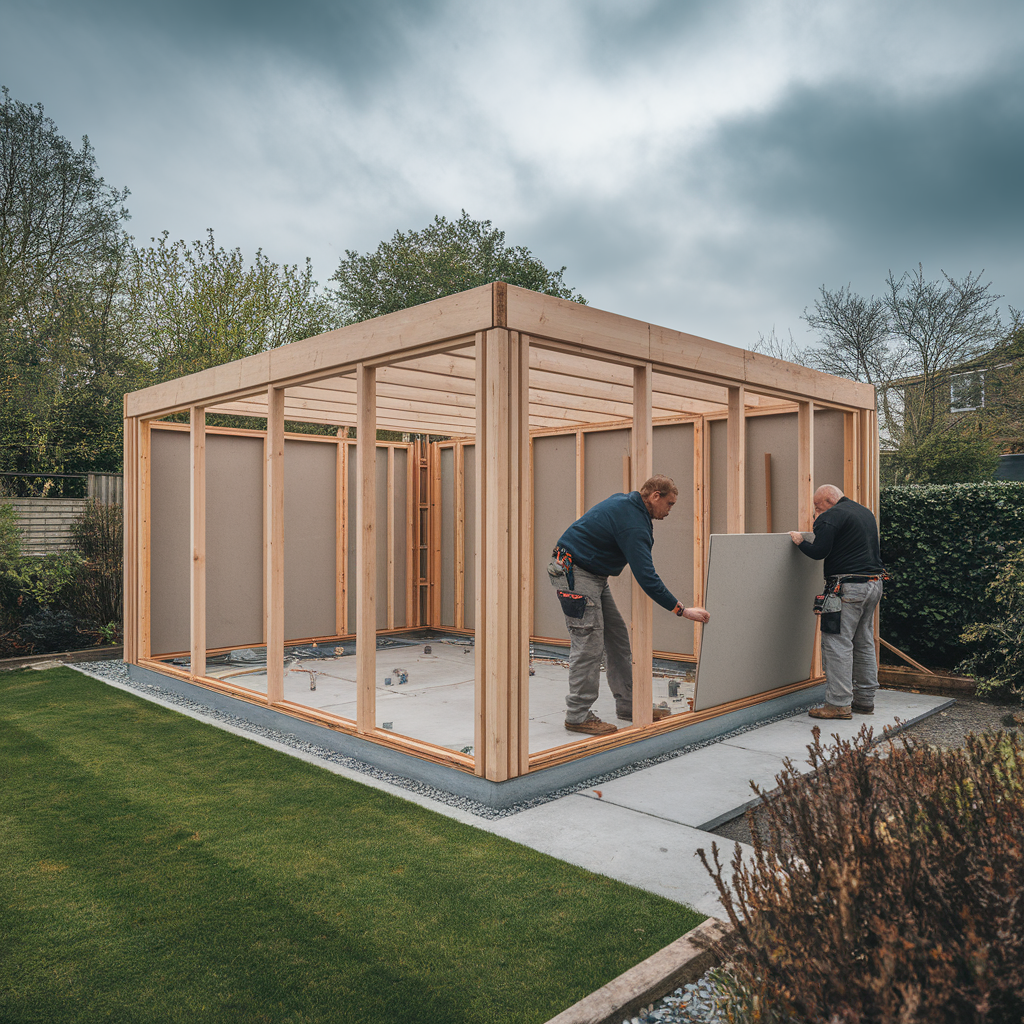
The assembly time for the structural frame, in ideal conditions with an experienced team, might indeed be a day or two. What the literature doesn’t always make clear is everything that surrounds that assembly. Preparing the base — including any ground clearance, levelling, and waiting for concrete to cure — takes time that can’t be rushed. The external cladding, fitted correctly with the right detailing at all junctions, takes longer than the frame. Internal lining, plastering or skimming if required, and decoration take longer still. Electrics need to be done before internal lining goes on if they’re being surface-chased, or after if they’re surface-mounted.
A realistic timeline for a competent self-builder working at weekends, with all materials on site and no significant problems: six to twelve weekends spread over three to five months, depending on the size of the building and the specification. Some of those weekends will be full days; some will be half days. The process is not linear — there are phases that require curing time, delivery lead times for materials, and points where you’re waiting on a trade before you can proceed.
This is manageable for someone who has planned for it and set realistic expectations. It’s a source of significant frustration for someone who expected to have a usable room in six weeks and is still looking at an unfinished shell three months in.
If you’re planning to use the room as a home office and are currently working in a suboptimal space at home, the timeline matters more than it would otherwise. Factor in the reality that you won’t have a usable room until the build is complete, which is a different thing from when the structural shell goes up.
What the Good Self Build Kits Offer
The kit market, as discussed elsewhere, covers a wide range. The kits that are genuinely appropriate for self-build are a subset of the total market, and they have specific characteristics.
Precision-machined components that fit together accurately and consistently are the single most important feature. A kit that requires on-site adaptation — trimming panels to fit, adjusting for dimensional inaccuracies, solving junction problems that the design didn’t resolve cleanly — is harder to build to a good standard, produces more waste, and requires higher skill levels to deliver a good result. The best self-build kits are engineered to the point where if you follow the instructions carefully, the building goes together correctly. That precision is worth paying for.
Comprehensive, clearly written instructions with drawings that correspond to what’s actually in the kit rather than a slightly different configuration. This sounds like a low bar, but kit documentation varies enormously in quality. Instructions that assume knowledge the self-builder doesn’t have, or that describe a different variant of the building from the one you’ve ordered, are a genuine problem. Request sample documentation before purchase if the supplier will provide it.
Technical support that actually answers the phone and can provide useful guidance when you encounter an unexpected situation. Every self-build project has moments where something doesn’t match the drawing, where a component appears to be missing, or where the instructions for a specific detail are unclear. Having access to a technically knowledgeable person at the manufacturing company who can resolve these quickly is valuable. Find out what the support arrangements are before you buy, and look for reviews from actual self-builders that mention the support experience specifically.
A clear, specific list of tools and materials required beyond the kit itself. A kit that assumes you own or can hire specific tools without listing them leaves the self-builder to discover gaps mid-project. A kit that provides a comprehensive list allows proper preparation.
Planning and Building Regulations for Self-Builds
These requirements apply regardless of whether you’re self-building or using a contractor, and they don’t become simpler to navigate just because you’re doing the work yourself.
Most garden rooms under 30 square metres, not used as sleeping accommodation, and built within the permitted development rules will not require planning permission in England. Check the specific permitted development criteria for outbuildings on the Planning Portal at www.planningportal.co.uk against your specific situation, and if there’s any doubt, contact your local planning authority for a pre-application enquiry.
Building Regulations for the electrical installation apply regardless of the size of the building. The electrical work in a garden room, being connected to the main house supply, falls under Part P of the Building Regulations. This means it must either be carried out by a registered competent person who can self-certify, or notified to and inspected by Building Control. This is not a detail to overlook — an uninspected electrical installation in a garden building is a safety issue and a potential problem when you come to sell the property.
If the building exceeds 30 square metres, Building Regulations apply to the structure, insulation, fire safety, and drainage as well as the electrics. For self-builds in this size range, engaging a structural engineer to check your calculations and a Building Control officer to inspect at key stages is essential regardless of your confidence in your own work.
The Scenarios Where It Makes Most Sense
Pulling this together into practical terms, a self build garden room kit is most likely to be the right choice when:
You have demonstrable practical building skills and have completed comparable projects satisfactorily. Not a vague sense that you’re good with your hands — actual evidence of competent timber construction work.
The financial saving is genuinely significant to whether the project happens. If the saving is the difference between having a garden room and not having one, the effort is easier to justify than if it’s a saving of convenience that could be deployed elsewhere.
You have the time, and the project timeline is flexible. If you need a usable room in eight weeks, self-build is probably not the right approach. If you can absorb a four to six month build period without it being a significant problem, the pressure is manageable.
You find building work genuinely satisfying rather than a necessary inconvenience. Self-building a garden room is a significant commitment of time and mental energy. People who enjoy the process, who find satisfaction in the making as well as the having, consistently report the self-build experience positively. People who just want the room at the end of it, and who find the process a chore, consistently wish they’d paid someone else to do it.
The Short Answer
A self build garden room kit is an excellent option for the right person. It isn’t a shortcut or an easy way to get a garden room on the cheap. It’s a serious project that rewards skill, patience, and careful preparation with a genuinely good outcome and a meaningful cost saving.
If that description fits you — go for it. Research the kit options thoroughly, specify well, plan the base and the electrics before you start, and take the preparation stages seriously. The building you end up with will have a quality of ownership that a contractor-built room doesn’t quite produce, and that counts for something.
If it doesn’t — if any part of the honest assessment above has given you pause — there’s no shame in that. Pay for a quality installation, specify the building well, and spend your weekends differently. The garden room will still transform how your property works. It just won’t have cost you every weekend for four months to get there.