Table of Contents
The brief was unusually clear from the start. The clients — a family of five in a detached house in Cheshire with a generous back garden and three children between the ages of nine and sixteen — wanted a dedicated games room at the end of the garden. Not a summer house that occasionally got used for table tennis. Not a shed with a dartboard on the wall. A proper, fully designed, year-round garden games room that would work for the children now and evolve with them as they got older, while also being somewhere the adults would actually want to spend time.
It’s the kind of brief that sounds straightforward and turns out to be genuinely interesting to design. Games rooms have specific functional requirements that pull against each other: you need space for activity, but you also need acoustic containment so a teenage games night doesn’t carry across the garden at eleven o’clock. You need durable surfaces that can take impact and spillage, but you also want a space that feels good rather than functional and clinical. You want flexible lighting for different activities, but you also want atmosphere.
What we ended up designing, and what this project produced, is one of the spaces we’re most pleased with from the past few years. Here’s how it came together.
The Site and the Structure
The garden was roughly 28 metres deep. The far end, beyond the lawn and a planted border, was bounded by a timber fence with an established hedge growing against it. The area immediately in front of the hedge — about a metre and a half of depth that couldn’t practically be built on — provided a natural buffer between the building and the boundary, and meant the building could sit comfortably within permitted development without any planning application required. We confirmed this position against the permitted development rules on the Planning Portal at www.planningportal.co.uk before proceeding.
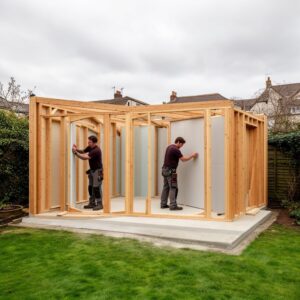
The footprint we agreed on was 7 metres by 5 metres — 35 square metres in total, which is above the 30 square metre threshold at which Building Regulations typically apply for outbuildings. This triggered a Building Regulations application, which we handled through a full plans submission. The structural engineer produced drawings for the timber frame and the concrete slab foundation, and Building Control were straightforward to work with throughout.
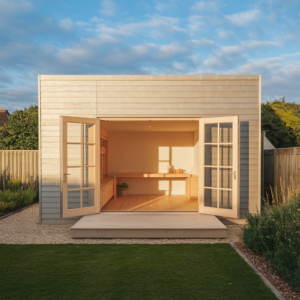
The structure itself is a timber frame on a reinforced concrete slab, with the floor level raised slightly above the surrounding ground level for drainage. External cladding in a dark stained larch — the clients wanted the building to recede visually into the garden rather than dominate it, and the dark colour against the hedge achieved that. A mono-pitch roof sloping gently back toward the boundary, clad in standing seam steel in a dark anthracite. From the garden, the building reads as a confident, low-profile structure rather than an imposing box.
Insulation and Acoustic Performance
For most garden rooms, insulation is primarily a thermal question. For a garden games room, it’s equally an acoustic one. Music, film sound at volume, competitive games that produce shouting — all of this needs to stay within the building rather than travelling across the garden and over the fence.
Standard insulation improves acoustic performance as a side effect of thermal performance — mineral wool between studwork dampens sound transmission considerably compared to an uninsulated cavity. But for the level of acoustic separation the clients wanted, we went further: a decoupled internal lining, where the plasterboard is mounted on resilient bars rather than fixed directly to the studwork, breaks the acoustic connection between the outer skin and the inner surface and significantly reduces the transmission of airborne sound.
The floor was treated separately: a floating floor system with an acoustic underlayer beneath the finished floor surface, which addresses both impact sound transmission downward (less relevant in a garden building, but still good practice) and the acoustic character of the room itself. Hard floor surfaces without any acoustic treatment produce a lively, slightly echoey quality that tires the ear quickly. The floating floor system, combined with some soft furnishings and the fabric-wrapped acoustic panels we installed on sections of the rear wall, produced a room with a balanced acoustic character — present and energetic, which is right for a games room, but controlled rather than chaotic.
The ventilation system is mechanical — a heat recovery unit that maintains fresh air without opening windows or creating gaps in the acoustic envelope. It runs quietly enough to be unobtrusive during use and maintains a comfortable environment even when the room is occupied by multiple people for extended periods.
The Layout: Dividing the Space
Thirty-five square metres sounds generous. In a games room it goes quickly, because the activities that make a games room worthwhile have specific space requirements. A full-size pool table needs clearance of roughly 1.5 metres on every side to use a standard cue without obstruction — the table itself plus clearance amounts to a footprint of roughly 4.5 by 3.7 metres. A table tennis table in play needs about a metre behind each end and 0.75 metres each side at minimum for recreational use, more for anything competitive.
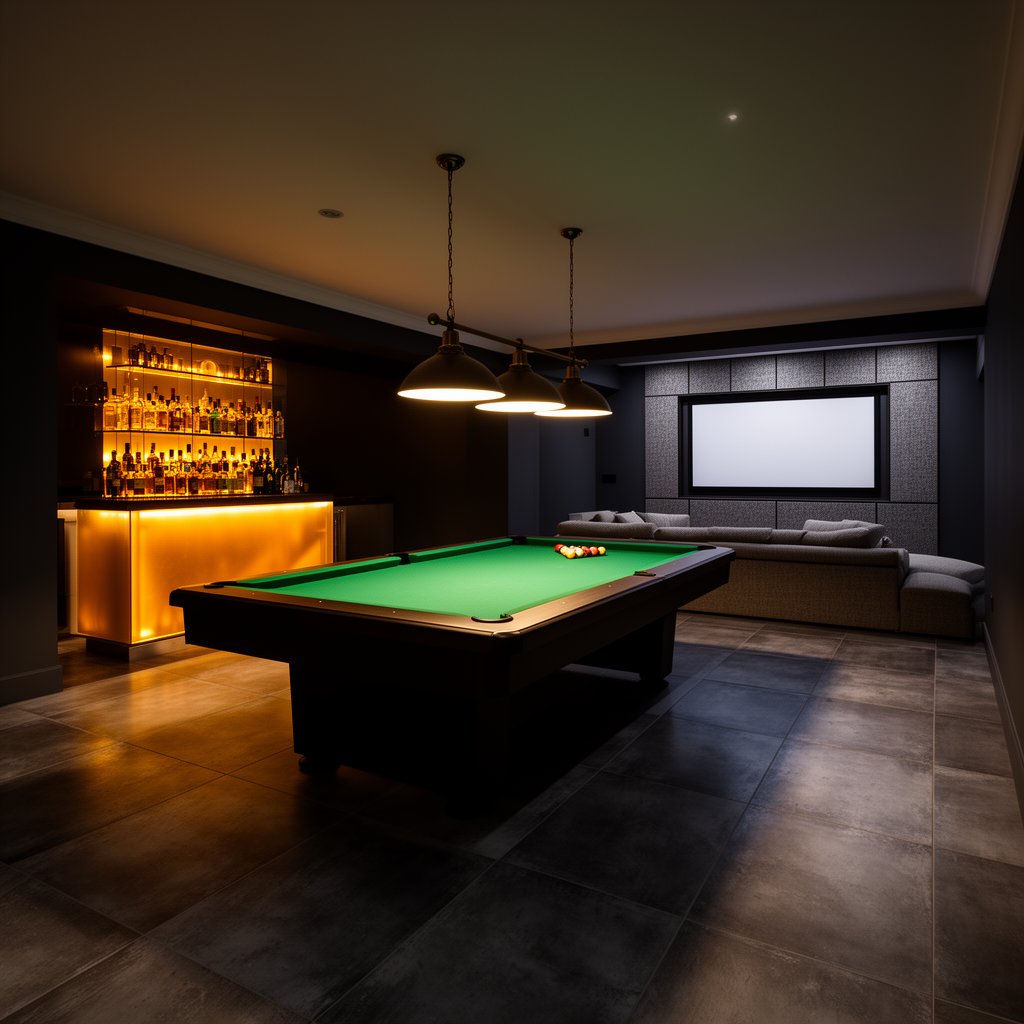
The layout solution was a flexible zoning approach rather than a fixed allocation of the space. The central zone — the largest continuous area — was designed as a multi-use space that can accommodate a pool table when configured for that, or table tennis when the pool table is covered and moved fractionally, or simply open floor space for other activities. The far end of the room from the entrance is the dedicated seating zone: a wide, low sofa arrangement facing a wall-mounted screen, with the audio system above it and the games console storage built into the wall unit below. The near end, to one side of the entrance, is the bar area — more on that below.
This arrangement means the room functions distinctly in different modes rather than being a compromise between all of them simultaneously. When the screen is the focus, the sofa arrangement works. When the pool table is the focus, the central space is oriented for that. The transitions between modes take minutes, not reorganisations.
The Bar and Refreshment Area
Every good games room needs somewhere for drinks, and the difference between a well-designed bar area and a mini-fridge on a shelf is significant in terms of how the room feels and how it gets used.
The bar occupies roughly 2.5 metres of the wall to the right of the entrance. A run of base units with a solid timber worktop at bar height — slightly taller than a kitchen worktop, designed to stand at or sit at on a bar stool. Under-counter refrigeration built in flush with the units. A sink with a simple mixer tap. Open shelving above, running the full width of the bar, with back-lighting behind the bottles that creates the warm amber glow that distinguishes a considered bar from a drinks storage solution.
The back-lighting is a simple LED strip in a warm amber tone, running behind a glass shelf that the bottles sit on. It costs almost nothing relative to the impact it makes. In the evening, with the main ambient lighting dimmed and the bar lit from behind, the room has an atmosphere that lifts it considerably above what the individual elements would suggest.
The bar area is finished in a slightly different material palette from the rest of the room — dark oiled timber for the cabinet fronts rather than the painted MDF used elsewhere, and a pressed metal tile on the wall behind the shelving that references the industrial character the family wanted for the space. These distinctions mark the bar as a zone with its own identity within the larger room, which is good spatial design as well as good hospitality design.
The Gaming and Screen Setup
The screen wall at the far end of the room is the focal point when the room is used in its cinema or gaming mode, and it was designed accordingly.
A large format screen — the clients specified the size; we specified the acoustic and visual environment around it — is mounted at the correct viewing height for the sofa arrangement. The acoustic panels flanking the screen serve a dual purpose: they improve the acoustic character of the room and they frame the screen, which gives the wall a finished, deliberate quality rather than looking like a television mounted on a plain plasterboard surface.
The audio system is integrated into the wall unit below the screen, with speakers positioned for the seating arrangement rather than the door. This sounds obvious but is consistently got wrong in DIY setups where speakers end up positioned for convenience rather than for the listener. The room is acoustic enough — thanks to the floating floor, the acoustic panels, and the soft furnishings — that a well-positioned system sounds genuinely impressive without requiring anything at the extreme end of the budget.
Cable management was designed from the outset, with conduit and back boxes positioned during the construction phase rather than cables run retrospectively along the surface. The finished wall has no visible cables. This is a small thing that has a large effect on how the space reads — visible cable management in an otherwise well-finished room always looks like an afterthought, because it is.
Lighting: The Layer That Made the Difference
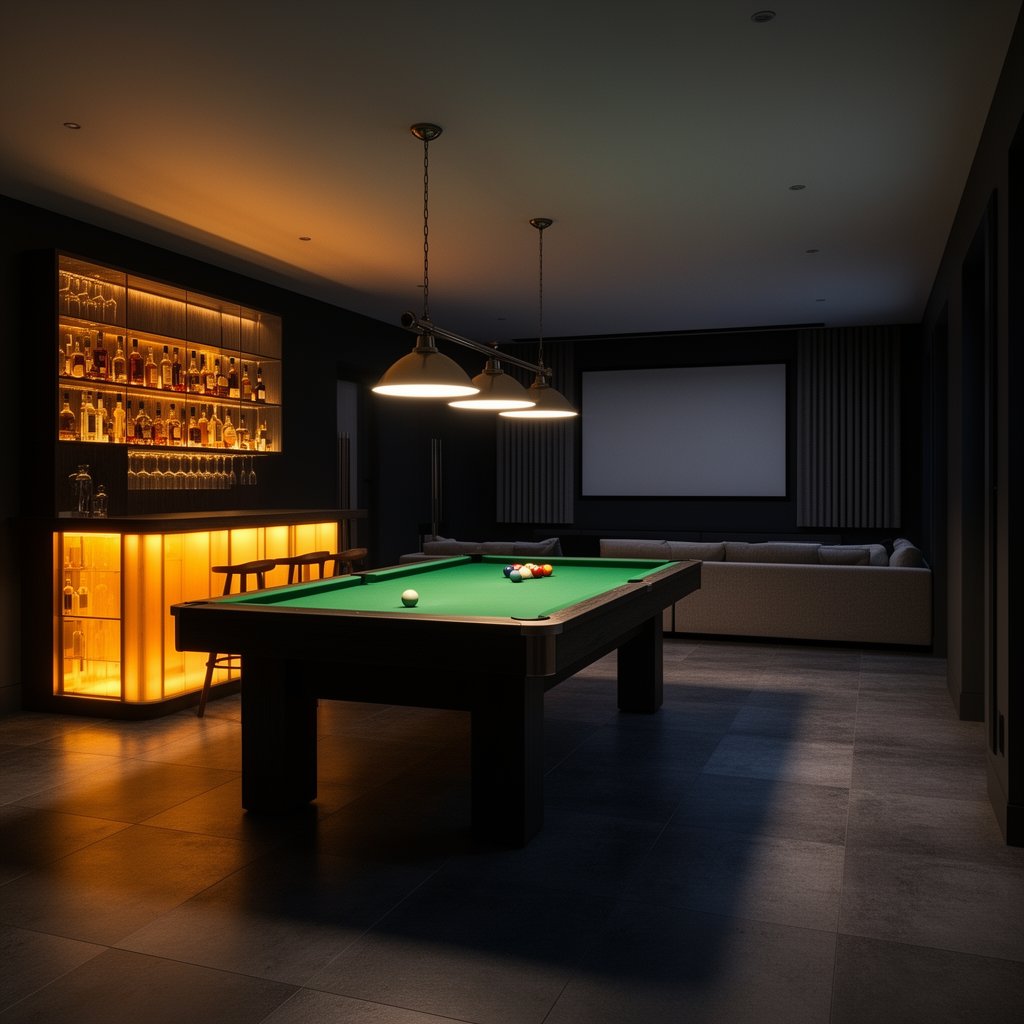
Lighting in a games room has requirements that sit unusually far apart on the spectrum. For pool, you need bright, even, shadow-free illumination over the playing surface. For cinema viewing, you want dim, warm ambient with no light fall on the screen. For the bar area in the evening, you want atmospheric accent lighting. For table tennis, you need broad even illumination without glare. One lighting scheme cannot do all of these things simultaneously, which means designing for zones and controls rather than a single solution.
The pool table zone has dedicated pendant lights — specifically designed billiard table pendants that direct light downward onto the playing surface without creating glare. These are on their own circuit and can be on at full brightness while the rest of the room is dimmed for a different activity.
The general ambient lighting is recessed downlights, dimmable, providing even illumination across the floor when needed and disappearing into the background when dimmed.
The bar lighting — the back-lit glass shelving — is on its own circuit, as is a subtle LED strip that runs at low level around the base of the built-in seating unit, providing floor-level accent lighting that’s particularly effective when the room is used in evening mode with most of the overhead lighting off.
All circuits are controlled from a single panel beside the entrance door, with preset scenes programmed for the main use modes: Games (pool table pendants on, general ambient bright), Cinema (all ambient dimmed to near-zero, subtle accent lighting only), Bar (general ambient at mid-level, bar back-lighting full), and Full (everything on at full brightness for cleaning and general access). The family use the presets constantly, which is the validation that the programming was worth doing.
The Floor and Wall Finishes
Durability was the primary criterion for floor and wall finishes, with appearance secondary but still genuinely considered.
The floor is a large-format porcelain tile in a dark concrete-effect — practical, cleanable, extremely hard-wearing, and good-looking in the context of the industrial aesthetic the clients wanted. The grout colour matches the tile closely, which prevents the grid pattern from dominating visually and makes the floor read as a surface rather than a mosaic. Underfloor heating runs beneath the tiles — electric mat on a thermostat — which takes the chill off a tiled floor in winter and makes the room comfortable without relying solely on the wall-mounted heating unit.
Walls are painted plasterboard throughout the main areas, in a very deep charcoal — almost black, with enough grey in it to prevent it feeling completely absorbent of light. Dark walls in a room with strong, carefully designed lighting create a theatrical quality that works extremely well for a games room: the surfaces recede and the activities in the space become the visual foreground. The same walls in a pale colour would make the room feel like a well-lit box rather than a considered environment.
The ceiling was kept simple — white painted plasterboard, which provides the one light surface in an otherwise dark room and prevents the space from feeling entirely enclosed. The contrast between the dark walls and the white ceiling creates a clean horizontal line at high level that, combined with the lighting design, gives the room a more considered spatial quality than either a fully dark or fully light scheme would.
How the Family Use It
The building has been in use for eighteen months. The feedback has been consistent and, gratifyingly, exactly what the brief asked for.
The teenage children use it almost every day after school. Friends come over and it absorbs the noise and the energy in a way that the main house no longer has to. The parents use it on Friday evenings — the bar setup gets used properly, the pool table gets used, and the children are in their own part of the house. The whole family use it together for film nights in a way they hadn’t done in the main house, because the screen and the seating arrangement and the sound quality make it a genuinely better cinema experience than the sitting room ever was.
The acoustic separation performs as designed. Neighbours on both sides have mentioned the building and asked about it — not to complain about noise, but because they’re curious. That’s a reasonable measure of success.
The one thing the family said they’d do differently is go bigger. Thirty-five square metres feels generous until the pool table is out and five people are in the room. They’d go to 40 or 45 if they were starting again. It’s the most consistent piece of feedback from garden games room projects: people consistently wish they’d built slightly larger. Build as big as the site and budget allow, and consider seriously whether the budget might stretch just a little further.
It almost always should.