
Table of Contents
There’s something about a basement that triggers a particular kind of imagination, thanks to these awesome basement designs. Maybe it’s the blank-slate quality of the space — no windows dictating where the sofa goes, no existing layout to work around, no accumulated history of previous owners’ decorating decisions. Or maybe it’s just the novelty of it. Most UK homes don’t have one, so when you do have a basement — or you’re thinking about creating one — it feels like a genuine opportunity rather than just another room to sort out.
The reality of basement design is that the best ones tend to start not with aesthetics but with an honest conversation about what the space can actually be. Basements have specific constraints: limited natural light, potential moisture issues, ceiling heights that are often lower than you’d choose, and access that needs careful thought. Get those fundamentals right first, and the design possibilities open up considerably. Get them wrong, and no amount of clever lighting or expensive finishes will make the space feel good to spend time in.
What follows is a look at some of the approaches we’ve seen work brilliantly — and a few thoughts on why they work.
The Cinema Room Done Properly
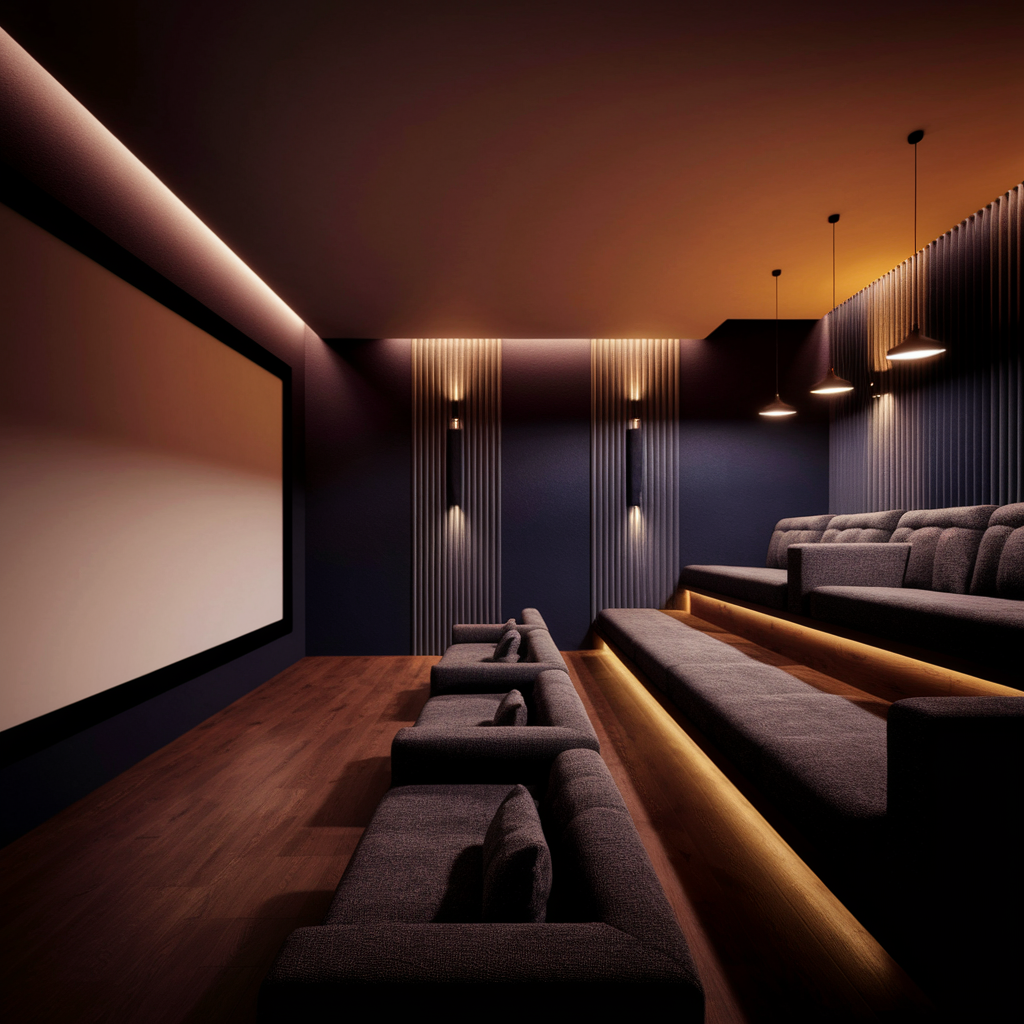
This is the one everyone mentions first when they talk about what they’d do with a basement, and there’s a reason for that. A basement is genuinely the ideal location for a dedicated home cinema. The absence of natural light, which feels like a liability in a living room or kitchen, is an outright advantage here. The acoustic separation from the rest of the house — all that earth and concrete between you and the floors above — means you can run a proper sound system at real volume without it being a domestic issue.
What distinguishes a cinema room done properly from one that’s just a dark room with a large television is, mostly, the acoustic treatment and the seating. Good acoustic panels on the walls and ceiling — they don’t have to look clinical, they can be upholstered, fabric-wrapped, genuinely attractive — make a significant difference to how sound behaves in the space. A mix of absorption and diffusion gives you clarity without deadness.
Seating matters more than the screen. A genuinely comfortable seat, at the right angle, at the right distance, in the right position relative to the audio — this is where a lot of home cinemas fall down. Tiered seating, even a single step up at the back of the room, transforms the experience for a group. It also adds visual interest to what would otherwise be a rectangular box.
For the screen itself: a projection setup on a proper acoustically transparent screen almost always beats a large flat panel for that genuine cinema feel, though the economics and the ambient light control need to be right for it to work well.
The Home Gym That You’ll Actually Use
The reason most home gyms fail — wherever they are in the house — is that they’re treated as afterthoughts. Equipment gets stored rather than set up. The lighting is whatever was already there. The floor is whatever was already there. And using the space feels like an act of will rather than something you want to do.
A basement gym works because it can be genuinely dedicated. No other function competes with it. The floor can be properly surfaced for the purpose — rubber matting for weights areas, sprung flooring for anything involving impact — without it being in conflict with the rest of the house’s aesthetic.
The design elements that make a basement gym feel like somewhere you want to train rather than somewhere you feel obliged to: mirrors used generously and placed deliberately, not just stuck on one wall as an afterthought; lighting that’s bright and even, with no gloomy corners; adequate ventilation, which in a basement requires mechanical thought rather than just opening a window; and a sound system that’s properly installed rather than a Bluetooth speaker on a shelf.
Storage built in from the start — for weights, accessories, bands, mats — keeps the space feeling controlled rather than chaotic. A small utility sink if you can run the plumbing. A mounted screen for training programmes. These are small things individually but they add up to a space that feels considered rather than cobbled together.
The Basement Kitchen and Bar
This one is more niche, but when it works, it really works. A basement kitchen or bar — distinct from the main kitchen upstairs — functions as an entertainment space with a life of its own. A proper bar setup with under-counter refrigeration, a sink, spirits storage, good glassware storage, and seating at the counter creates a space that feels genuinely hospitality-grade without the self-consciousness of a home bar that’s just been shoe-horned into a spare corner.
The design language that tends to work here is deliberately different from the rest of the house. Where the upstairs might be light, airy, neutral — the basement bar can afford to be darker, more atmospheric, more deliberately styled. Deep colours on the walls and ceiling. Pendant lighting over the bar counter. Shelving that’s lit from behind for the bottles. Materials that are tactile and warm — timber, brass, leather for the bar stools — rather than the hard surfaces that dominate most kitchens.
The practical element that makes or breaks this is the ventilation and drainage. A basement bar with nowhere for cooking smells to go, or drainage that’s been improvised, is a problem waiting to happen. Get the services designed properly from the start. It’s less glamorous than choosing the bar stools, but it’s more important.
The Games Room With Some Ambition
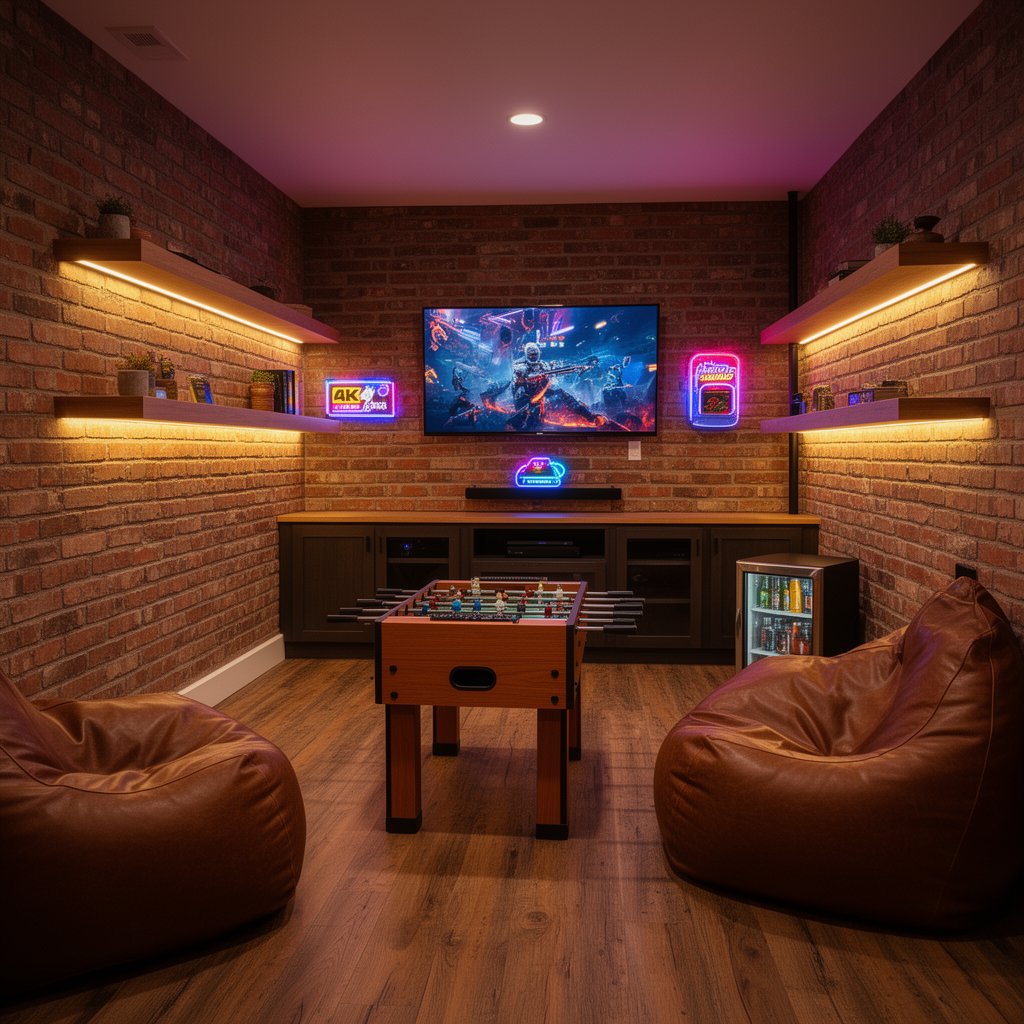
Pool table, table tennis, a dart board, a vintage arcade cabinet or two — a basement games room is one of those ideas that appeals across every demographic in a household. Children and adults. People who want something competitive and people who just want to sit on a comfortable sofa and watch other people play.
What lifts a games room above a collection of equipment is cohesion. A decision about what this space is and what it looks like, carried through in the lighting, the materials, the colour. Something that’s been thought about.
The mid-century American pool hall is a reference point that works particularly well — dark timber, pendant lights over the table, leather seating, a jukebox if you’re going the whole way. But it doesn’t have to be retro. A clean, contemporary approach with a palette of greys and greens, good task lighting, and built-in storage for cues and accessories works just as well. The point is that it’s a decision, not a default.
Acoustic considerations matter here too, particularly in families with young children. Impact noise from a pool table or table tennis travels upward through the structure. A proper floating floor system — a resilient layer beneath the finished floor — makes a significant difference and is much easier to build in from the start than to retrofit.
The Study and Home Office
The pandemic changed the calculation on this one for a lot of people. A dedicated home office — genuinely separate from the rest of the house, with a door you can close — has moved from a nice-to-have to something closer to essential for anyone working from home regularly.
A basement study has advantages that no other room in the house can match: quiet, separation, and the ability to completely control the environment. No natural light interruptions (or distractions). Temperature and acoustics you can spec to your own preferences rather than negotiating with everyone else in the house.
The challenge is that a basement office can also feel oppressive if it’s not designed carefully. Low ceilings, poor lighting, and no visual connection to the outside world adds up to somewhere that drains you rather than supports you. The antidotes are well understood: a ceiling height that’s genuinely adequate (2.4 metres minimum), layered lighting that mimics the quality of natural light without depending on it, good ventilation, and something on the walls that’s visually interesting or calming.
A lightwell — an excavated external void with glazing — can bring in genuine natural light and even a glimpse of sky. Where the basement is at the rear of the house with access to a garden, full-height glazed doors opening onto a sunken courtyard are transformative. It stops the space feeling subterranean and gives you something to look at other than a screen.
The Playroom That Grows With Children
A basement playroom is the gift that keeps giving through a child’s first decade or so — and the design choices that work best are the ones that acknowledge it’s going to evolve.
In the early years: storage, above everything else. Built-in shelving and bins at child height, a wipeable floor, walls that can take some impact and a repaint, soft zones for younger children. The design can be bold and playful without being precious about it — a basement playroom is one of the few spaces in the house where you can use strong colour and pattern without it being a long-term commitment, because you know it’ll be redone as the children get older.
In the middle years: a table for building, making, painting. A space for a train set or a Lego city that can stay out. A comfortable seating area for older children to hang out in. The storage needs change but the need for it doesn’t.
By the time they’re teenagers, the playroom has usually become something else — a chill-out room, a gaming space, a place to have friends round without it being in the middle of the main living areas. Design for that transition by not over-specifying the space for small children. Keep the infrastructure flexible.
Turning a Wine Cellar Into a Feature
A lot of older UK properties with basements have a historic wine cellar or at least a cool, dark storage room that’s been used as one. Turning this into a genuine feature — a properly designed, temperature-controlled, visually compelling wine cellar — is one of those projects that pays dividends in both function and atmosphere.
The design elements are fairly constrained by the function, which paradoxically makes them easier: proper racking, climate control if you’re storing anything serious, good but low lighting (heat and UV both damage wine over time), and a tasting table or counter if space allows. The materials that work are the ones that feel appropriate to the context — stone, dark timber, wrought ironwork.
Even if you don’t drink wine, a well-designed cellar space reads as an asset. It’s one of those features that makes a property feel genuinely special rather than just well-renovated.
The Essentials You Can’t Design Around
Whatever you put in a basement, the fundamentals have to be right first. Waterproofing is non-negotiable — a tanked or membrane-lined basement that keeps water out is the foundation everything else sits on. The British Standard for basement waterproofing (BS 8102) exists for good reason, and a specialist contractor working to that standard is worth every penny. A beautiful basement that has a damp problem is miserable to be in and expensive to fix retrospectively.
Ventilation needs to be mechanical and designed, not improvised. Ceiling height, as discussed elsewhere, should be 2.2 metres minimum for habitable use, and ideally 2.4 or above. Natural light, where you can get it, is worth fighting for.
Get those things right, and the rest is the enjoyable part.