Table of Contents
Creating a laundry room with mudroom from an underused pre-existing extension is one of those projects that sounds modest in the brief and turns out to be the renovation the whole household notices most. Not because it’s the most dramatic transformation on paper, but because it’s the room that everyone interacts with multiple times every day — and when it stops being a problem and starts being a solution, the effect on daily life is quietly significant.
The property in question is a four-bedroom detached house in Worcestershire, built in the 1960s with a single-storey rear extension added sometime in the 1980s. The extension had been the kitchen at some point, then a general storage and laundry space, and by the time we were called in it was serving as a holding area for everything that didn’t have a proper home — sports equipment, outdoor clothes, a washing machine against one wall, a tumble dryer stacked on top of it, a chest freezer occupying a third of the floor area, and the particular atmosphere of a room that has been the default destination for displaced objects for too long.
The family — two adults, three children aged between seven and fourteen — used the back door of the extension as their main entry point from the garden, the driveway, and the school run. The front door opened into a decent hallway. The back door opened into chaos. The brief was to give that transition a proper design rather than an accumulation of compromises.
The Space and What It Offered
The extension measured 4.8 metres by 3.2 metres — approximately 15 square metres — with a flat roof and a large rear window facing the garden. The back door was on the side wall rather than the rear, which turned out to be a layout asset rather than an obstacle: it created a natural division of the room into two zones along the main axis, with the entry point at one end and the far end available for a different function.
The flat roof needed to be inspected before anything else. The previous owners had applied a proprietary coating system about four years earlier which was in reasonable condition — no active leaks, no bubbling or cracking — and the decision was made to leave it in place, address the minor edge details properly, and focus the budget on the interior. A roof in acceptable condition that might last another eight to ten years doesn’t justify replacement on the basis of age alone.
The walls were single-skin brick — the typical construction of late 1980s domestic extensions — which needed thermal upgrading for the space to function comfortably year-round. The floor was a concrete screed in reasonable condition, with no DPM visible, which meant assuming the worst and installing one as part of the floor build-up.
The large rear window was a real asset — good natural light into the laundry zone — and was retained. The existing back door was replaced with a more thermally efficient composite unit with a lower threshold for easier access with arms full of laundry or sports bags.
Planning the Zones
The fundamental decision in any laundry room with mudroom combination is how to divide the space between the two functions. In a room of generous dimensions — 20 square metres or above — the two can be fully separated with their own distinct character. In a 15 square metre room, the approach needs more care: the two functions need to coexist without either compromising the other.
The layout we arrived at was determined by two fixed points: the back door on the side wall, and the plumbing positions for the washing machine. With the back door at one end of the room, the mudroom zone occupied the first third — approximately 1.6 metres of depth from the door, the full 3.2 metres of width. Beyond a visual dividing element at approximately 1.6 metres, the laundry zone occupied the remaining two-thirds of the room, with the machines, the worktop, and the storage running the full width at the far end.
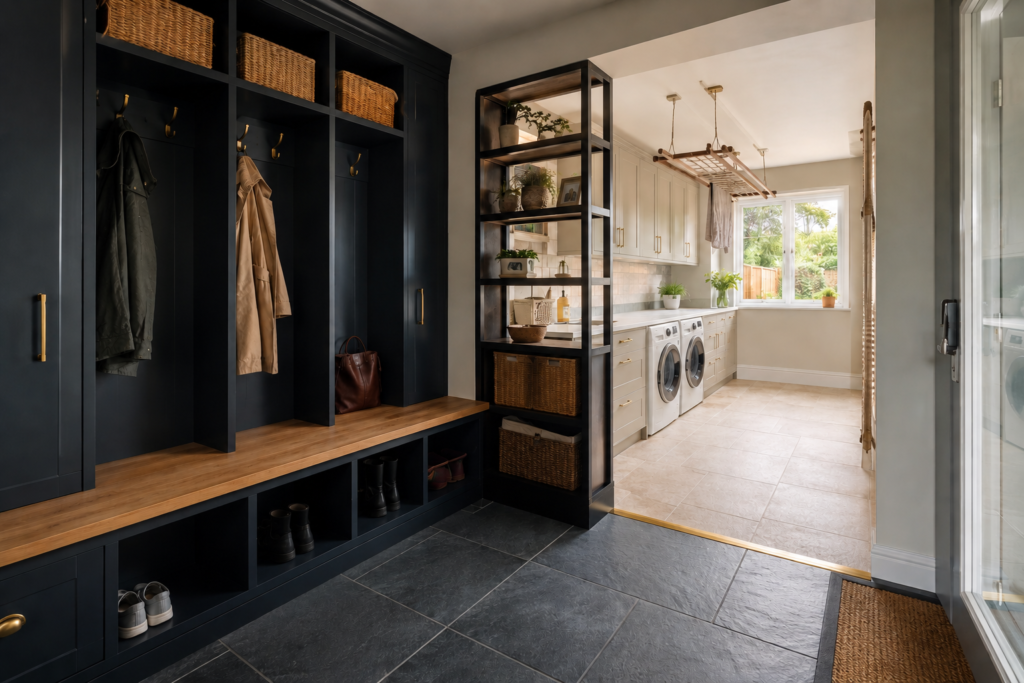
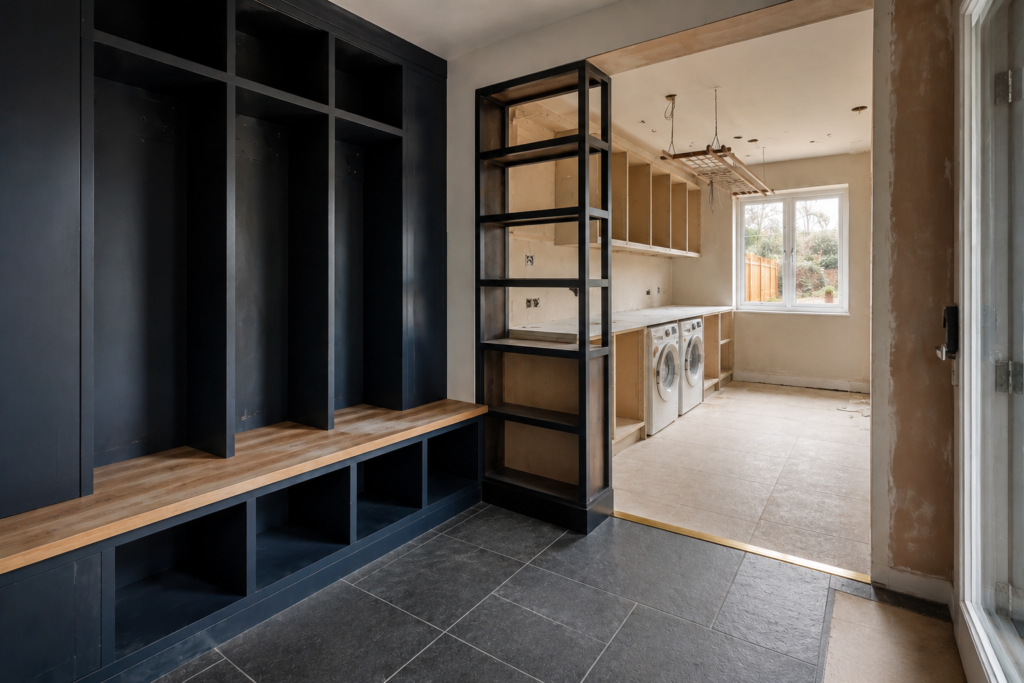
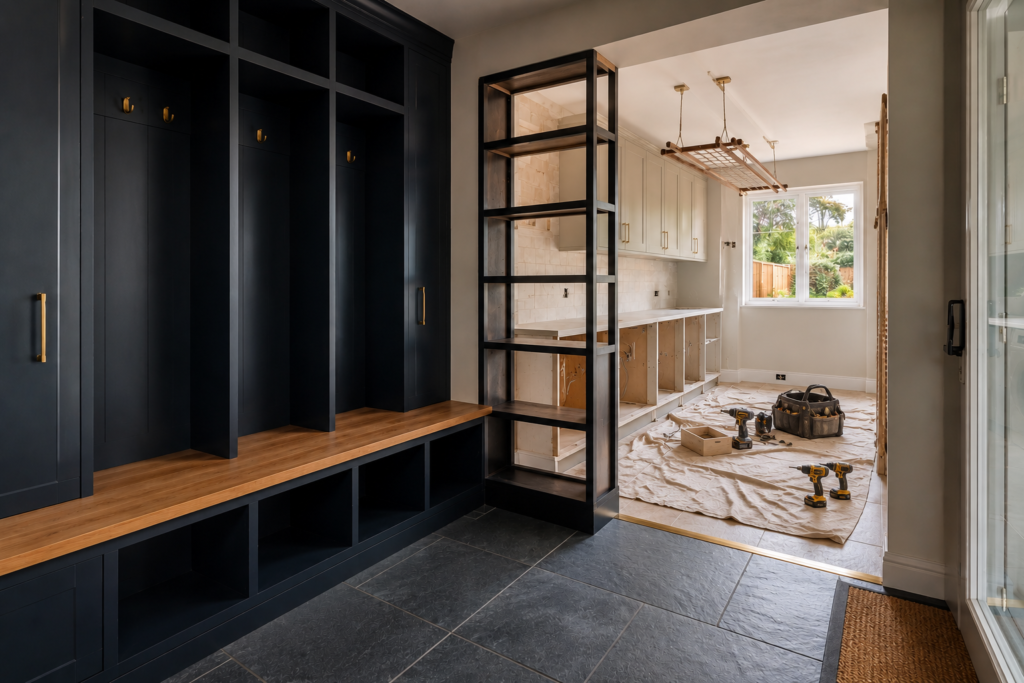
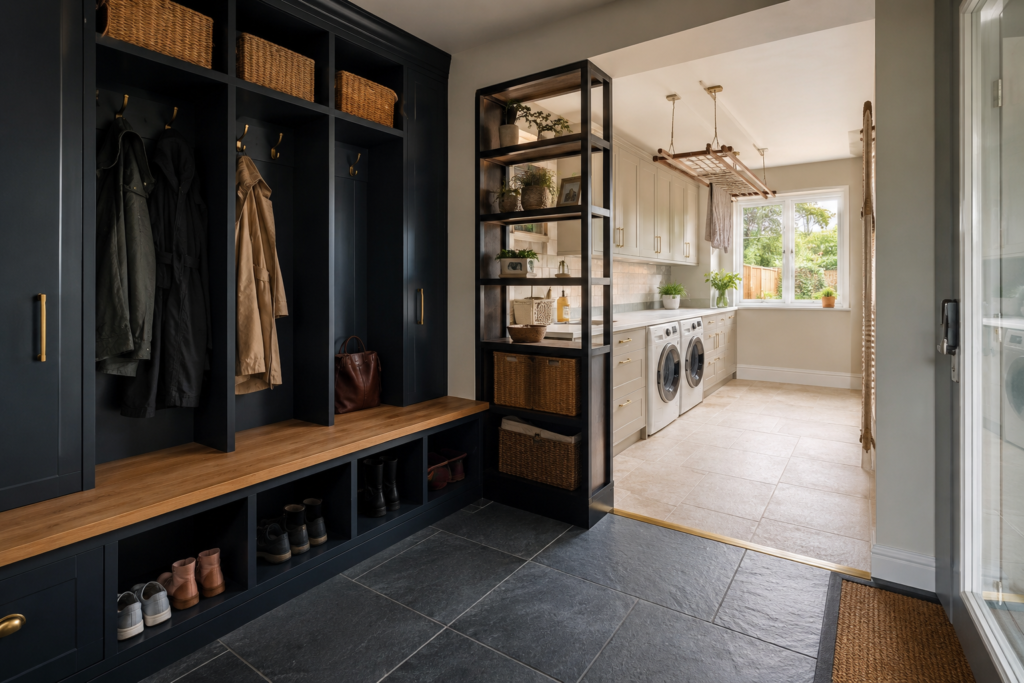
The visual dividing element — rather than a wall, which would have divided a modest room into two cramped rooms — is a run of full-height open-back shelving units, island-style, positioned perpendicular to the long axis of the room. From the mudroom side, this reads as a storage and display shelf. From the laundry side, it reads as a visual separator. Open rather than solid, it preserves the sense of the room as a continuous space while clearly marking the transition between functions. It also provides the laundry zone with a visual backdrop that prevents the worktop and machines from being the first thing visible from the back door.
The Mudroom Zone
This first third of the room is the one that gets the most use, the most physical punishment, and the most visible scrutiny. It needed to be genuinely robust and genuinely designed — not one or the other.
The floor in the mudroom zone is large-format slate-effect porcelain tile, 600x600mm, in a dark tone that sits somewhere between charcoal and black. The practical argument for dark floor tiles in a mudroom entry is simple and consistent with everything said above about mudroom paint colors: mud is brown, and brown on dark charcoal is significantly less visible than brown on pale stone. The tiles are textured for grip when wet, which matters in an entry space where wet boots and a smooth floor would be a daily hazard.
A recessed doormat insert — a stainless steel frame with a removable coir mat at exactly the threshold of the door — stops the first layer of outdoor debris at the point of entry rather than having it carried further in. This is a detail that costs very little relative to its impact on the cleanliness of the room beyond it.
The full width of the back wall — 3.2 metres, facing you as you come through the back door — is occupied by a run of built-in cabinetry that was the centrepiece of the design brief.
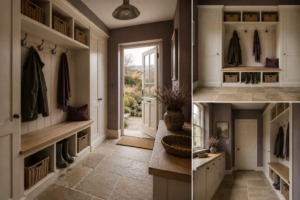
Floor-to-ceiling, painted to match the walls, with the following layout from left to right: a full-height coat cupboard with internal hooks, a shelf for bags above head height, and a floor area for wellies and outdoor footwear; a run of open cubbies at mid-height between a bench seat below and hooks above, sized for one cubby per family member (five cubbies across approximately 1.8 metres of the run); a tall broom and sports equipment cupboard at the right end, with a lockable lower section for garden chemicals and a full-height area above for long-handled tools, sports bags, and umbrellas.
The bench seat runs the full 1.8 metres of the cubby section — a solid oak top on painted MDF base units, with internal storage under lift-up lids in each section. The cubbies above the bench are open-fronted and appropriately sized: wide enough for a school bag lying on its side, deep enough for a helmet. Each family member knows which cubby is theirs, which means the system works because there’s always somewhere for things to go.
The hook rail above the cubbies is a continuous length of painted mild steel with individual cup-hook inserts at consistent spacing — a detail that makes adding or removing hooks straightforward without replastering or redecoration.
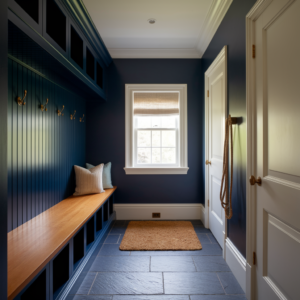
The wall color in the mudroom zone is a deep, warm navy — slightly warmer and less pure than a standard navy, with just enough blue-green in it to prevent it reading as cold. Against the dark floor tiles and the warm oak bench, it reads as considered and deliberate. The painted cabinetry in the same tone as the walls makes the whole back wall read as a single composed element rather than a collection of units against a wall.
The Laundry Zone
Beyond the open shelving divider, the laundry zone is a different room in character. The floor transitions to large-format warm stone-effect porcelain — the same format and scale as the mudroom tile, but warm rather than dark, which distinguishes the zones clearly and makes the laundry zone feel lighter and more generously lit. The transition strip between the two tiles is a simple brushed brass threshold, which reads as a deliberate design element rather than a practical necessity.
The machines — washing machine and tumble dryer, side by side rather than stacked because the client specifically wanted the stacked option avoided, having found it ergonomically uncomfortable in a previous house — sit under a continuous quartz composite worktop at 960mm. The worktop is a warm white with a very faint grey veining — enough movement to make it interesting, not enough to distract. It runs the full width of the laundry zone and provides approximately 2.8 metres of continuous working surface — considerably more than the machines need, which means the sorting, treating, and folding functions have proper space rather than spilling onto the bench in the mudroom.
Above the worktop, wall units extend to the ceiling in the same painted finish as the mudroom cabinetry — a slightly lighter tone in the laundry zone, distinguishing the two areas while maintaining the visual language of a single project. The wall units include a dedicated section for the integrated ironing board, a run of closed storage for laundry products, and two open sections for the things that benefit from visibility: the ceramic detergent jars, the mesh bag collection, a small plant that caught the morning light from the garden window.
The ceiling drying rack is installed above the central circulation area — a traditional pulley-and-cleat system in dark metal, raising and lowering via a wall-mounted cleat on the laundry wall side. Extended, it provides approximately four metres of drying length at an accessible working height. Raised, it sits at ceiling level and is effectively invisible.
The large rear window — facing the garden — was retained in its existing position and fitted with a simple roller blind in a warm linen fabric. Morning light through this window makes the laundry zone the best-lit part of the room, which is exactly the right allocation of natural light for the zone where colour-sorting and stain treatment happen.
Services, Electrics, and the Infrastructure Nobody Sees
The infrastructure work was substantial and preceded every design decision, because infrastructure constrains design rather than the reverse.
The plumbing for the washing machine was in the wrong position relative to the new layout, which required re-routing through the screed. This was done during the floor build-up stage — far easier than lifting a finished floor — and the new positions were confirmed before the screed was laid. The standpipe for the dryer vent was installed at the same time. The drainage for both machines was connected to the existing soil stack via a properly configured trap arrangement.
The electrical installation included: a dedicated 32A circuit for the washing machine, a 13A circuit for the tumble dryer, under-cabinet LED strip lighting on the laundry side, recessed downlights on dimmers throughout, a specific circuit for the electric underfloor heating in the mudroom zone (a warm-up mat on a programmable thermostat for cold mornings), and five double sockets across the laundry worksurface. All wiring was new throughout and installed by a registered electrician who also handled the Part P notification to Building Control.
The ventilation extract — a single unit with two intake grilles, one in each zone, connected to a common duct exiting through the external wall — provides continuous background ventilation and prevents the condensation build-up that a sealed laundry room without adequate air movement will develop regardless of heating.
The Result: Six Months On
Six months after completion, the family reports what every successful laundry room with mudroom project produces: the back door is now the entrance they use and are not embarrassed by, the school run decompresses into the mudroom rather than into the kitchen, and laundry exists as a managed system rather than a persistent low-level crisis.
The eldest child — fourteen — was, according to the parents, initially sceptical about the cubbies being “not really for teenagers.” She now has a personalised collection of objects in her cubby and a specific hook for her school bag. Teenagers who claim not to care about organisation use organisation when it’s provided correctly.
The clients were asked at the handover whether there was anything they’d change. One answer came back: they’d have made the laundry worktop even longer. It’s always the worktop.
The extension that was a problem space for a decade is now the room the household passes through most often, uses most consistently, and notices most positively. That’s not a modest outcome for what started as a single-storey 1980s kitchen extension with a flat roof and a chest freezer in the corner.
It’s a room that works. That’s the whole brief, done properly.