Table of Contents
Farmhouse kitchen sinks are one of those design elements where function and character work in the same direction rather than against each other. The defining feature of the farmhouse sink — the apron front, that exposed face of the sink basin that sits proud of the cabinet below rather than being recessed behind a standard front panel — exists for a practical reason. It was developed for agricultural kitchens where large quantities of produce, dishes, and equipment needed to be washed, where leaning over a conventional recessed sink for extended periods was genuinely uncomfortable, and where the depth and width of the basin needed to accommodate buckets, stockpots, and the general scale of rural domestic work.
Those functional origins are exactly what makes the farmhouse kitchen sink translate so well into contemporary kitchen design. It isn’t ornamental in the way that purely decorative elements are — it earns its presence through what it does as well as what it looks like. A deep, wide farmhouse sink with a proper apron front is genuinely better to use than a standard undermount sink, and it looks genuinely better in a kitchen that suits it. That alignment of practical merit and aesthetic quality is rare enough to be worth understanding before making a choice.
What Makes a Sink a Farmhouse Sink
The terminology deserves some unpacking because it’s used loosely in the market, and not everything described as a farmhouse sink actually is one.
The authentic farmhouse sink — also called a butler sink in British tradition — is defined by the apron front: the exposed vertical face of the sink that sits flush with or slightly proud of the cabinet face below it. This requires a specific cabinet construction — the base unit beneath the sink must be cut back to accommodate the sink apron rather than having a standard full-height door running across the front. The sink, in other words, defines the cabinet rather than sitting within it.
A standard undermount or overmount sink in a shaker-style kitchen is not a farmhouse sink even if the kitchen has farmhouse aspirations. The farmhouse sink is the one where the basin itself is architecturally present — where it’s visible, where it makes a statement about the kitchen’s character, where it’s clearly part of the room’s design rather than hidden inside a cupboard.
Within that defining characteristic, there’s considerable variation in basin configuration, material, depth, and profile, all of which affect both practical performance and aesthetic character.
Single Basin vs Double Basin
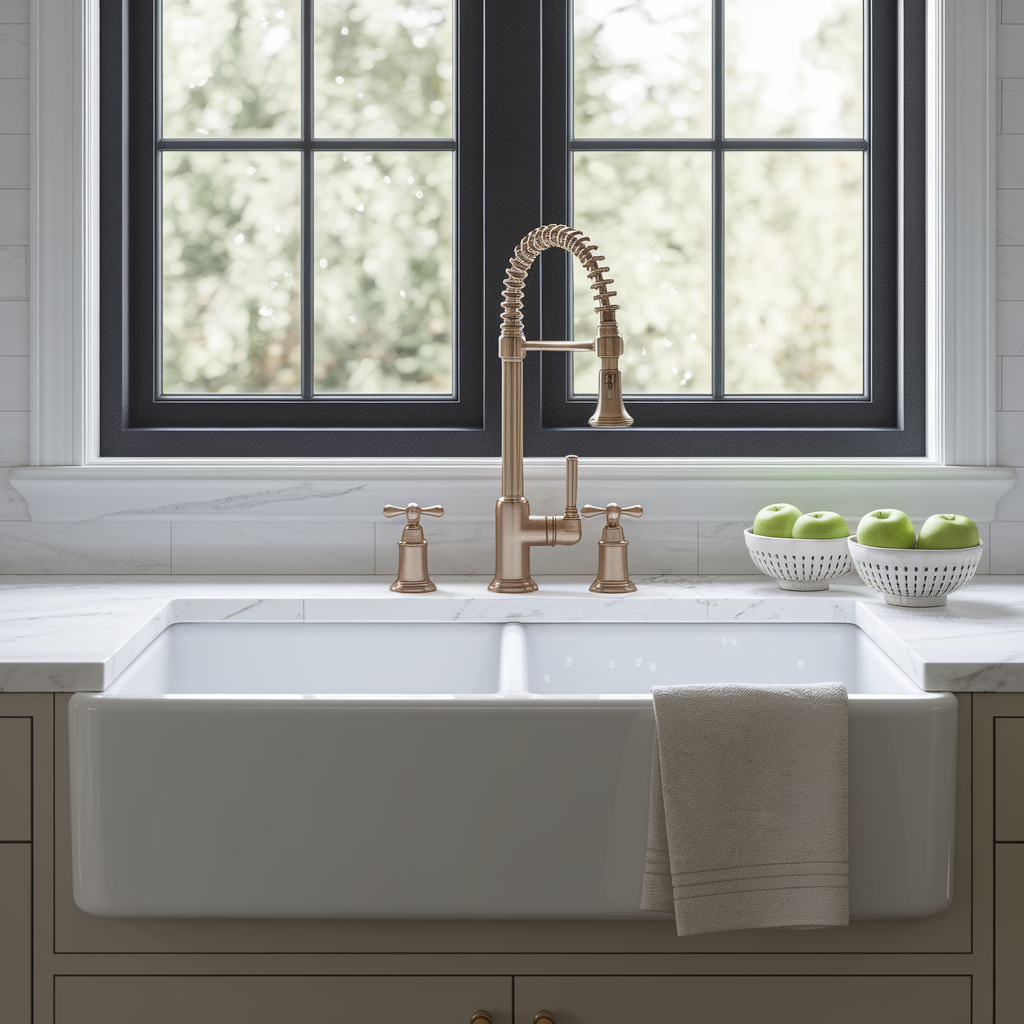
The single large basin is the most classical farmhouse sink configuration and the most practically useful for the purposes that defined the category. A single basin of approximately 600mm to 900mm width provides the unrestricted space for large items — stock pots, baking sheets, large roasting dishes — that makes the farmhouse sink specifically better than a standard sink for serious cooking households.
The double basin configuration — two equal basins, or one large and one small — addresses a slightly different use pattern. The two-basin arrangement allows simultaneous washing and rinsing, or food preparation in one basin while dishes soak in the other. In a kitchen that does a high volume of washing up — a family household without a dishwasher, or one where the dishwasher handles everyday items but the hand-wash items accumulate separately — the double basin is genuinely more functional.
The trade-off is the partition between basins, which prevents large items from lying flat across the full width of the sink. A stock pot that fits across a 750mm single basin doesn’t fit in a 375mm half-basin. For kitchens where serious cooking is the primary use case, the single large basin is almost always the better choice. For kitchens where simultaneous multi-function use is more important than maximum single-item capacity, the double basin has merit.
Fireclay: The Classic Material
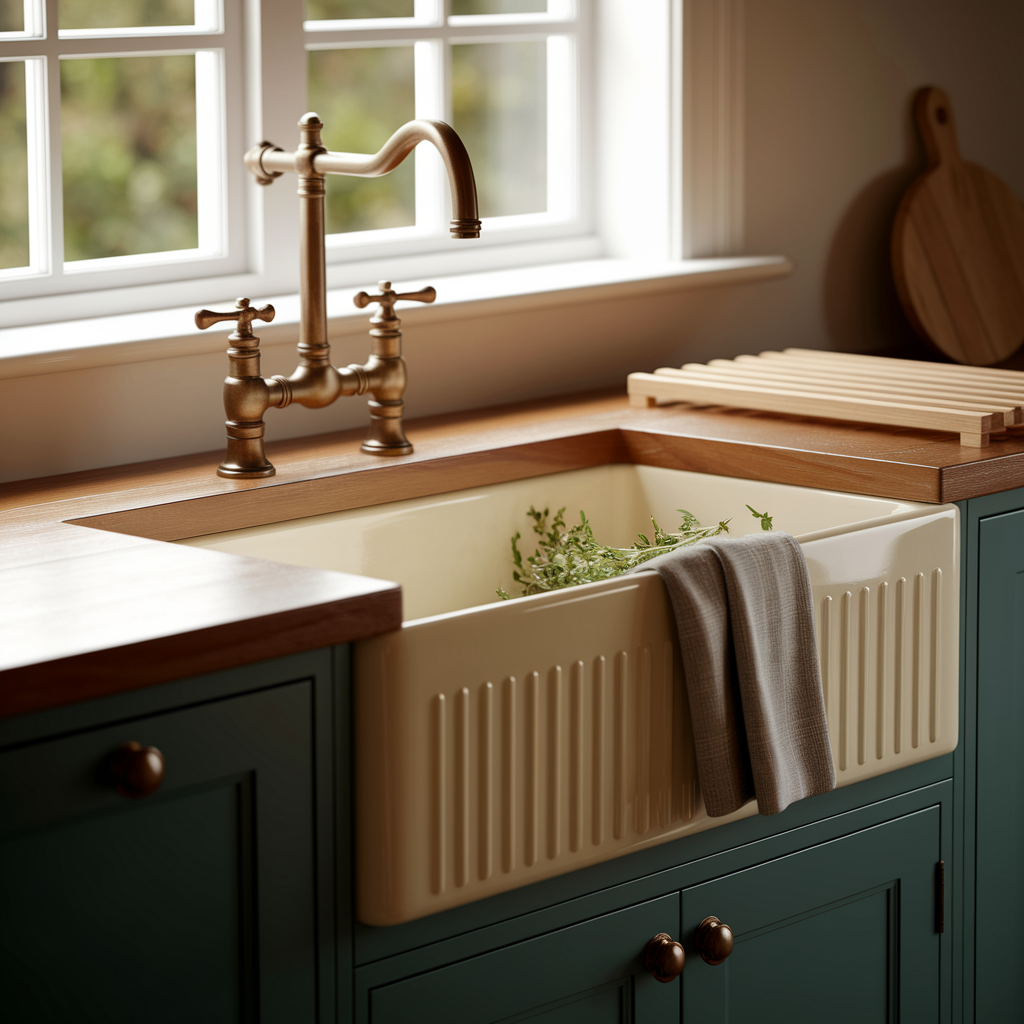
Fireclay is the material most associated with the traditional farmhouse or butler sink, and for good reason. The original Belfast and London sinks — the deep ceramic sinks that were standard in British domestic service until the mid-twentieth century — were fireclay, and the fireclay farmhouse sinks available today are direct descendants of that tradition.
The material is made by pressing clay into a mould at high pressure and firing it at very high temperatures — a process that produces a dense, non-porous ceramic with a vitrified surface that is genuinely resistant to staining, chipping, and the general punishment of heavy kitchen use. A quality fireclay sink properly maintained will outlast the kitchen around it several times over. There are fireclay sinks in active use in British country houses that have been there since the 1880s, looking much the same as they did when they were installed.
The appearance is what most people associate with farmhouse sinks: pure, slightly warm white or off-white, with the slight gloss of a well-fired glaze. The surface is smooth but has a slight depth and warmth that makes it look different from the flat, harder whiteness of enamel-coated cast iron or polished quartz. In a farmhouse kitchen with warm material tones — timber, stone, aged brass — the off-white warmth of fireclay sits precisely right.
Practical considerations: fireclay is heavy — a single large basin can weigh 30-50 kilograms without any installation — which requires a genuinely robust cabinet beneath it. The base cabinet and any adjacent cabinetry need to be capable of supporting the sustained weight of the sink plus water plus whatever is in it. This is a specification issue for the cabinet maker or installer rather than a dealbreaker, but it needs to be addressed at the design stage rather than at the point of installation.
Fireclay can chip if heavy items are dropped directly onto it — a cast iron pan landing on the basin with force rather than placed. The chip is visible but typically doesn’t affect function, and it can be repaired with a ceramic touch-up pen if cosmetically important. This is the main practical concession relative to metal alternatives.
Cast Iron with Enamel Coating
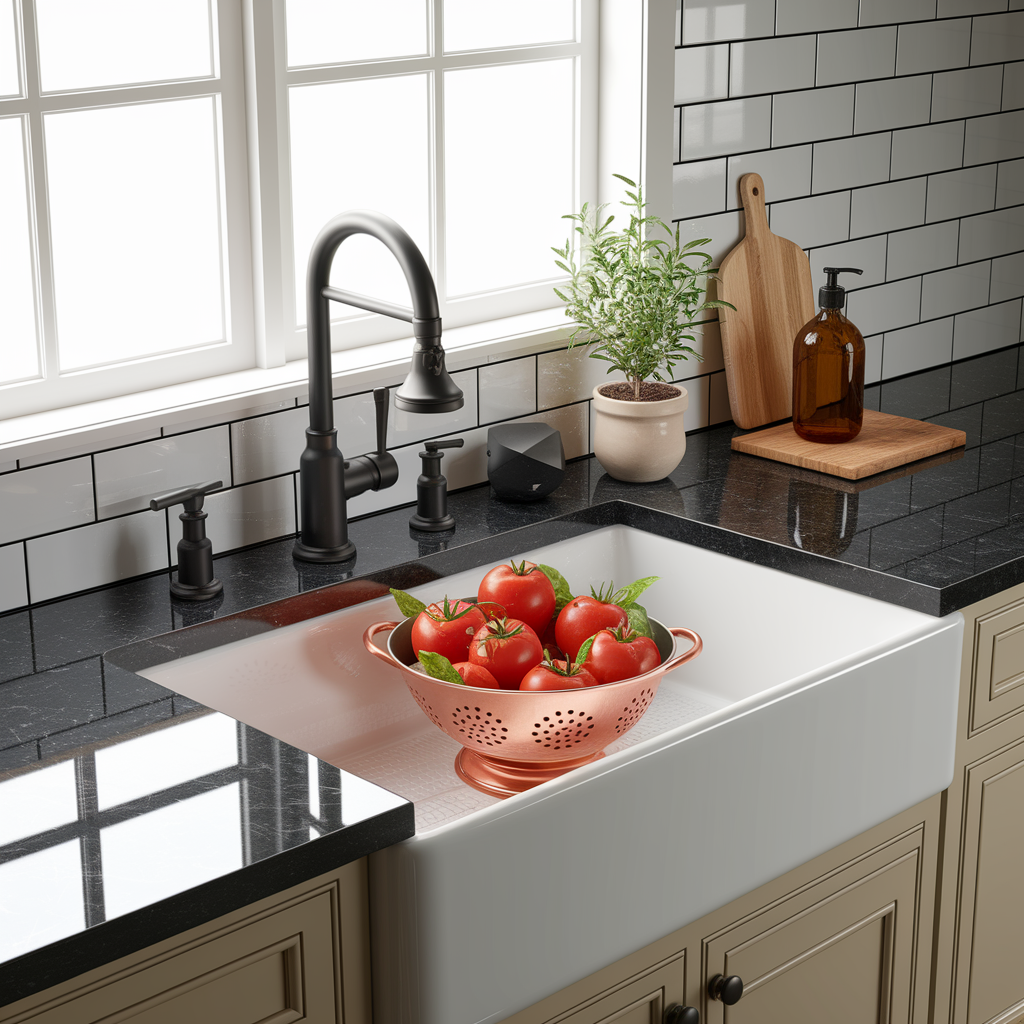
Cast iron farmhouse sinks share the deep basin and apron front configuration of fireclay but in a different material with different characteristics. The cast iron core is coated with a fused enamel finish — applied in layers at high temperature — that provides the working surface.
The practical advantages of cast iron over fireclay are principally in durability of the surface: enamel over cast iron is more chip-resistant than fireclay glaze because the metal substrate has more flex than ceramic. A heavy pan dropped into a cast iron sink is more likely to leave an impact mark in the enamel than a true chip, and these impact marks can sometimes be polished back. The surface is also slightly warmer to the touch than fireclay because the cast iron retains and conducts heat.
The disadvantages are the weight — cast iron farmhouse sinks are even heavier than fireclay, which makes installation more demanding — and the surface maintenance. Enamel over cast iron, unlike fireclay, is vulnerable to the prolonged contact of acidic liquids and to the abrasion of metal scouring pads. Standard kitchen cleaning products and a soft cloth are the correct maintenance regime, and the surface will look good for decades on that basis.
Cast iron farmhouse sinks are available in a wider range of colors than fireclay — because the enamel coating can be produced in any color rather than the natural range of ceramic. A deep navy, a forest green, a rich terracotta — these are available in cast iron farmhouse sinks and suit specific kitchen color schemes in a way that naturally-colored fireclay doesn’t accommodate.
Stainless Steel: The Functional Alternative
Stainless steel farmhouse sinks occupy a different aesthetic register from fireclay or cast iron — more contemporary, more professional kitchen in character — and they suit a different type of kitchen. In a farmhouse kitchen that leans toward the traditional, the natural, and the period-influenced, stainless steel is typically the wrong material for the sink. In a farmhouse kitchen that’s been interpreted in a more contemporary direction — where the agricultural origin provides structure but the treatment is clean and modern — stainless steel can work well.
The practical advantages of stainless steel are significant: it’s lighter than ceramic or cast iron, it’s genuinely impervious to chipping and impact damage, it’s easy to clean, and it’s resistant to staining with normal kitchen use. The professional kitchen uses stainless steel throughout because it performs without compromise under heavy, continuous use. A domestic kitchen used seriously can make the same calculation.
The gauge of the steel matters more than most people realise when comparing options. Thicker gauge steel — 16 or 18 gauge — produces a sink that doesn’t drum when water hits it and that resists the slight flexing that thinner gauge sinks develop over time. Sinks marketed at the lower end of the price range are typically thinner gauge, and the acoustic difference between a quality 16-gauge apron front sink and a cheaper thin-gauge version is immediately noticeable when water falls into the basin.
Copper: Character at a Premium
Copper farmhouse sinks are the most distinctive material option and the one that most clearly states a design position. The warm orange-red of new copper, transitioning over years to a deeper, more complex patina — the blues, greens, and browns of naturally-oxidised copper — gives these sinks a quality of living, changing character that no other material produces.
The practical reality of copper is that it is a material requiring acceptance of its natural behaviour rather than resistance to it. Water droplets left on a copper surface create marks; they’re easy to wipe away but they’re there if you don’t wipe them. The patina develops unevenly in the areas of most contact — the central wash zone may develop differently from the rim. This uneven development is part of the authenticity of the material but it needs to be understood as a feature rather than a defect.
Copper farmhouse sinks suit a very specific kitchen aesthetic — the deeply traditional, the artisanal, the kitchen where hand-crafted objects and aged materials are the explicit design language. They’re the right material for the right kitchen and the wrong material for any other.
Sizing and Installation
The size of a farmhouse sink needs to be determined in relation to the kitchen, the cabinet it sits in, and the workflow it’s expected to support.
A basin width of 600mm is the practical minimum for a farmhouse sink to deliver on its character and function — smaller than this and the basin reads as a standard sink with an apron front rather than a genuine farmhouse configuration. The range from 600mm to 900mm covers most residential kitchen applications, with 750mm to 800mm the most commonly specified for a single large basin.
The depth of the basin — the internal depth from rim to basin floor — is significant for comfort and function. A basin of 200mm depth is adequate. 230mm to 250mm is comfortable for tall pots and for the immersive hand position that serious washing up requires. Below 200mm and the basin starts to feel more like a standard sink in use than a genuine farmhouse configuration.
Installation requires the base cabinet to be cut down at the front to accommodate the apron. The cabinet manufacturer or maker needs to know the exact dimensions of the sink before fabrication — this is not an afterthought addition to a standard cabinet. For retrofit installation — fitting a farmhouse sink into an existing kitchen — the base cabinet typically needs to be replaced or substantially modified.
The cutout for the sink in the worktop, if the worktop runs above the level of the sink rim, requires precise measurement and clean execution. A badly fitted worktop-to-sink junction is one of the most common failure points in kitchen installations, allowing water to penetrate to the cabinet below. The junction should be sealed with a silicone appropriate for the worktop material, and the seal should be maintained on a regular basis.
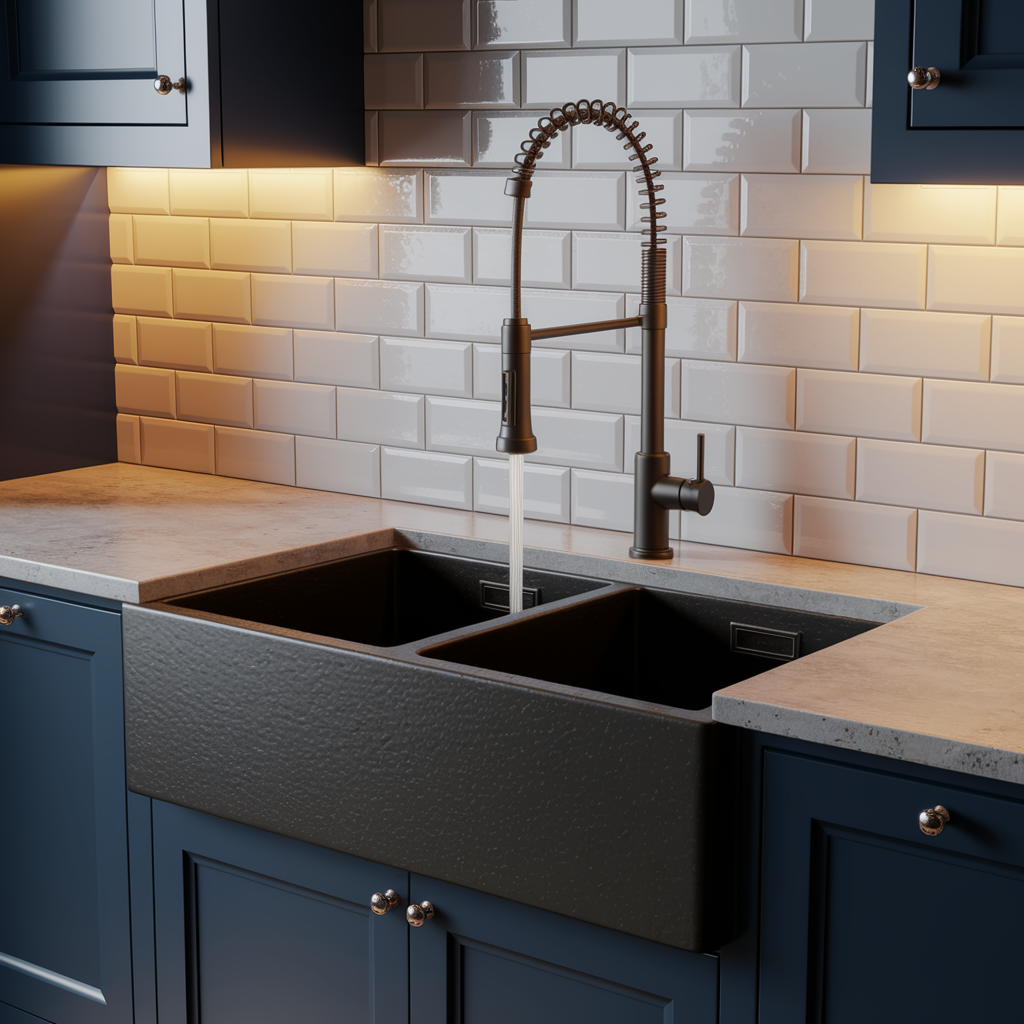
The Right Tap for a Farmhouse Sink
The tap — or taps — at a farmhouse sink need to be in proportion with the scale of the sink and in character with its aesthetic. A standard spout that would look correct above a standard inset sink often looks slightly meagre above a wide, deep farmhouse basin.
Bridge taps — the configuration where hot and cold feeds rise separately and are joined by a horizontal bridge before the spout — are the historically and aesthetically correct choice for a traditional farmhouse sink. The configuration references the plumbing of the period when these sinks were developed, and it reads as appropriate in a way that a single-lever contemporary tap doesn’t always.
Pillar taps — separate hot and cold, traditional crosshead controls — are the most period-correct option and suit fireclay and cast iron sinks particularly well. The requirement to use both hands to set the temperature is the practical concession; the visual result is worth it in a kitchen where period authenticity is a genuine priority.
Whatever tap configuration is chosen, the finish should connect to the hardware used elsewhere in the kitchen. Aged brass, brushed nickel, unlacquered brass, oil-rubbed bronze — the tap is part of the hardware family and should be considered alongside the cabinet handles, the light fittings, and the other metal elements in the room rather than in isolation.
Why Farmhouse Kitchen Sinks Endure
The farmhouse sink has been in continuous production, in essentially the same form, for well over a century. That longevity is the most reliable indicator of genuine quality. It hasn’t persisted because of trend cycles — it predates them — and it won’t be replaced by them. The form follows the function so closely that there’s nothing to improve in the fundamental concept.
What changes over time is the quality of individual products within the category, the range of materials available, and the kitchen contexts into which the sink is placed. A fireclay farmhouse sink in a newly completed barn conversion kitchen looks exactly as right as a fireclay farmhouse sink in a Georgian country house kitchen — because the form has a depth of character that adapts to context without losing itself.
That’s what distinguishes a genuinely good design from a fashionable one. It keeps working long after the fashion that temporarily adopted it has moved on.