Table of Contents
When a playroom is what a family needs, a disused basement is one of the best possible places to put one. That’s the conclusion we arrived at on this project, and eighteen months on from completion it’s a conclusion the family arrives at every single day — usually at high volume, usually running.
The house is a substantial Victorian semi in north London. Four floors including the basement, which had been used for storage since the current owners moved in seven years earlier. The basement contained a defunct boiler, several decades of accumulated furniture nobody wanted to throw away, original stone-flagged floors, and the particular atmosphere of a space that’s been ignored for long enough that it feels slightly separate from the rest of the house. Not damp — the previous owners had done basic tanking work at some point — but dark, cold, and completely without personality.
The brief from the clients was direct. Three children, ages four, seven, and ten. The main house was running out of space for them in the evenings and at weekends. They needed a dedicated space that could absorb the mess, the noise, and the energy that three children in a Victorian terrace generate. They wanted something properly designed rather than a room with some toys in it. And they wanted it to work for the next decade — not just for the four-year-old’s current phase of obsession with dinosaurs, but for whoever these three children were going to become by the time the eldest was twenty.
That last requirement turned out to be the most interesting design challenge.
The Structural Reality
Before any of the interesting decisions could be made, the basement needed to be assessed honestly for what it could and couldn’t become.
The ceiling height was 2.35 metres — marginally above the 2.2-metre minimum for habitable space under Building Regulations, but tighter than ideal. We discussed lowering the floor slab to gain additional height, but two things argued against it: the cost and disruption of excavating and re-laying the floor was substantial, and the existing stone flags — Victorian originals — were genuinely worth preserving. They’re beautiful in themselves and they’re part of the building’s history. At 2.35 metres, the space is perfectly habitable for children and adults. It’s only if you’re self-conscious about the height that it feels limiting, and a well-designed playroom doesn’t require you to be self-conscious about the height.
The waterproofing was assessed by a specialist contractor. The existing tanking had held adequately but not brilliantly — there were damp patches on the lower sections of the walls suggesting water finding its way through the original London stock brick. The decision was to install a cavity drain membrane system over the existing walls, which manages any water ingress by collecting it at the base of the wall and draining it away rather than trying to form a completely impermeable barrier. This is the appropriate approach for a Victorian basement where the structure will continue to move slightly with temperature and moisture changes — a rigid tanked system would eventually crack at movement joints.
The ventilation question was addressed with a compact heat recovery unit — a MVHR system that provides continuous fresh air to the basement without creating either draughts or heat loss. This is essential in a basement used by children: fresh air circulation matters enormously for comfort and health in a below-ground space with no opening windows.
The Design: Thinking About How Children Actually Live
The instinct with a children’s playroom is to make it playful. Bright colours, fun shapes, themed elements, things that communicate to a four-year-old that this is their space. The problem with that instinct is that it produces a room that looks great at four and embarrassing at twelve, and the clients were clear that they didn’t want to be back in two years redecorating because the eldest had outgrown the aesthetic.
The design approach we took was to make the space robust and flexible in its bones, and playful in its surfaces. In other words: invest in the quality of the construction, the lighting, the storage, and the flooring — all of which can serve any age group — and then put the age-specific, personality-specific character into elements that can change relatively easily. Paint colour on a feature wall. Rugs. The artwork on the hooks. The cushion covers on the built-in seating.
The room divides naturally into zones, which is partly a function of the basement layout — it runs the full width of the house, with a front section under the front bay and a longer main section leading back toward the garden — and partly a deliberate design decision to give different activities their own spatial identity.
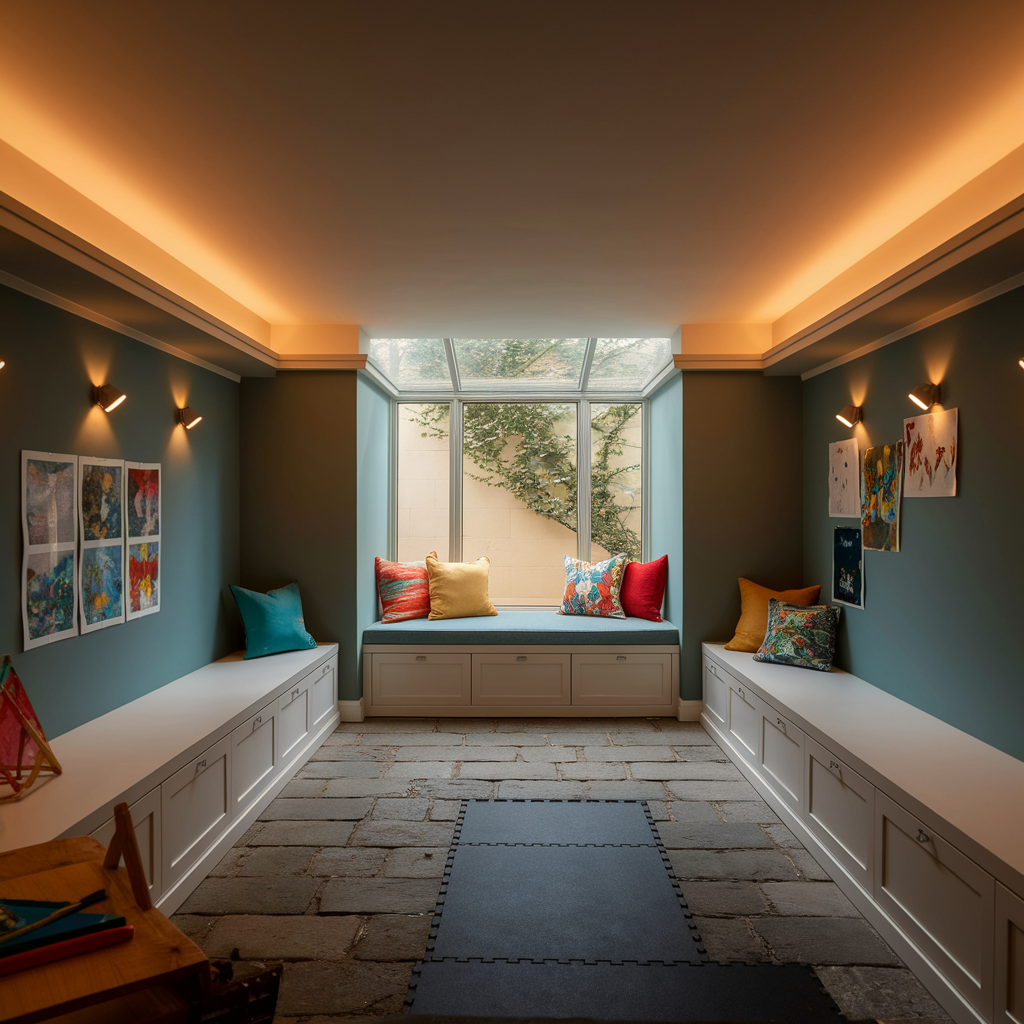
The front section, where the lightest comes through the lightwell below the front bay window, became the calmer zone: a low built-in seating unit with upholstered cushions, a small table for drawing and making, and wall-mounted shelving for books. This is the zone that works for reading, for Lego that needs to stay in place, for the quieter activities that require a surface and a seat.
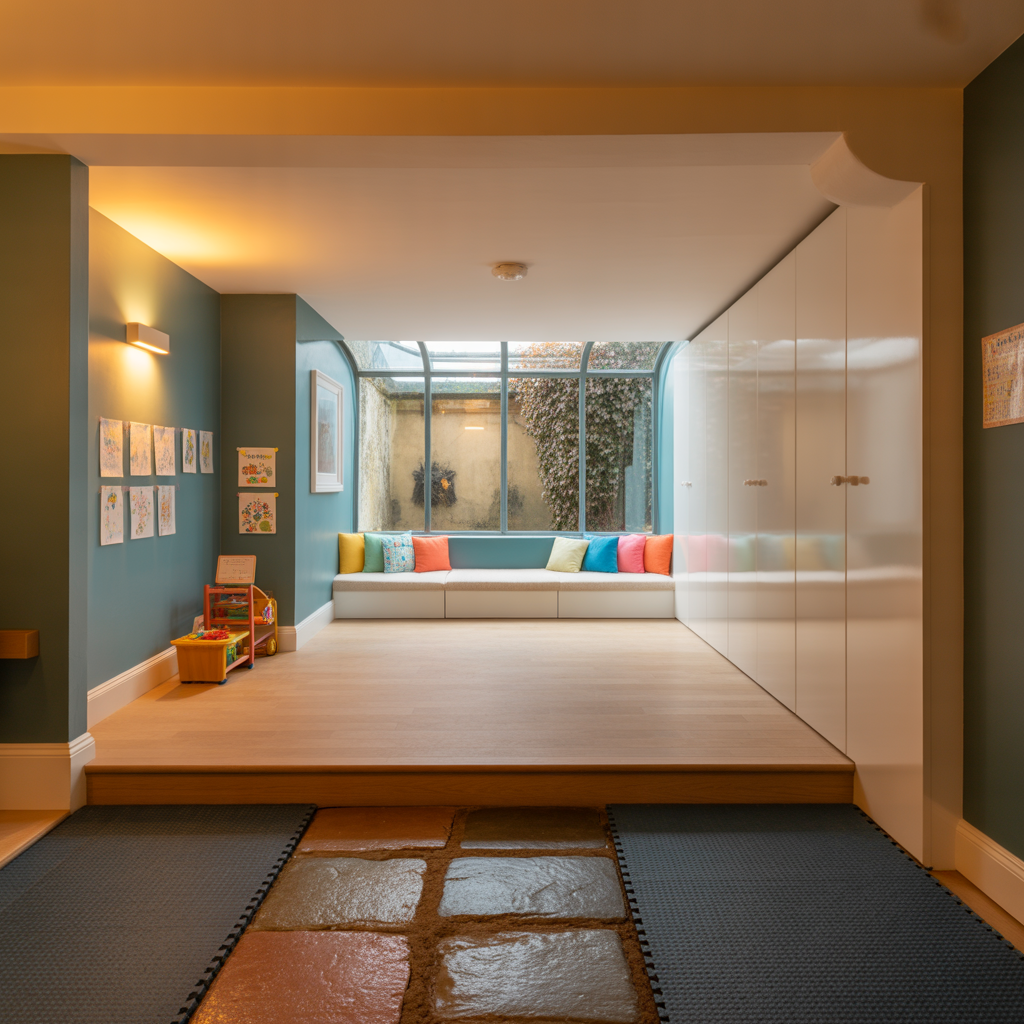
The main section is the activity zone: a large open floor area for building, running, tumbling, and whatever game is current. A fixed table tennis table could go here. A projector screen pulls down from the ceiling at the far end. The floor is entirely clear of furniture, which means the space is genuinely available for whatever the children decide to do with it.
Along one wall, a long run of built-in storage — floor-to-ceiling, painted to match the walls, with a combination of open shelving at accessible heights and closed cupboards at the top — contains everything without displaying everything. The principle is that the storage is large enough that there’s always somewhere to put things away properly, which makes tidying a realistic rather than aspirational proposition.
The Lightwell: Bringing Daylight Underground
The single most significant design decision was the lightwell. The front of the basement sits below the front garden of the house — a small but usable garden behind the original iron railings. Excavating a lightwell approximately 1.2 metres wide and 1.5 metres deep immediately in front of the basement window brought the window from a small high-level opening admitting a slice of light near the ceiling to a full-height window looking onto a small external space.
The lightwell itself was designed rather than simply excavated. The walls are rendered and painted white to maximise light reflection. A drain in the base keeps it clear of standing water. The opening at garden level is protected by a steel grille — flush with the garden surface, hinged for access, and designed to take the weight of adults walking over it. A climbing plant — a jasmine — was trained against one wall of the lightwell to soften the concrete character and give the children something living to look at from below.
The window itself was replaced with a larger, double-glazed unit that opens inward for ventilation — a building regulation requirement for basement habitable spaces — and allows some level of emergency escape access if needed. The transformation in the quality of light in the front section of the basement was dramatic. What had been a gloomy storage room feels, with the lightwell, like a proper room with natural light.
Flooring: Working With What Was There
The Victorian stone flags were the best thing in the basement and the decision to keep them was right. Cleaned, sealed, and in a few places relevelled where the stone had settled unevenly over 140 years, they read as what they are — beautiful original material in a Victorian house — and they give the playroom a quality of permanence and character that no new flooring could match.
The disadvantage of stone flags in a playroom is obvious: they’re hard and cold underfoot. The solution was rubber matting in the activity zone — commercial-grade, interlocking tiles in a dark charcoal — which sits over the stone and provides the cushioning and thermal comfort that a high-activity children’s space needs. The mat is removable: when the children are older and the space changes its function, the mat comes up and the stone flags are there unchanged beneath it.
In the seating zone, a large wool rug over the stone provides warmth underfoot without covering the stone permanently.
Underfloor heating — a wet system, running from the house’s central heating — was installed beneath a screed in the main section where the stone flags had to be lifted for the drainage work required by the cavity membrane system. In the front section where the flags were in better condition and could be retained without lifting, a low-profile electric mat provides supplementary warmth. The combination means the floor is warm throughout the day during the colder months — essential in a basement, where the temperature without heating is consistently lower than the floors above.
Colour, Lighting, and the Things That Make It Feel Like Somewhere
The walls are painted in a mid-toned blue-green — the kind of colour that reads as slightly adventurous without being aggressive, that provides a backdrop for the children’s artwork and the toys and the activity without asserting itself too strongly. It’s a colour that will still work when the youngest is fifteen. The ceiling is white, which lifts the slightly lower ceiling height without fighting against it.
The feature wall in the activity zone — the wall against which the projector screen unrolls — is painted in a deeper version of the same blue-green family, almost a teal, which gives the zone visual definition and works as the cinema backdrop when the screen is in use.
The built-in joinery is painted in the same off-white as the ceiling throughout, which makes it read as part of the architecture rather than as furniture. This is the detail that makes built-in storage look different from freestanding — the continuity of colour between the storage and the walls and ceiling absorbs it into the room rather than announcing it.
Lighting is layered. Recessed downlights provide the general ambient, on a dimmer. A linear LED strip runs behind a batten at high level around the perimeter of the main zone, providing an indirect wash of light that gives the space a warmth in the evening that downlights alone can’t produce. Individual reading lights are mounted on the wall above the seating zone. And the projector ceiling mount has its own circuit — when the screen is down and the projector is on, the downlights dim automatically and the perimeter lighting provides the low ambient that a cinema experience needs.
What the Children Did With It
The moment the room was handed over was one of those project completions that stays in the memory. Three children, in descending order of age, walked down the stairs and looked at the room for approximately four seconds before the four-year-old ran for the open floor space and the other two started arguing, pleasantly, about which end of the room was better.
By the end of the first week, the drawing table had been colonised by the eldest for her art projects. The youngest had established a dinosaur zone in the far corner of the activity space that nobody was permitted to enter. The projector had been used for a family film night that the clients described, somewhat emotionally, as the best evening they’d had in the house.
The room has been in continuous use since. The dinosaur zone has been replaced twice — once by a Minecraft building zone and once, most recently, by what is apparently a bakery. The drawing table is still the eldest’s. The middle child uses the open floor for everything.
A playroom designed to grow with children doesn’t stay the same. That’s how you know it worked.