Table of Contents
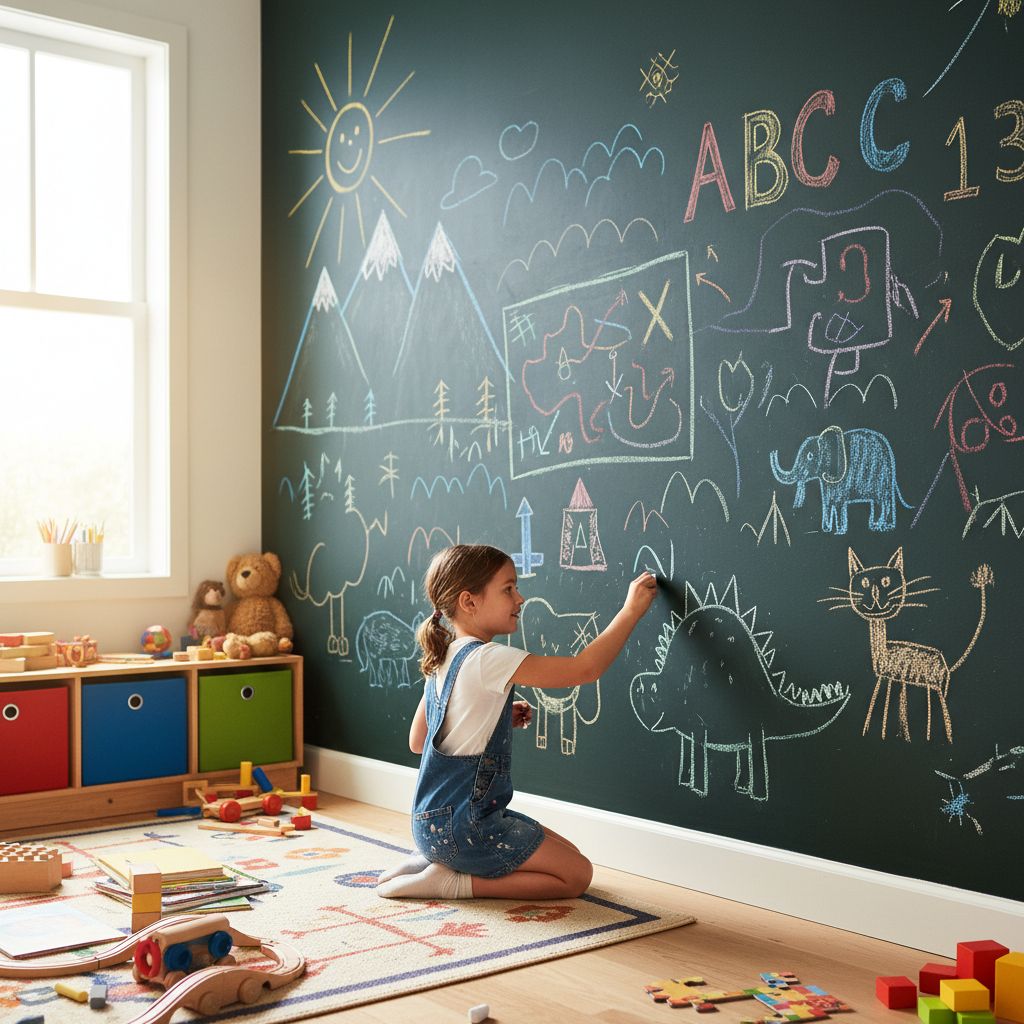
Chalkboard walls for playroom spaces have been a fixture of family interior design for the better part of two decades now, and they’ve earned their place in the conversation for good reasons. They’re interactive, they encourage creativity, they give children genuine ownership of a wall surface in a way that framed prints and careful displays don’t. And they’re relatively inexpensive to do. Put all that together and it’s easy to see why they appear in so many playroom mood boards and finished project photographs.
What the mood boards don’t show is the chalk dust settling on the floor. Or the moment two children disagree about whose drawing occupies which section of the wall. Or the gradual greyness that an intensively used chalkboard wall develops after eighteen months of enthusiastic use and imperfect cleaning. Or the realisation that your seven-year-old has moved on from chalkboard drawing entirely and now wants a wall with a projector screen.
None of these things make a chalkboard wall a bad idea. They make it a decision worth thinking about carefully — which is a different thing. Here’s an honest account of the genuine advantages, the genuine disadvantages, and what determines whether a chalkboard wall is right for a specific playroom.
The Case For: Why Chalkboard Walls Work
They give children creative ownership of a space. This is the most compelling argument, and it’s a genuinely strong one. Children who have a wall they’re permitted to draw on — without restriction, without the anxiety of marking something they shouldn’t — relate to that space differently. It’s theirs in a tangible, expressive way. The freedom to draw on a wall, which is one of the instinctive impulses in children and one of the things adults spend a great deal of time discouraging, being legitimised and given a specific place is psychologically valuable in a way that’s hard to replicate with other design choices.
They change. A chalkboard wall is never the same twice. The drawing that’s there today will be erased and replaced tomorrow. This mutability is one of the things that makes it interesting to children over time — unlike a painted mural, which looks the same from day one to year five, a chalkboard wall is a living surface. For some children, and in some households, this ongoing change is genuinely engaging for years.
They’re educationally useful. Beyond freeform drawing, a chalkboard wall is a practical learning surface. Spelling, numbers, maps, diagrams — the kind of informal, low-stakes practice that happens naturally when there’s a convenient large surface to write on. Older children use chalkboard walls for brainstorming, for working through problems, for writing out things they’re trying to remember. This use case tends to become more relevant, not less, as children get older.
They’re relatively cheap and reversible. Chalkboard paint is inexpensive. Application requires preparation but no specialist skills. And if it’s no longer wanted, a chalkboard wall can be painted over — it takes a couple of primer coats but it’s achievable. Compared to tiling, panelling, or other permanent wall treatments, chalkboard is a low-commitment investment. The reversibility argument is particularly relevant in rented properties where permanent changes aren’t an option.
They photograph beautifully. This is a more frivolous advantage but worth acknowledging. A chalkboard wall with children’s drawings on it is one of the most reliably charming interior photographs available. If the playroom is going to be documented or shared, the chalkboard wall delivers reliably.
The Case Against: What Nobody Puts in the Mood Board
Chalk dust is real and it goes everywhere. This is the most consistent complaint from families who’ve lived with chalkboard walls for any length of time. Chalk dust settles on floors, on furniture, on shelving, on anything stored near the wall. In a room used frequently, and by enthusiastic chalk users, the dust accumulation is significant enough to require regular cleaning of the surrounding surfaces as well as the wall itself. For families with children who have dust allergies or respiratory sensitivities, a chalkboard wall in a frequently used room can be a genuine problem.
Some of this is mitigated by the quality of chalk used — dustless chalk formulations produce considerably less airborne dust than standard chalk — and by the ventilation of the room. But it doesn’t eliminate the issue. Anyone who tells you a chalkboard wall in a children’s room produces no dust hasn’t lived with one.
Cleaning is less satisfying than it looks. The fantasy of chalkboard cleaning is a clean sweep with a wet cloth that returns the surface to pristine black, ready for the next masterpiece. The reality is that chalk residue builds up over time, particularly in the grain of the chalkboard surface, and regular wet cleaning produces a grey ghosting effect rather than a clean surface. Periodic deep cleaning with a proper chalkboard cleaner helps, and re-seasoning the surface — rubbing with the flat side of a chalk stick and then erasing — can restore more of the original quality. But a heavily used chalkboard wall that’s a year or more old rarely looks as good as it did on day one, and that gradual deterioration can be disheartening.
The space management is more complicated than it sounds. A single chalkboard wall shared by two or more children of different ages and different temperaments involves negotiation. The five-year-old’s careful drawing gets erased by the eight-year-old who wants the whole wall. The eight-year-old’s complex map gets rubbed out by accident. These conflicts aren’t unique to chalkboard walls — siblings conflict over shared resources generally — but they are a real feature of shared chalkboard walls that the single-child household mood board doesn’t capture.
It anchors the room to a specific phase. A chalkboard wall that reads as a brilliant feature for children aged four to eight becomes less relevant for a ten-year-old whose interests are screen-based, and slightly embarrassing for a fourteen-year-old. The wall can be painted over, but it’s an additional project at a point when the family’s attention is elsewhere. A more neutral wall treatment in the first place might serve longer without requiring intervention.
Not all rooms suit the aesthetic. Chalkboard paint — typically a very dark green-black — is a strong visual element in a room. In a small playroom, a full wall in chalkboard creates a dark anchor that makes the space feel smaller. In a room with limited natural light, a dark chalkboard wall can make the quality of light uncomfortable. The aesthetic works best in rooms with good natural light, where the chalkboard wall is one strong element within a balanced palette rather than the dominant surface.
Doing It Properly: The Specification Matters
If the decision is to go ahead with a chalkboard wall, how it’s done significantly affects how it performs.
Surface preparation is everything. Chalkboard paint applied over an improperly prepared surface — one that’s dusty, slightly damp, or has a sheen from previous paint — doesn’t bond correctly and will produce a surface that deteriorates faster and cleans less well. The wall should be cleaned, sanded lightly if there’s any gloss, primed if the surface is porous, and allowed to dry completely before any chalkboard paint is applied.
The quality of the paint matters. Chalkboard paints vary considerably in performance. The cheaper products produce a surface that feels slightly rough and chalky, cleans poorly, and deteriorates faster. Better-quality chalkboard paints — including those marketed specifically for interior use in high-traffic areas — produce a smoother, denser surface that holds up better to intensive use and cleans more completely. The price difference is modest relative to the overall project cost and worth paying.
Two or three thin coats rather than one thick one. Each coat should be fully dry before the next is applied, with a light sand between coats to keep the surface flat. The final coat should be left to cure for the full time recommended by the manufacturer — typically twenty-four to seventy-two hours — before use. Applying chalk before the surface is fully cured produces a surface that never cleans properly thereafter.
Season the surface before first use. Before the first drawing goes on, the surface should be seasoned: rub the flat side of a chalk stick across the entire surface and then erase completely. This fills the grain of the surface evenly and prevents the first drawings from leaving a permanent ghost. It’s a ten-minute job that makes a significant difference to how the surface performs long-term.
Consider the chalk type. Standard school chalk is cheap and widely available but produces significant dust. Dustless chalk — formulated to bind the particles so they fall rather than become airborne — is a modest additional expense that meaningfully reduces the dust problem. Liquid chalk markers, which are sometimes used on chalkboard surfaces, produce less dust but can be harder to erase completely and may require a specific cleaner.
The Compromise Positions
For families who want the creative engagement of a chalkboard surface without committing the whole wall, there are halfway positions worth considering.
A chalkboard panel rather than a full wall. A section of chalkboard — perhaps 1.2 metres wide and full height, framed out in timber to give it a defined boundary — provides a substantial drawing surface without the full visual and practical commitment of a whole wall. The framing defines it as a specific zone rather than a general surface, which can also help with the space negotiation between siblings.
A chalkboard table surface. A table painted in chalkboard paint — or a purpose-made chalkboard table — provides a horizontal drawing surface that produces less airborne dust (because gravity helps keep chalk on the surface rather than in the air) and that can be moved or replaced when it’s no longer wanted. For younger children in particular, a horizontal surface is often more natural than a vertical one.
Chalkboard paint on a single door. Painting a door in chalkboard paint gives children a drawing surface that’s bounded, obvious, and easily explained. It’s also a surface that can be closed and therefore hidden when guests arrive, which some adults find more comfortable than a wall of children’s drawings visible from the hallway.
Alternating between a chalkboard section and a display section. Half wall in chalkboard, half wall in a pinboard or display surface — a combination that gives both a creative drawing surface and a space for displaying finished work, photographs, and things the children want to keep visible. The two surfaces serve different creative purposes and together cover more of what a playroom wall might reasonably be asked to do.
The Verdict
Chalkboard walls for playroom spaces are a genuinely good idea for some families in some rooms, and a decision that creates more maintenance and more conflict than it was worth for others. The families who get the most from them tend to be those with younger children, rooms with good natural light, one or two chalk enthusiasts rather than a group of competitors for the surface, and a realistic tolerance for the cleaning regime that heavy chalk use requires.
The families for whom it works less well tend to have older children who’ve outgrown the drawing phase, rooms where another dark wall surface makes the space feel smaller or darker than it should, or dust sensitivities that make the chalk environment uncomfortable.
Go in with clear eyes about both sides of the equation. It’s an inexpensive enough decision that getting it slightly wrong isn’t a disaster — but getting it right from the start, by understanding whether the household’s specific circumstances suit a chalkboard wall, is better.