Table of Contents
Reviving a Victorian hearth to add authentic character and warmth to a period home is, in our experience, one of the projects that people feel most strongly about once it’s done — and most regretful about having neglected for so long. There’s something about a Victorian fireplace, properly restored and properly lit, that changes the fundamental character of the room it’s in. Not just the warmth, which is real, but the focal point it creates, the quality of light when a fire is burning, and the sense of continuity with the generations of people who sat around it before you.
The Victorian hearth is fundamentally different from its Georgian predecessor in philosophy and in form. Where the Georgian fireplace was a classical architectural statement — restrained, proportional, drawing on continental precedent — the Victorian hearth reflects a period that was simultaneously industrial and romantic, that combined mass production with a genuine enthusiasm for ornament, and that produced fireplaces with a richness and variety that was new in domestic architecture. By the 1870s and 80s, a middle-class Victorian household could choose from hundreds of cast iron grate designs, dozens of tile patterns, multiple surround styles in painted timber, marble, slate, or combinations thereof. The variety is extraordinary, and surviving examples of the full range are still findable.
Many homeowners are rediscovering the charm of reclaimed fireplaces, not just for their vintage character but for the way they instantly give a room a sense of history. There’s something grounding about installing a piece that has already lived a life elsewhere — it softens modern spaces in a way new fixtures rarely can.
The Victorian Fireplace: What It Consists Of
Understanding the constituent elements of a Victorian hearth makes the assessment and restoration process considerably more logical.
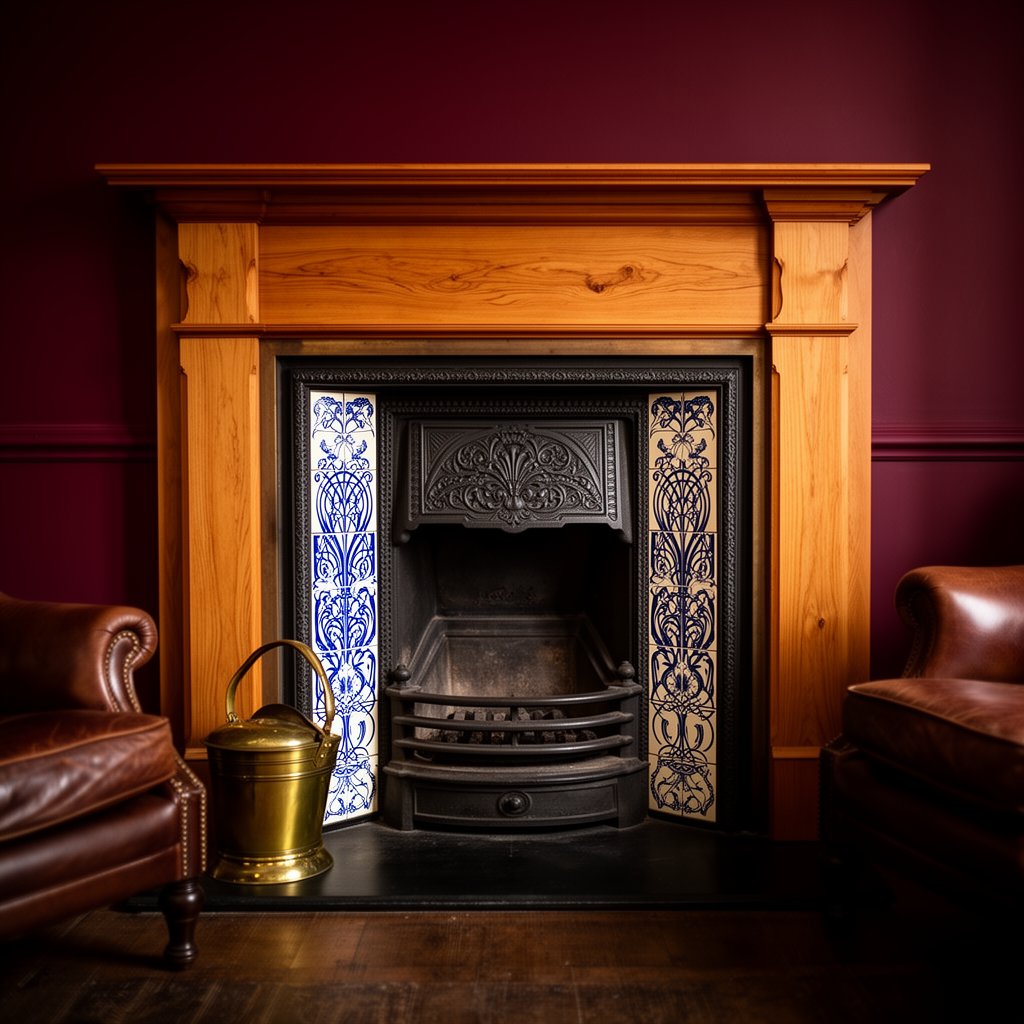
The surround is the decorative frame — in timber, marble, or slate — that encloses the fireplace opening. In grander Victorian rooms, marble surrounds with carved ornament continue the tradition established in the Georgian period. In most middle-class Victorian properties, the surround is timber — often pine, painted in gloss — with a shelf, pilasters, and a frieze. Later Victorian and Edwardian surrounds sometimes incorporate tiles into the surround itself, particularly on the pilaster faces.
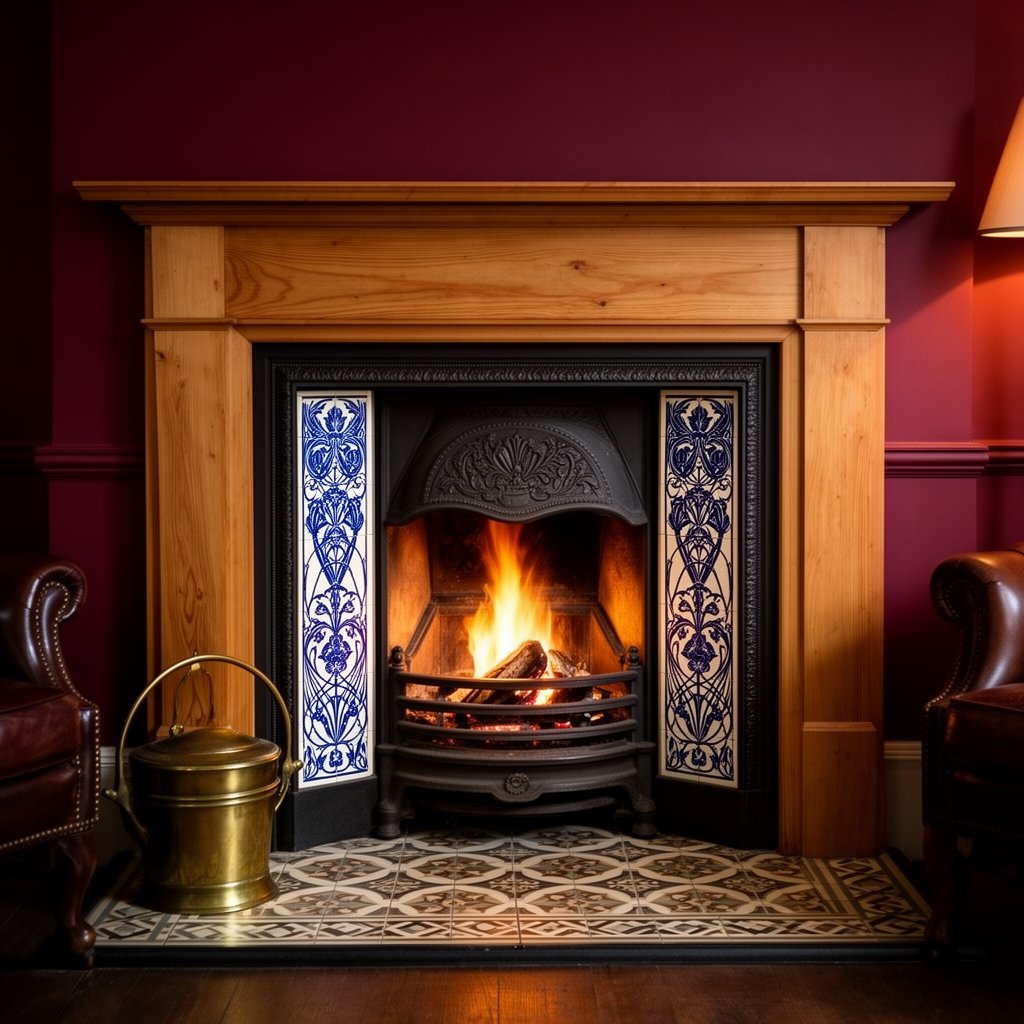
The register grate or combination grate sits within the opening, filling the fireplace from the hearth to the throat. Unlike the Georgian hob grate, which was freestanding in the opening and relatively shallow, the Victorian register grate fills the opening completely. It typically consists of a cast iron frame with decorative cheeks, a central fire basket, an ash pan below, and a register plate above that closes off the chimney throat when the fire is not in use. The cheek panels on either side of the fire basket are usually decorative — cast with Gothic, Aesthetic Movement, or Art Nouveau ornament depending on the period — and are the element most likely to be cracked or damaged.
The tiles — typically 6-inch square ceramic tiles lining the cheek panels either side of the fire basket — are one of the most distinctive elements of the Victorian hearth. Transfer-printed, hand-painted, or embossed and glazed, they came from potteries across the Midlands and are still made in period styles by several manufacturers. The patterns range from simple geometric repeats to elaborate pictorial scenes, botanical studies, and Aesthetic Movement blue-and-white designs.
The hearth itself — the tiled or stone surround at floor level that extends in front of the fire opening — is typically in encaustic tiles or plain quarry tiles in Victorian properties, sometimes extended to form a decorative tiled hearth rug pattern in higher-quality installations.
Assessing What Has Survived
Before any restoration work begins, the condition of all elements needs to be assessed, and any missing elements identified.
Surrounds are the most likely element to have survived intact, even where everything else has been removed or blocked. A timber Victorian surround that’s been painted over multiple times may look unpromising — the profiles blurred, the details indistinct — but the underlying timber is often in excellent condition. Stripping paint from a Victorian timber surround reveals the quality of the original joinery in a way that’s genuinely surprising.
Where surrounds have been removed entirely, the chimney breast usually survives as a plastered rectangle, and sourcing a period replacement is the first task. Architectural salvage dealers across the UK hold large stocks of Victorian surrounds in all sizes and styles. The key measurement is the width and height of the fireplace opening — surrounds need to be specified for the correct opening size, not simply chosen for their appearance.
Register grates are more likely to have been removed than surrounds. Where a gas fire has been installed, the original grate almost certainly came out. Where the fireplace was simply blocked and left, the grate sometimes survives behind the boarding, though it may be in poor condition after decades in a damp, unventilated chimney.
Tiles are frequently cracked, missing, or replaced with inappropriate modern tiles. Original Victorian tiles that survive in place — even those with hairline cracks — should be conserved rather than replaced where possible. Original tiles have a glaze character and slight irregularity that reproductions approximate without fully matching.
Stripping and Restoring the Timber Surround
A painted Victorian timber surround is usually in better structural condition than it looks. The timber — typically pitch pine or good-quality deal in Victorian properties — is dense and durable, and paint, however many coats have accumulated, protects the wood beneath from mechanical damage.
Chemical stripping is the most effective method for removing multiple paint layers from the complex profiles of a Victorian surround. The stripper is applied generously, left to work for the time specified, and then removed with wooden tools — never metal scrapers, which will gouge the soft timber profiles. Multiple applications are usually needed, and the final residue in the smallest moulding details needs to come out with fine brushes and wooden skewers rather than tools. Full neutralisation of the chemical stripper before any new finish is applied is essential.
Once stripped, the timber needs inspection for any woodworm or fungal damage — unlikely if the surround has been in a continuously occupied room, more possible if it’s been in storage or in a damp environment. Active woodworm should be treated; old, inactive flight holes are simply part of the history and don’t need treatment.
The finish on a restored Victorian timber surround should be oil-based paint — either a modern alkyd or a true oil formulation — applied over an appropriate primer and undercoat. A semi-gloss or gloss finish is historically correct and produces the right visual effect. Matt paint on Victorian joinery always looks slightly wrong — the period expected a degree of reflectiveness that matt paint doesn’t provide.
The Register Grate: Restoration and Sourcing
A Victorian register grate in reasonable condition — surface rust, old deposits, perhaps a cracked cheek panel — can be brought back to excellent condition with the right approach.
Surface rust on cast iron is addressed first with mechanical cleaning — wire brushing to remove loose scale and rust — followed by a rust converter where necessary. The decorative cast panels need careful wire brushing by hand rather than with power tools, which risk breaking the relatively thin castings.
Cracked panels are the most common structural problem. Cast iron welding is possible but requires a specialist who understands the brittle nature of cast iron and the need to pre-heat and post-heat the metal to prevent further cracking. For panel cracks that don’t affect the structural integrity of the grate, a cast iron repair product (typically a high-temperature epoxy or graphite-loaded filler) is a practical alternative to welding.
Traditional black grate polish — applied with a brush, left to dry, and then buffed to a shine — produces the characteristic appearance of a well-maintained Victorian grate. This finish needs periodic reapplication, but the process takes minutes and the result is exactly correct for the period.
Where the original grate is missing or beyond economic repair, sourcing a period replacement through architectural salvage is the right approach. Victorian register grates were made in standard sizes — the width being the critical measurement — and a patient search through salvage dealers will almost always produce a suitable match.
Tiles: Conservation and Replacement
Victorian hearth tiles are among the most distinctive period interior elements in British housing and deserve careful treatment.
Original tiles still in place should be conserved wherever possible. Cracked tiles that are stable can stay — the cracks add to rather than detract from the authentic character of the installation. Loose tiles can usually be re-bedded using a heat-resistant adhesive formulated for use near fire openings. Cleaning original tiles requires a mild, pH-neutral cleaner that won’t attack the glaze — avoid anything acid-based, which will permanently etch Victorian tile glazes.
Where tiles are missing or damaged beyond conservation, the approach depends on how many are affected. A few missing tiles in an otherwise intact set can be matched — period tile suppliers and architectural salvage dealers both carry stocks of original Victorian tiles, and matching the pattern, size, and glaze colour, while it takes time, is usually achievable for common patterns. For a complete re-tiling, reproduction tiles in appropriate Victorian designs are available from several UK manufacturers and produce a very good result.
The hearth floor — where original encaustic or quarry tiles have survived — should be cleaned and sealed rather than replaced. Original Victorian encaustic hearth tiles have a material depth and colour that reproductions don’t fully match, and their survival is worth protecting.
Reinstating the Fire
If the intention is to use the restored Victorian hearth as a working fire rather than a purely decorative element, the chimney needs inspection and potentially lining before any fire is lit.
A HETAS-registered sweep and inspector can assess the condition of the flue — checking for structural integrity, adequate draw, and any debris or obstructions. A clay or pumice liner installed within the existing flue brings it up to current standards for solid fuel or wood burning and significantly improves the fire’s performance.
For wood-burning use, a small enclosed stove fitted within the Victorian register grate opening is one option — efficient and safe, though it conceals the open fire that is integral to the Victorian hearth aesthetic. An open basket grate burning seasoned wood or smokeless fuel is more authentic in appearance but less thermally efficient. Local authority regulations on solid fuel burning — particularly in Smoke Control Areas, which cover most urban areas in England — need to be checked before using open fires.
For a decorative fireplace that isn’t to be used, capping the chimney against rain and birds while maintaining some ventilation through the fireplace opening prevents the damp and chimney smell problems that a completely sealed flue develops over time.
The Room Around the Hearth
A restored Victorian hearth changes the room it’s in, and the room around it needs to respond to what it’s now offering. The proportions of Victorian fireplaces — the height of the surround, the width of the chimney breast, the visual weight of a dark cast iron grate — suggest certain things about how the walls, the floor, and the furnishings should relate to them.
Strong wall colour on the chimney breast — something that gives the fireplace a backdrop of appropriate depth — is almost always right. A pale or neutral chimney breast wall makes a Victorian fireplace look orphaned rather than grounded. Deep greens, rich navies, burgundies, dark terracottas — these are colours that existed in Victorian interiors and that give the hearth the visual context it needs.
The furniture arrangement should acknowledge the fireplace as the focal point it was designed to be. Seating facing the fire, occasional tables within arm’s reach of the primary seats, a mirror or artwork above the mantel shelf at the correct height — these are the spatial decisions that complete the picture the Victorian hearth was always intended to create.