Table of Contents
Restoring a Georgian fireplace to bring back true architectural grandeur is, when you approach it properly, one of the most rewarding projects available in a period house. Georgian fireplaces occupy a particular position in the history of interior architecture — they were designed not merely as functional heating appliances but as the principal architectural statement of a room, the element around which everything else was composed. The proportions, the materials, the restrained classical ornament — all of it was considered as part of a coherent visual language that the great pattern book writers of the eighteenth century had codified and disseminated across the country.
When that language is recovered — when the layers of paint come off, the broken elements are reinstated, and the fireplace is returned to something like its original condition — the effect on a room is extraordinary. A Georgian fireplace isn’t just a good-looking piece of furniture. It’s an architectural armature that organises the entire room around it, that gives the space its formal logic and its sense of considered proportion.
What Georgian Fireplaces Actually Are
Understanding the type before starting the restoration is essential, because Georgian fireplaces span a century of stylistic development — from the Baroque heaviness of the early eighteenth century through the Palladian refinement of the mid-century to the Neoclassical delicacy of the Adam period and its followers — and the approach to restoration differs depending on what you’re working with.
Early Georgian fireplaces — roughly 1714 to 1750 — tend to be substantial and architecturally assertive. Surrounds in stone or marble with bold bolection mouldings, heavy cornices carried on console brackets, overmantels sometimes incorporating broken pediments and carved figures. The scale is significant: these fireplaces were designed for rooms with ceiling heights of three metres and above, and they read as architecture rather than furniture.
Mid-Georgian work — 1750 to 1775 — reflects the influence of Palladianism: more restrained, more precisely proportioned, the ornament becoming less exuberant and more disciplined. Marble surrounds with fluted columns or pilasters, plain friezes or those with simple geometric enrichment, overmantels that integrate mirrors and architectural framing.
Late Georgian and Regency fireplaces — 1775 to 1830 — are often the finest in terms of craftsmanship and the most delicate in terms of ornament. The Adam style, and the Soane and Hope variations that followed, produced fireplace surrounds of extraordinary refinement: white statuary marble carved with festoons, paterae, and urns; Coade stone enrichments of extraordinary delicacy; composition ornament applied to timber surrounds and painted to resemble stone. The proportions are slender and vertical compared to the heavier early Georgian work.
Assessing the Condition
Before any work begins, a methodical condition assessment determines what’s actually needed. Georgian fireplaces typically present with one or more of the following issues.
Paint. Marble fireplaces in particular have frequently been painted — either because a previous owner disliked the appearance, because the marble was stained or damaged and painting seemed easier than restoration, or simply because the whole room was painted over including the fireplace surround. Marble that’s been painted can usually be restored: the paint comes off, and the stone beneath, though it may need cleaning and polishing, retains its essential character.
Damage. Broken sections of carved marble or stone, missing elements of applied composition ornament, cracked or replaced sections of the fire surround. Georgian marble is typically a fairly forgiving material to work with — a skilled stone conservator can repair cracks invisibly using colour-matched fill, and cast replacement elements where originals are missing.
Inappropriate alterations. Gas fires fitted in Georgian fireplace openings are extremely common, usually involving the removal of the original cast iron hob grate and the installation of a gas appliance of varying degrees of inappropriateness. The grate removal is usually the most significant loss — original Georgian hob grates are relatively rare in good condition, and finding a matching replacement requires time and patience at the architectural salvage market.
Blocked or removed surrounds. In properties that have been through commercial or institutional use, Georgian fireplaces sometimes survive only as chimney breasts with the opening blocked and the surround removed. Reinstatement in this situation is a different project — one of sourcing an appropriate period surround and reinstating the opening correctly — but entirely achievable with the right salvage network and a builder competent in masonry.
Restoring Marble: The Right Approach
Marble restoration is specialist work, and the temptation to attempt it with products available from a hardware store should be firmly resisted. The wrong chemical on marble produces permanent damage — etching, staining, or surface deterioration that cannot be corrected.
Paint removal from marble starts with a poultice — an absorbent material mixed with a paint-stripping agent that’s applied to the surface and left to draw out the paint as it dries. Multiple applications are typically needed for heavy paint build-up. The process is slow but safe, and avoids the mechanical abrasion that would damage the polished surface.
Once paint is removed, the marble surface is assessed for staining and surface condition. Water staining, smoke deposits, and old wax residues all respond to different treatments. A conservator will work through a cleaning sequence — starting with the mildest effective treatment and progressing only as far as necessary — that brings the surface back without risking further damage.
Re-polishing follows cleaning where the surface has been dulled by years of use, cleaning with abrasive products, or mechanical damage. The re-polishing sequence for marble involves a progression of diamond pads or abrasive papers of increasing fineness, followed by polishing compounds, and ending with a fine crystallisation treatment that restores the characteristic shine of polished marble. Done by someone who knows what they’re doing, the result is a surface that’s genuinely difficult to distinguish from new marble.
Cracks and chips are filled with colour-matched two-part epoxy or polyester filler, applied carefully, cured fully, and then abraded back flush with the surrounding surface before polishing. The colour matching is the skilled part — the filler needs to match not just the base colour of the marble but the veining and tonal variation. A skilled stone restorer does this from experience and by eye; the results in skilled hands are effectively invisible.
The Hob Grate: Heart of the Georgian Fireplace
The cast iron hob grate is the defining functional and visual element of the Georgian fireplace opening. Unlike Victorian grates, which fill the opening, Georgian hob grates have a central fire basket flanked by flat hob surfaces — useful originally for keeping kettles and pots warm — with decorative cheeks either side. They’re relatively narrow, fitting within the fireplace opening and leaving the marble surround visible on both sides.
Original Georgian hob grates in good condition are available through architectural salvage dealers and specialist period fireplace suppliers. The key measurements are the opening width and height — Georgian openings vary considerably depending on the room and the period, and the grate must fit the opening correctly, not approximate it. A grate that’s too small looks lost in the opening; one that’s slightly too wide has to be forced in and may damage the surround.
Restoration of an original hob grate in poor condition involves: cleaning to remove rust and old deposits; repair of any broken sections, which for cast iron typically means welding by a specialist familiar with cast iron’s brittleness and tendency to crack if heated unevenly; and finishing with traditional black grate polish or a heat-resistant paint where polishing isn’t achievable. The decorative elements on Georgian hob grates — the fan-shaped firebacks, the urn finials, the beaded borders — are often still visible through accumulated deposits, and their recovery after proper cleaning is extremely satisfying.
The Overmantel and the Room Above
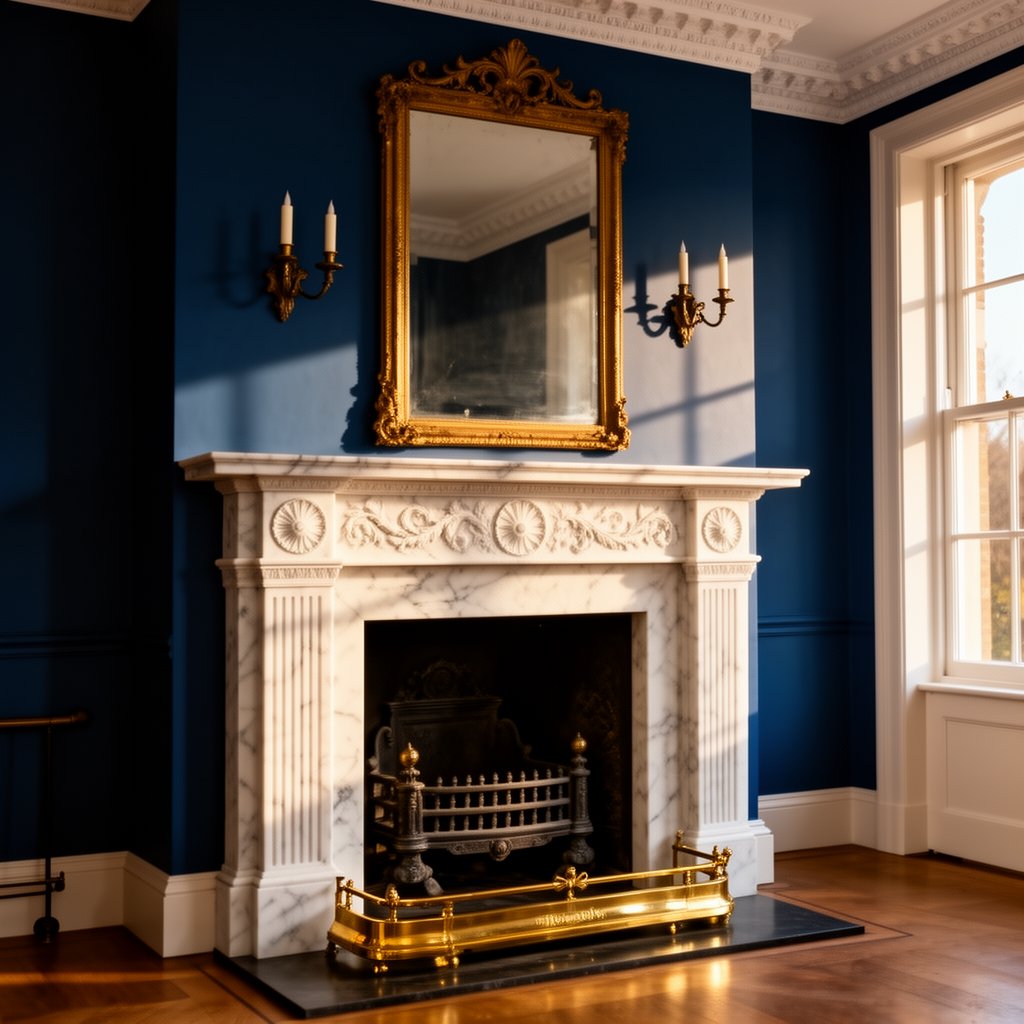
Georgian fireplaces were typically designed as part of a complete chimney breast composition that included not just the surround but the overmantel — the decorative treatment above the mantel shelf extending up to the cornice. In grander houses this might be a full architectural treatment in plaster or timber with pilasters, panels, and a central painting or mirror frame. In more modest Georgian houses it might simply be a carefully composed arrangement of the surrounding plasterwork.
Where the overmantel treatment survives, restoring it as part of the fireplace project is essential — the fireplace and the overmantel are parts of a single composition and should be treated as one. Where it’s been removed or destroyed, reinstatement using period references — pattern books, surviving examples in comparable properties — allows sympathetic reconstruction.
The mirror above the mantel shelf, where appropriate to the period and the formality of the room, is one of the details that makes a Georgian fireplace composition complete. A period mirror — or a well-chosen reproduction in an appropriate frame — placed at the correct height and proportion relative to the mantel shelf and the cornice above transforms the chimney breast from a restored element into a fully realised architectural statement.
Working on Listed Buildings
Most Georgian houses with original interiors are listed, and any restoration work to original fabric requires careful navigation of the consent process. Repairs carried out on a like-for-like basis using matching materials are generally acceptable without formal Listed Building Consent. The replacement of original material — even in kind — may require consent. The removal and reinstatement of a fireplace surround for restoration work is an area where the local conservation officer should be consulted before work starts.
Historic England’s guidance on works to listed buildings is at historicengland.org.uk/advice/your-home/owning-historic-property and is the appropriate reference for understanding consent requirements.
The restriction isn’t merely bureaucratic. The consent process for listed buildings is designed to ensure that significant historic fabric is preserved and that restoration work is carried out to an appropriate standard. For a Georgian fireplace of any quality, the conservation officer is a resource as much as a gatekeeper — experienced officers have seen a great deal and can provide useful guidance on appropriate approaches and suitable specialist craftspeople.
The Result
A restored Georgian fireplace, returned to something close to its original condition and properly integrated back into the room it was designed to anchor, produces an effect quite different from a modern fireplace however well designed. It has the quality of authority — the sense that this room has been here, with this level of considered architectural detail, for a very long time. That quality doesn’t come from reproduction or pastiche. It comes from the original, properly conserved. There’s no substitute for it.