Table of Contents
Understanding authentic ways to restore mouldings, cornices and traditional joinery is the difference between a period renovation that genuinely honours the original building and one that superficially references it while quietly undermining what made it special. The mouldings, cornices, and joinery in a Victorian or Edwardian house aren’t decorative add-ons — they’re integral to the architecture, the thing that gives these buildings their proportional logic and their sense of craft. Get the restoration right and the building reads as it was intended to read. Get it wrong, or simply replace original work with modern approximations, and the building loses something that’s genuinely difficult to recover.
The distinction worth making upfront is between conservation — the careful maintenance and repair of original material — and replacement. Conservation should always be the first ambition. Original mouldings and joinery, even those in poor condition, have a material authenticity that reproductions don’t possess. The grain of timber sash windows planed and fitted by a Victorian joiner, the crisp edge of a plaster cornice run in situ by a skilled plasterer, the careful mitred joints of an original door architrave — these carry the evidence of their making in a way that modern equivalents, however accurate in profile, don’t fully replicate.
Assessing Original Plaster Mouldings
The first step in any mouldings restoration project is understanding the condition of what’s there. Plaster mouldings — cornices, ceiling roses, dado rails, picture rails — deteriorate in predictable ways, and the approach to restoration varies depending on what’s failed and why.
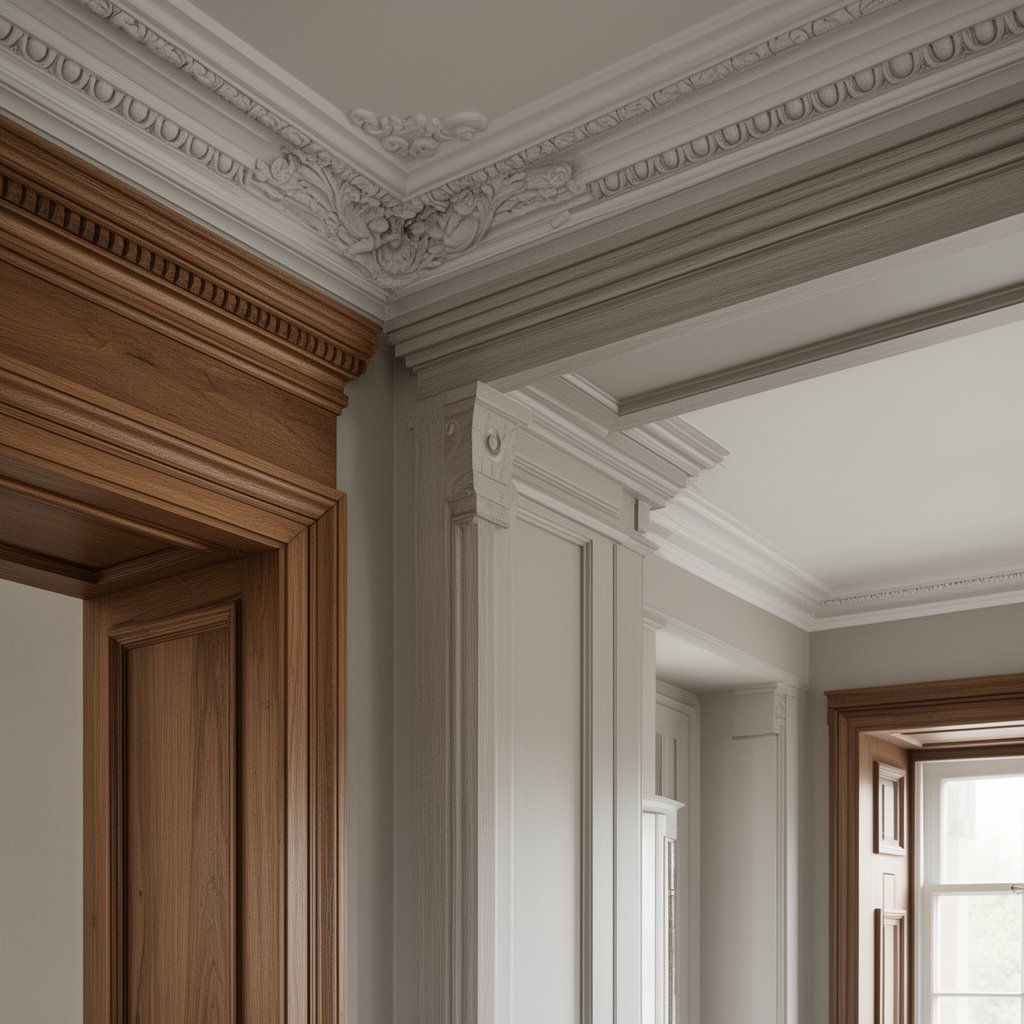
Paint build-up is almost universal in properties that have been inhabited continuously since their construction. Each repaint adds another layer over the plaster profiles, blurring the crisp edges and filling the sharp internal angles that give mouldings their character. In a house with 120 years of repainting history, the accumulated paint build-up can be several millimetres thick — enough to significantly reduce the visible depth and detail of even a fairly robust Victorian cornice.
Stripping paint from plaster mouldings requires either steam, chemical strippers, or hand removal with wooden tools and fine brushes — the same approaches used for ceiling restoration. The choice depends on the paint types present and the fragility of the plaster beneath. Steam works well on many paint types but requires care not to over-wet lime-based plasterwork. Chemical strippers need full neutralisation before any new finish is applied. Hand removal is slower but gives the most control on fine or fragile profiles.
Cracks in plaster mouldings are usually the result of movement in the building structure — differential settlement, thermal cycling, vibration. Fine hairline cracks that have been stable for years are often best left alone: they’re part of the building’s history and may not be structural. Widening or active cracks need investigation before repair — understanding what’s driving the movement is essential before sealing the crack, because a repair over an active movement joint will simply crack again.
Running Cornices: The Traditional Method
Where sections of plaster cornice are missing or beyond repair, the traditional approach to replacement is running the profile in situ in lime plaster. This is the technique that produced the original mouldings and it remains the most accurate way to reinstate them.
The process starts with making a running mould — a zinc or thin sheet steel template cut to the negative profile of the cornice. The template is mounted on a wooden stock and fitted with guides that run against a screed fixed to the wall and ceiling surfaces. Wet plaster — traditionally a coarse lime and hair undercoat followed by finishing coats — is applied to the ceiling and wall junction, and the running mould is drawn repeatedly along the screed, cutting away excess plaster and leaving the profile behind.
The quality of the result depends on the accuracy of the template, the quality of the plaster mix, and the skill of the operative. Running a complex Victorian cornice profile — with multiple members, beads, ogees, and sometimes enrichment such as egg-and-dart or dentil courses — requires a level of skill that is genuinely rare. It’s worth spending time finding someone who has actually done this, rather than someone who believes they could.
For shorter missing sections that need to match an existing run, precast plaster sections — cast from a mould taken from the original — are often more practical than running in situ, and the result is effectively identical.
Enrichments and Cast Ornament
The enriched elements of Victorian and Edwardian plasterwork — the applied ornamental details on cornices, the elaborate centre flowers, the plaster friezes with repeating botanical or classical motifs — are cast rather than run. They’re made in moulds and applied to the background plasterwork while it’s still green, keyed in with the background and then finished over.
Where original enrichments survive but are damaged — a section of egg-and-dart missing from a cornice, a petal broken from a ceiling rose — repair by casting is the standard approach. A silicone rubber mould taken from an intact section of the original produces a cast that matches exactly. Where the enrichment is in lime, the cast should be in lime; where it’s a later fibrous plaster repair, casting in fibrous plaster is appropriate.
Where enrichments are entirely missing, matching them requires either finding an original in another room of the house, consulting historical pattern books and trade catalogues from the relevant period (many of which survive in architectural libraries and can be consulted to identify the specific elements used), or working from comparison examples in similar properties of the same era. Period plasterwork suppliers maintain extensive ranges of reproduction enrichments that cover most common Victorian and Edwardian patterns.
Timber Mouldings and Joinery: Conservation Before Replacement
The timber joinery of a period property — the sash windows, the panelled doors, the architraves and skirtings, the dado rails, the staircase with its turned balusters and moulded handrail — is often in better condition than it appears. The typical problems are paint build-up, minor rot in localised areas (particularly at the base of window frames and at sill level), and broken or missing elements. None of these are reasons for wholesale replacement if the timber is otherwise sound.
Paint stripping on timber joinery follows similar principles to plaster work — steam, chemical, or hot air gun depending on the paint type, the timber species, and the profile complexity. For timber specifically, one additional option is caustic-tank stripping: immersing the element in a tank of caustic soda solution that strips paint completely. This works well on simple solid elements like doors but is damaging to joinery with complex glued assemblies — it can open glue joints and cause delamination. It should not be used on sash windows with multiple components.
Once paint is removed from original timber joinery, the quality of what’s beneath is often a genuine revelation. Victorian joinery was typically made in good-quality softwood — often Baltic or Scandinavian redwood — with a tight, even grain that holds paint beautifully and is considerably denser than modern softwood. The profiles of the mouldings, unobscured by layers of paint, have a crispness and precision that confirms they were produced by skilled craftspeople using properly maintained tools.
Repairing Timber Rather Than Replacing It
Where original timber is damaged — split, cracked, affected by localised rot — repair rather than replacement should be the default approach for heritage properties.
Localised rot, typically found at the base of window frames, at sill junctions, and at the foot of external doors, can almost always be repaired rather than replaced. The decayed material is cut back to sound timber, the cause of the moisture (inadequate painting, failed sealant, broken drip detail) is addressed, and the void is filled with a two-part epoxy wood filler. Done properly, with the right primer, filler, and finish, an epoxy repair is extremely durable — more so than a timber splice if the splice joint isn’t perfectly fitted and sealed.
Structural repairs — where significant sections of a sash window box have decayed, or where a door frame is compromised — require timber splices rather than filler. This is mortise-and-tenon, dowelled, or scarf-jointed work depending on the specific situation. The splice material should match the original as closely as possible in species, grain orientation, and density. The joint should be glued with an exterior-grade adhesive and pinned for belt-and-braces security. When finished and painted, a well-executed timber repair is invisible.
Skirtings, Architraves, and Dado Rails
The moulded timber sections that define the rooms of a period property — the skirtings that run at floor level, the architraves that frame the doors, the dado rails at approximately hand height on the wall — are sometimes removed, damaged, or replaced with inappropriate modern profiles during previous renovations.
Where original sections survive, matching any missing lengths requires finding the same profile. If the profile is standard — and many Victorian moulding profiles were standard, produced from the same range of planes and cutters that the trade used across the country — a timber merchant or period joinery specialist may stock it or be able to produce it. Taking a clean section of original to a specialist is the most reliable way to get a match.
Where the profile is non-standard or elaborately moulded, having a purpose-made spindle cutter produced to match the original is the right approach. The cost of a custom cutter is justified where a significant run of moulding is needed — the alternative, building up the profile from multiple standard sections and filling the joints, rarely matches the original cleanly.
The species should match. Original Victorian pine skirtings don’t look right when the replacement sections are in hardwood or MDF, however similar the profile. MDF mouldings are particularly problematic in heritage contexts: the material is dimensionally stable but absorbs moisture at cut edges, produces a different paint surface from solid timber, and lacks the visual quality that period buildings deserve.
The Materials Question
Running through all of the above is a consistent principle: the materials used in restoration work should be compatible with the original, and wherever possible should match it. Lime plaster for lime plasterwork. Appropriate timber species for period joinery. Traditional finishes — limewash, oil-based paint, wax — where the original would have used them.
The compatibility issue is most acute with plaster. Gypsum-based modern plasters applied over original lime substrates, or lime-based repairs applied over hardened gypsum backgrounds, can create differential movement and moisture behaviour that produces cracking, delamination, and ongoing maintenance problems. A specialist plasterer with lime experience will understand this and specify accordingly.
For traditional finishes on joinery, oil-based alkyd paint — whether a modern water-based version or a true oil formulation — produces a harder, more durable, and more authentic-looking finish on period timber joinery than modern emulsion. The surface it produces when properly applied and rubbed down between coats is what period joinery was designed to receive, and it looks right in a way that other finishes don’t quite achieve.
Finding the Right People
Authentic restoration of mouldings, cornices, and traditional joinery is skilled, specialist work. The right people to look for are: traditional lime plasterers with experience of running in-situ work; joiners with experience of period sash windows and panelled doors who understand the construction methods and can repair rather than reflexively replace; and decorators who understand traditional paint systems and surface preparation.
The Society for the Protection of Ancient Buildings publishes guidance on finding craftspeople with traditional skills. The Building Crafts College and a number of specialist training organisations run courses in traditional plastering, lime work, and period joinery that are producing a new generation of practitioners. They’re out there — they just require more searching than the nearest general builder.
For listed buildings, the requirement for Listed Building Consent applies to any works affecting original fabric. Repairs carried out on a like-for-like basis in matching materials are generally exempt from the consent requirement, but any replacement of original material — even in kind — can require consent. The local authority’s conservation officer is the right person to advise on where the boundary falls for a specific project.
The investment in finding and working with the right specialists is returned in a result that genuinely restores the building’s original character rather than approximating it. That distinction matters, both aesthetically and in terms of the long-term value of the property. Original fabric, properly conserved, is irreplaceable.