Table of Contents
Start by measuring counter depth, usable width, cabinet clearances, and vertical space, then map grounded/GFCI outlets and confirm 15A vs 20A capacity so you don’t overload circuits. Pick compact multi-function appliances first: a 3–6 qt multi-cooker, a countertop oven/air fryer, and a slim electric kettle or induction burner. Choose front controls, side vents, cord wraps, and nesting accessories, and favor stackable, foldable, or mountable tools to keep counters clear—more smart swaps and storage tricks are up next.
Measure Your Space: Counters, Cabinets, Outlets
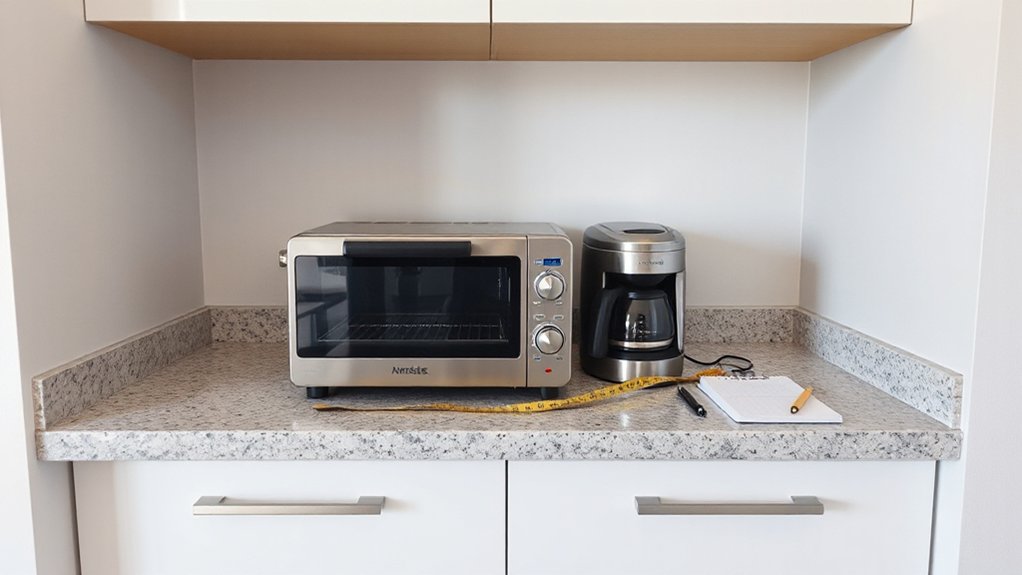
Before you buy any appliance, measure what you actually have: counter depth and usable width, cabinet clearances (including door swing and shelf height), and the exact outlet locations and amperage.
Compare dimensions to spec sheets, not marketing photos, and leave airflow gaps for compressors and toaster ovens.
Check vertical clearance under uppers so lids and cords don’t bind, and verify drawer pull-outs won’t collide with handles.
Map outlets: count grounded receptacles, note GFCI placement, and match loads to 15A vs 20A circuits to avoid nuisance trips.
For space savings, evaluate wall-mounted options like microwaves or slim range hoods, but confirm stud spacing and vent routes.
Add plumbing considerations: shutoff access, drain height, and hose run length for compact dishwashers or ice makers.
Small-Kitchen Essentials Worth Buying First
Three buys deliver the highest space-to-function payoff in a small kitchen: a compact, multi-function countertop oven (or air-fryer oven) to replace a full-size oven for most tasks, a narrow-footprint electric kettle or induction hot plate for fast, efficient heating, and a slim, high-suction venting solution (ducted if possible, recirculating with carbon if not) to control heat and grease without eating counter space.
Choose an oven with convection and a square basket/pan; you’ll fit a 9-inch pie plate and improve cooking techniques like roasting and crisping.
Pick a kettle with a tight base or an induction unit with a 6–7 inch coil for faster boil and less wasted heat.
Prioritize low-profile vents rated for real CFM and easy filters; appliance maintenance stays simple.
Best Multi-Cookers for Small Kitchens (One-Pot Wins)
Although a small kitchen can’t spare burners or big pots, a well-chosen multi-cooker can replace a slow cooker, rice cooker, steamer, and often a sauté pan in one compact footprint.
Choose 3–6 qt if you cook for 1–3; go 8 qt only if you batch-cook, since it demands more clearance and storage.
Compare models by heat-up wattage (900–1200 W is faster), sauté temperature control, and inner-pot material: tri-ply stainless sears better than nonstick, but nonstick cleans quickest.
For Multi cooker safety, prioritize lid-lock sensors, overheat protection, and a pressure-release you can vent away from cabinets.
For maintenance tips, hand-wash the sealing ring, descale monthly, and replace gaskets yearly to prevent odors and leaks.
Compact Countertop Cookers for Small Spaces
When you’re tight on counter space, you’ll get more utility per square inch from multi-function compact cookers that combine pressure, slow-cook, sauté, and steam in one chassis.
Compare footprints, wattage-to-capacity ratios, and vertical-lid clearance to guarantee the unit fits under cabinets and still vents safely.
Prioritize space-saving features like nesting accessories, cord wrap, lockable lids, and stackable or slim profiles so you don’t trade storage volume for convenience.
Multi-Function Compact Cookers
If you need one appliance to cover multiple cooking jobs without sacrificing counter space, a multi-function compact cooker gives you the best function-to-footprint ratio. You can pressure-cook beans, slow-cook stews, steam rice, sauté aromatics, and keep food warm in a single chassis, so you don’t park separate pots, steamers, and hotplates.
Compared with a microwave or toaster oven, it delivers higher moisture control and sealed, faster heat transfer, reducing cook times and energy draw.
For cooking safety, you’ll want lid-lock sensors, overpressure release, and cool-touch handles, and you should keep the gasket seated and the vent clear.
Appliance maintenance stays simple: wipe the heating plate, descale regularly, and swap seals when they harden.
Space-Saving Cooker Features
Where does a compact countertop cooker really save space—on the counter, in the cabinet, or in the workflow? You’ll gain the most when the unit stacks vertically, replaces multiple pots, and stores with a locking lid and cord wrap. Compare footprints in square inches, but also check height under cabinets and whether the handles flare.
For workflow, prioritize front-facing controls, side vents, and a hinged lid that opens without rear clearance. Choose a removable inner pot that nests with accessories, plus a flat top you can park a cutting board on.
For Energy efficiency, look for insulated housings, pressure modes, and auto warm that throttles power.
For Safety features, demand a cool-touch exterior, tip resistance, lid-interlock, and overheat protection.
Space-Saving Prep Tools That Earn Their Spot
Although counter space is scarce in a small kitchen, the right prep tools can outperform bulkier “do-it-all” gadgets without crowding your workflow. Choose a slim mandoline with a fold-flat guard; it delivers consistent 1–3 mm slices faster than a chef’s knife and stores in a drawer.
Pair it with nesting mixing bowls that share a single footprint, plus a lid set that doubles as a strainer. Look for innovative storage solutions like magnetic blade covers, hanging rails, and stackable measuring cups that lock together to eliminate loose clutter.
Prioritize ergonomic design features: soft-grip handles, angled blades, and non-slip bases reduce wrist load and improve control. A microplane with a protective sleeve beats a box grater in space, cleanup, and precision.
Tiny Appliances That Replace Bulky Equipment
You can swap a full-size slow cooker, rice cooker, and steamer for a multi-function mini cooker that uses one heating base and a tight footprint to cover the same modes.
You’ll also cut counter sprawl with compact combo prep tools—mini processor + chopper + whisk—that replace separate units while keeping wattage and bowl capacity right-sized for small batches.
Compared to single-purpose, full-scale machines, these small-format appliances free cabinet volume and reduce setup time without sacrificing core functions.
Multi-Function Mini Cookers
Because counter space disappears fast in a small kitchen, a multi-function mini cooker earns its footprint by replacing several single-use appliances at once. You can pressure-cook beans, slow-cook stews, steam rice, sauté aromatics, and keep food warm in one lidded unit, so you won’t need a separate rice cooker, stockpot, or steamer.
Look for 3–6 quart models with a tall, narrow base; they store in a cabinet and still fit under uppers. For energy efficiency, choose insulated housings, quick heat-up elements, and programmable auto-off to reduce idle watts versus a full-size oven.
Compare sealed-lid pressure modes to open-pot sauté for better moisture control. Pick color options that match your space and hide splatter.
Compact Combo Prep Tools
When prep tasks stack up in a tight workspace, compact combo tools cut clutter by merging chopping, mixing, slicing, and grating into one stowable unit. You’ll swap a full-size processor, box grater, and mandoline for a palm-scale base with modular discs, a micro-bowl, and a hand-crank or low-watt motor.
Choose models with nested attachments and onboard cord wrap to improve countertop organization, and look for dishwasher-safe parts to reduce sink time.
Compared with bulky processors, these units sacrifice batch volume but win on footprint, setup speed, and storage density. Pick stainless blades with clear thickness markings for repeatable cuts, and a non-slip base for safer one-handed feeding.
Matte housings and matching lids preserve appliance aesthetics while staying low-profile on open shelving.
Appliances That Store Easy: Stackable, Foldable, Mountable
Although counter space disappears fast in a small kitchen, stackable, foldable, and mountable appliances keep your workflow intact by shrinking their storage footprint. Choose a blender set with Stackable storage cups that lock and nest; it stores vertically and cuts cabinet volume versus full-size pitchers.
Pick a Foldable design kettle or collapsible colander that flattens to under 2 inches, so you reclaim a whole drawer.
For cooking, compare a slim induction burner with a wall dock to a standard hot plate: the docked unit clears prep space immediately and keeps cords managed.
Mountable spice grinders, magnetic knife strips, and under-cabinet can openers shift hardware off counters. You’ll move faster, clean easier, and keep zones separated.
Frequently Asked Questions
Which Small-Kitchen Appliances Are Most Energy-Efficient for Daily Use?
Choose an induction cooktop, electric kettle, and countertop pressure cooker; they minimize energy consumption and heat loss versus ovens or microwaves. You’ll save space with multi-function units, and you’ll extend appliance lifespan through faster cycles, lower temperatures.
How Loud Are Compact Appliances, and What Decibel Level Is Acceptable?
Like a whispering engine, you’ll hear compact appliances at 40–65 dB: fans 40–50, blenders 80–90, compressors 50–60. You should treat 55 dB as an acceptable decibel for daily noise levels.
Are There Safety Concerns Using High-Heat Appliances in Tiny Kitchens?
Yes, you’ll face safety concerns: high-heat units raise fire hazards and ventilation concerns in tight spaces. You’ll mitigate risk by maintaining clearances, using thermal-shutoff models, preferring induction over coils, and adding exhaust or filters.
What Warranties Matter Most When Buying Mini Appliances for Small Spaces?
Don’t buy a pig in a poke: prioritize Warranty coverage on core components, heating elements, and control boards, plus labor/shipping. Compare term length, claim process, and exclusions; strong support boosts appliance longevity and minimizes downtime.
How Do I Clean and Descale Small Appliances Without Damaging Them?
Use Cleaning tips: unplug, cool, wipe with microfiber and mild detergent; avoid soaking bases. Compare Descaling methods: vinegar-water for kettles, citric acid for espresso. Rinse twice, run a water-only cycle, air-dry.
Conclusion
In a small kitchen, you don’t win by buying more—you win by buying smarter. Measure counters, cabinet depth, and outlet load, then choose essentials first. Swap single-use clutter for one-pot multi-cookers and compact countertop units with stacked functions. Pair tiny prep tools with high-output motors, and replace bulky gear with foldable, mountable, or stackable designs. Big meals, small footprint: you’ll cut storage drag while boosting speed, safety, and usable workspace.