Table of Contents
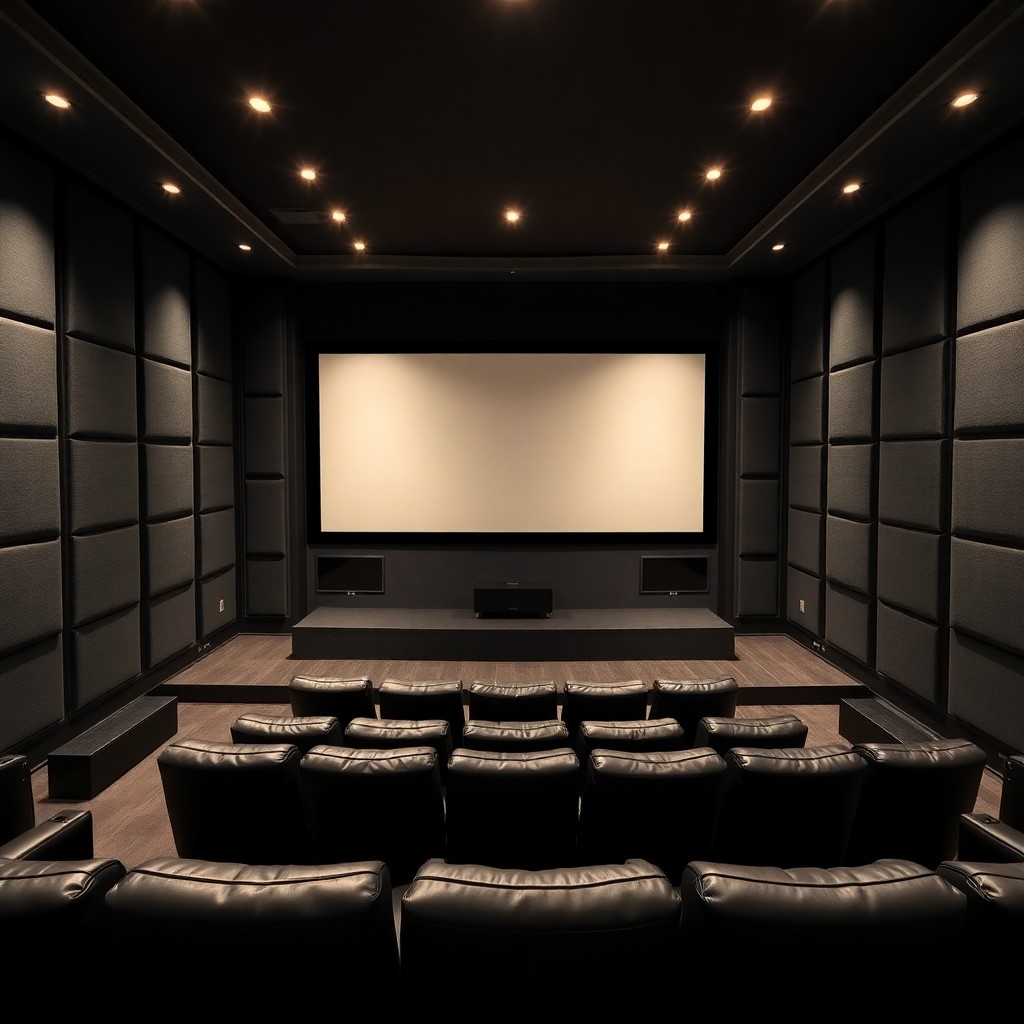
Home cinema seating is the element of a dedicated cinema room that gets underspecified more consistently than any other. The projector gets researched obsessively. The sound system gets debated at length. The acoustic treatment gets considered carefully. And then the seating — the thing every person in the room is in direct physical contact with for the entire duration of every film — gets chosen from a website in an afternoon, based primarily on how it looks in a photograph, with insufficient thought given to how it will actually perform in the specific room it’s going into.
The consequences of this approach are predictable. Seats that look impressive in photographs are uncomfortable after ninety minutes. Leather that seemed luxurious in isolation reflects sound in a way that undermines the acoustic treatment that cost considerably more to install. Dimensions that seemed fine on a product page leave the second row struggling for legroom. The seating is the element that determines whether a home cinema is a room people want to spend extended time in or one that looks the part but doesn’t quite deliver on the experience it promises.
This is the guide to getting it right — covering materials, styles, dimensions, layout, and the specific considerations that a basement conversion context introduces.
What Home Cinema Seating Has to Do
Before style and material, start with function. Home cinema seating operates under specific demands that distinguish it from any other category of domestic furniture.
It needs to be comfortable for periods of two to three hours without adjustment or repositioning. This sounds like a low bar until you sit in something that doesn’t meet it and find yourself shifting every twenty minutes. The chairs in commercial cinemas — which many people accept as the reference point — are typically not especially comfortable. The advantage of a home cinema is that you can do considerably better, and doing considerably better matters.
It needs to be quiet. A seat that creaks when anyone shifts position, or that makes noise when a recliner mechanism engages, or that has a leather surface that squeaks against clothing — these are not minor inconveniences in a cinema environment where the ambient noise floor, in a well-constructed room, is essentially silent. Every noise from the seating is audible and distracting.
It needs to be acoustically appropriate. The material covering the seat contributes to the acoustic character of the room. Hard, reflective surfaces — some leathers, certain vinyl fabrics — reflect sound. Soft, absorptive surfaces — textiles, microfibre, certain treated leathers — absorb it. In a room where the acoustic treatment has been carefully specified, the seating material is part of that specification, not separate from it.
It needs to fit the room correctly. This is a geometry problem as much as a design problem, and getting it wrong produces either a cramped room where people can’t get past each other, or a room where the seats are too far from the screen for the viewing geometry to work. The dimensions of the seats, the clearances between them, and the row spacing all need to be determined relative to the room and the screen before any seat is selected.
Dedicated Cinema Seats vs Sofas: The Fundamental Choice
The first decision is the category. Dedicated cinema seating — purpose-built recliners designed for home theater use — and domestic sofas or lounge seating occupy different positions in the market, and the choice between them is worth making consciously rather than defaulting to one or the other.
Dedicated cinema recliners are designed for the specific purpose and show it. They have the right seat depth, the right lumbar support, the right relationship between seat and back angle for extended viewing. They typically include motorised or manual recline, individual armrests between each seat, cupholders, storage in the armrests, and USB charging. They’re designed to work in rows — to align correctly, to space correctly, to create the viewing geometry that a dedicated cinema needs.
The disadvantages: they’re more expensive than equivalent-quality domestic seating, they have a specific aesthetic that reads unambiguously as cinema, and they’re less flexible in terms of use — they’re not furniture you’d rearrange for other purposes.
Sofas and lounge seating introduce domestic comfort and flexibility. A deep, well-made sofa in a good fabric is a genuinely comfortable place to watch a film, particularly for households that use the cinema room for other purposes as well. The aesthetic is warmer and more residential, which suits certain design briefs.
The disadvantages are acoustic — most sofa fabrics reflect more sound than dedicated cinema seats — and practical. Sofas don’t provide individual armrests, cupholder placement is awkward, and the viewing geometry for more than two or three people is compromised by the limitations of the sofa form. In a basement cinema room designed for four or more viewers, the sofa option typically produces something that works adequately rather than something that works well.
For a serious basement cinema conversion — one where the room is being purpose-built and properly specified — dedicated cinema seating is almost always the better choice. The benefits of the dedicated format are material and the flexibility of domestic seating is rarely needed in a room that has a single primary function.
Materials: The Decision That Affects Both Feel and Acoustics
The covering material of the seat does two things simultaneously: it determines how the seat feels physically and it determines its acoustic contribution to the room. These two functions don’t always point in the same direction, and understanding the trade-offs is essential.
Full-grain leather is the premium material in the cinema seating market and has legitimate claims to that status. It’s durable, it develops a patina rather than wearing badly, it’s easy to clean, and it looks appropriately luxurious.
The acoustic performance is the caveat: leather reflects mid and high-frequency sound rather than absorbing it, which means a room full of leather seats has less natural absorption than the same room with fabric seats. In a room where the acoustic panels are specified to compensate for the reflectiveness of hard surfaces generally, this is manageable. In a room where the acoustic treatment is minimal, leather seating can produce a slightly bright, etchy quality in the high frequencies that takes the edge off an otherwise good system.
The squeak issue with leather is also real. Leather against leather, or leather against clothing, produces noise at a level that’s inaudible in a room with ambient sound but very audible in a quiet cinema room during a quiet passage of a film. This isn’t a dealbreaker — the best leather formulations are treated specifically to reduce this tendency — but it’s worth testing before committing.
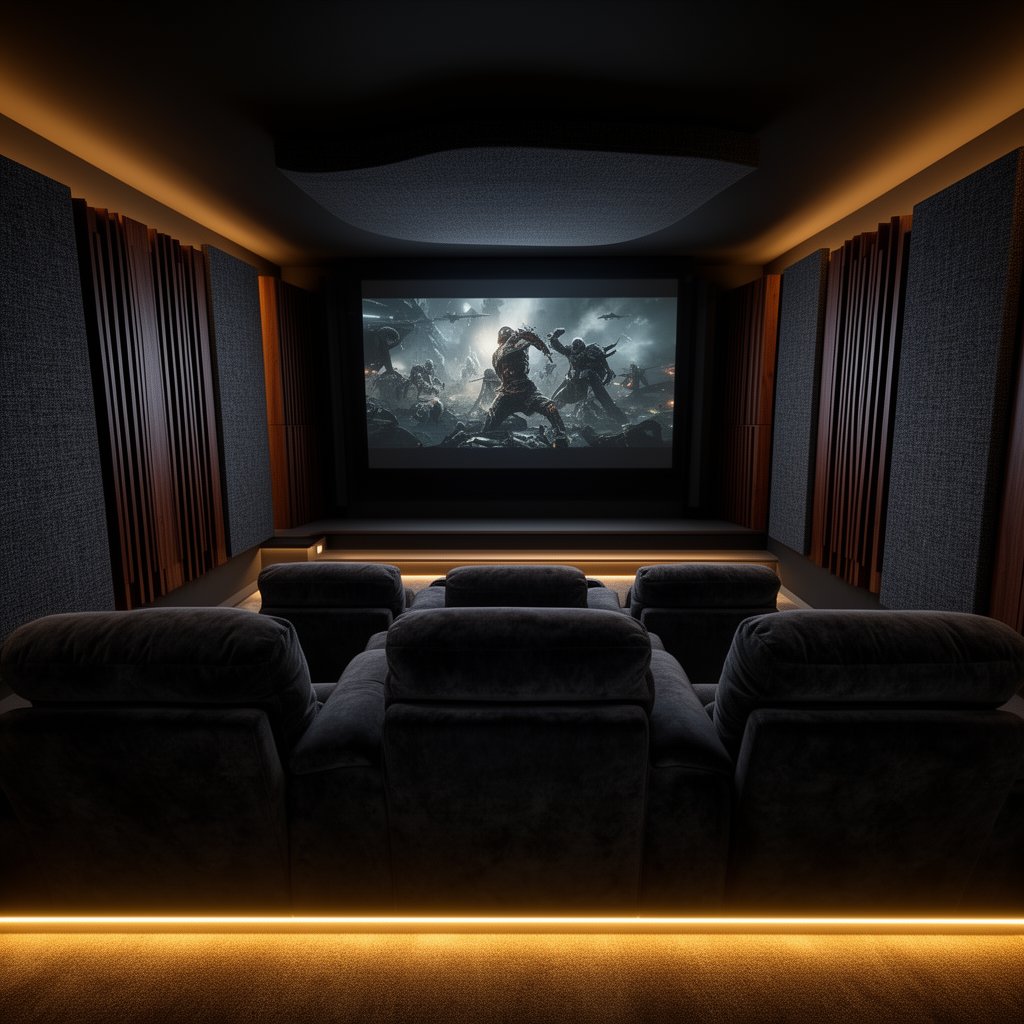
Performance fabric and microfibre is the category that consistently produces the best results in dedicated cinema rooms. It absorbs sound, it doesn’t squeak, it’s soft and warm to the touch, it doesn’t trap heat the way leather can during long viewing sessions, and modern performance fabrics are designed to resist staining and cleaning well — which matters in a room where drinks and snacks are a normal part of use. The visual appearance is less overtly luxurious than leather at first glance, but the difference is less significant in a properly lit cinema room than it appears in a product photograph under bright retail lighting.
Velvet and velvet-effect fabrics sit at the top of the textile category. The pile surface has excellent acoustic absorption, the visual appearance is genuinely sumptuous, and the tactile quality is outstanding. The maintenance consideration is that velvet shows contact marks — the directional compression of the pile where someone has sat — which in a cinema room is a minor point since the seats are being sat in rather than displayed, but worth noting.
Faux leather and PU materials are frequently used in the lower to mid range of the cinema seating market. They avoid the acoustic and squeaking issues of real leather, they’re easier to clean than most textiles, and they’re less expensive. The honest assessment is that quality varies considerably — the better PU materials look reasonably convincing and perform adequately, while the lower end of the market produces something that looks cheap within a year. For a room that represents a significant construction investment, the seating covering should be proportionate to the overall spend.
Styles and Configurations
The cinema seating market offers several configurations that suit different room sizes, row arrangements, and aesthetic preferences.
Individual power recliners are the gold standard for dedicated cinema rooms and the configuration that produces the best individual viewing and comfort experience. Each seat reclines independently, which means different people can adopt different positions simultaneously without affecting their neighbours. The mechanism should be whisper-quiet — this is specified in decibels in quality products and worth checking, because a loud motor under a quiet film scene is exactly the wrong thing.
The layout of individual recliners requires thought: the gap between seats matters acoustically and aesthetically. Too close and the room feels cramped. Too far and the individual seats look stranded rather than part of a composed arrangement. A gap of approximately 50-100mm between armrests reads as intentional spacing rather than either crowding or isolation.
Loveseat configurations pair two seats on a shared base, typically with a shared central console incorporating a cupholder and storage. These are designed for couples who want a close viewing experience, and they work well in that specific context. In a room with multiple pairs, they produce a neat, composed visual arrangement. The constraint is that the pairing is fixed — you can’t rearrange individual seats, and the console between the pair is always there.
Home theater sectionals are sofa configurations designed for cinema use — typically with built-in cup holders, some degree of recline, and chaise sections. These work well for households that want a more informal, living-room-adjacent experience in the cinema room. The acoustic and individual comfort limitations noted above apply.
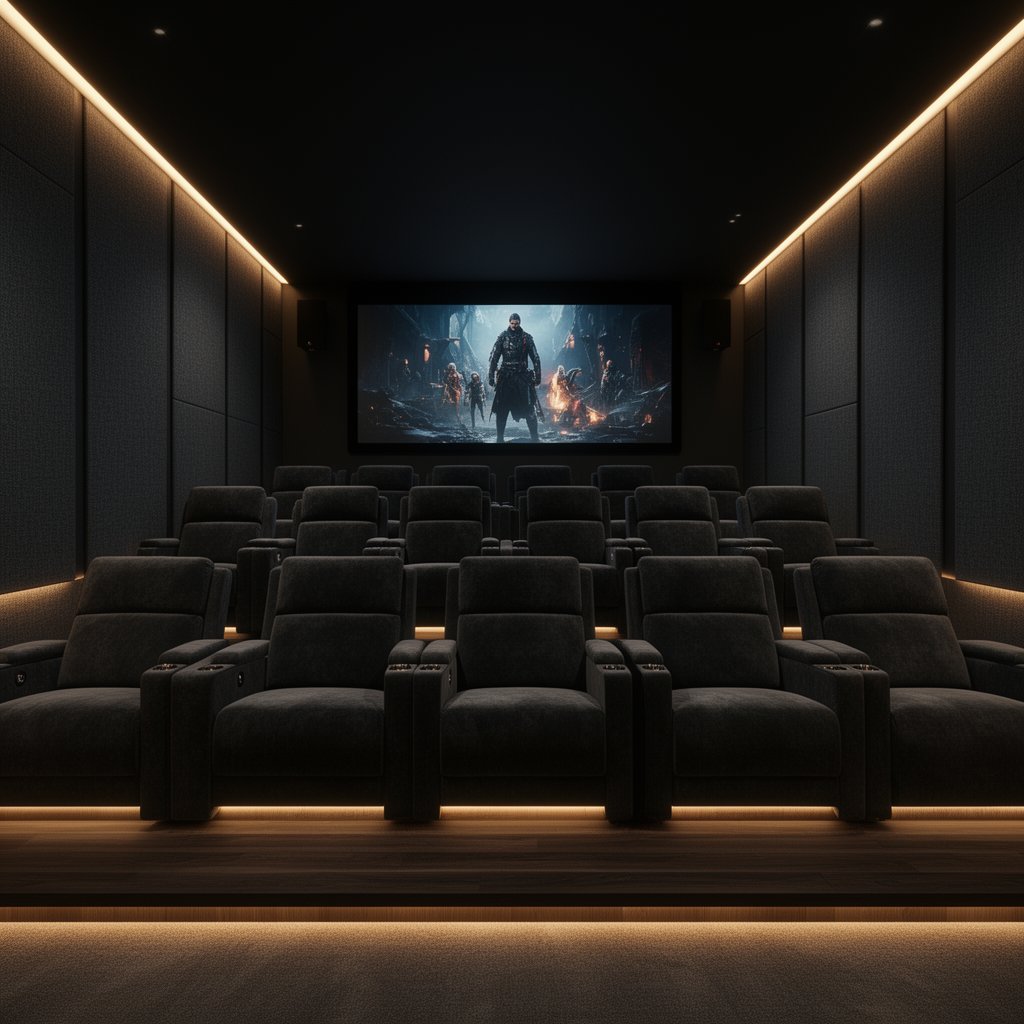
Row configurations — individual seats on a shared plinth or base, presented as a continuous row — are the most commercial-cinema-like option and the one that produces the most efficient use of floor area in a room with two or more rows. The shared base links the seats visually, creates a clean front profile, and handles the row lighting (typically an LED strip on the front face of the riser) in a single integrated element.
Dimensions and Layout for a Basement Room
The geometry of the seating layout is determined by the room and the screen, and it needs to be calculated rather than approximated.
Seat pitch — the distance from the front of one row to the front of the next — is the measure that most affects legroom and ease of movement. Commercial cinemas typically use a pitch of 900mm to 1050mm, which is workable but not generous. A home cinema can be more generous: 1100mm to 1200mm produces a comfortable experience for most body types with adequate space for movement past seated neighbours. At 1.2 metres pitch per row, a room with two rows occupies approximately 2.4 metres of floor depth before adding the front clear zone and the rear circulation space.
Seat width affects both comfort and room capacity. A seat width of 500mm is narrow by any standard. 550mm to 600mm is comfortable for most people. 650mm and above is generous and appropriate for premium seating. The total width of a row of eight seats at 600mm per seat is 4.8 metres plus armrest widths — check this against the room width before committing to a seat count.
Riser height for the second row is calculated from the sightline geometry: the eye level of the seated second-row viewer needs to clear the head height of the seated first-row viewer. For a typical screen height and viewing distance, a riser of 250mm to 350mm achieves this. The riser also needs to be deep enough to accommodate the full recline of the second-row seats without the footrest overhanging the front of the platform — typically 800mm to 900mm of platform depth is required for fully reclining seats.
The stagger option: offsetting the second row so seats are positioned between first-row seats rather than directly behind them — as commercial cinemas often do — improves sightlines without requiring a taller riser. In a basement room with constrained ceiling height, this can be more appropriate than a higher platform.
What a Basement Conversion Specifically Requires
A basement cinema room introduces some considerations specific to the below-ground context.
Ceiling height and recline clearance. A fully extended power recliner, with footrest deployed and head section raised, occupies approximately 300mm more vertical space than the seated position. In a basement room with a ceiling height of 2.4 metres, second-row seats on a 300mm riser have a clearance of approximately 2.1 metres above the seat — adequate, but a consideration. Check the fully extended height of any seat being considered against the finished ceiling height above the installation position.
Moisture and material selection. A basement environment, even one properly waterproofed and climate-controlled, tends to run at slightly higher ambient humidity than above-ground rooms. This is relevant for leather — which can be affected by sustained high humidity if climate control isn’t maintained consistently — and for some timber components in seat frames. A room with proper mechanical ventilation and climate control addresses this, but it’s worth specifying a material that’s tolerant of the environment rather than one that requires perfect conditions.
Access and delivery. Fully assembled cinema recliners are very large objects. The access route to a basement — typically a staircase with limited width and headroom — constrains what can be delivered in assembled form. Many cinema seat manufacturers can deliver in components and assemble in situ. Confirm this before ordering and measure the access route before confirming the seat dimensions.
The Comfort Test Nobody Does and Should
Before committing to any seating, sit in it. Not in a showroom for ten minutes while a salesperson talks at you — sit in it for an extended period, alone, watching something. Recline it. Check the lumbar support. Check whether the headrest is at the right position for your height. Check whether the armrests are at the right height relative to the seat. Check whether the cupholder is actually within reach when reclined.
This sounds obvious and it’s almost never done. People buy cinema seats from photographs and product specifications without sitting in them, which is the equivalent of buying a mattress the same way. The seat that feels fine for ten minutes may be uncomfortable after ninety. The seat that feels fine for one person at one height may be wrong for another.
Where possible, visit a showroom that has a working demonstration of the specific seats. Where that’s not possible, check the returns policy before ordering, and ensure you have the option to return if the seats don’t perform as expected in practice.
The seating is where the investment in everything else either delivers or doesn’t. The perfect acoustic treatment and the best projection in the world don’t compensate for seats that make people shift uncomfortably every half hour. Get it right, and the room does exactly what a home cinema should: it disappears, and the film takes over completely.