Table of Contents
Home theater acoustic panels are one of those elements that sit at the intersection of technical necessity and interior design — which means they’re simultaneously one of the most impactful improvements you can make to a home cinema space and one of the most misunderstood. People either dismiss them as unnecessary, assuming a good speaker system will compensate, or they go too far in the other direction, installing so much absorption that the room sounds dead and uninviting. The middle ground, where a well-specified acoustic treatment makes a real cinema room sound genuinely extraordinary, is where the interesting work happens.
This article is for anyone planning a home theater who’s wondering whether acoustic panels are worth the investment, what they actually do, and how to approach them without either ignoring the acoustic question entirely or disappearing down a technical rabbit hole that never arrives at a finished room.
What Home Theater Acoustic Panels Actually Do
Sound in a room behaves in ways that are invisible but immediately audible. When a speaker fires a sound wave, that wave travels outward in all directions. Some of it travels directly to your ears. The rest hits the walls, ceiling, and floor, bouncing back as reflections. These reflections arrive at your ears fractionally later than the direct sound — sometimes milliseconds later, sometimes more — and the combination of direct sound and reflected sound determines what you actually hear.
In an ordinary room with hard surfaces, the reflections are strong and arrive from multiple directions. The result is a smeared, confused sound where different frequencies linger longer than others, where dialogue is harder to follow, and where the sense of spatial precision that a good film soundtrack is designed to provide is degraded. You can still hear everything, but it doesn’t sound like a cinema. It sounds like a room with a television in it.
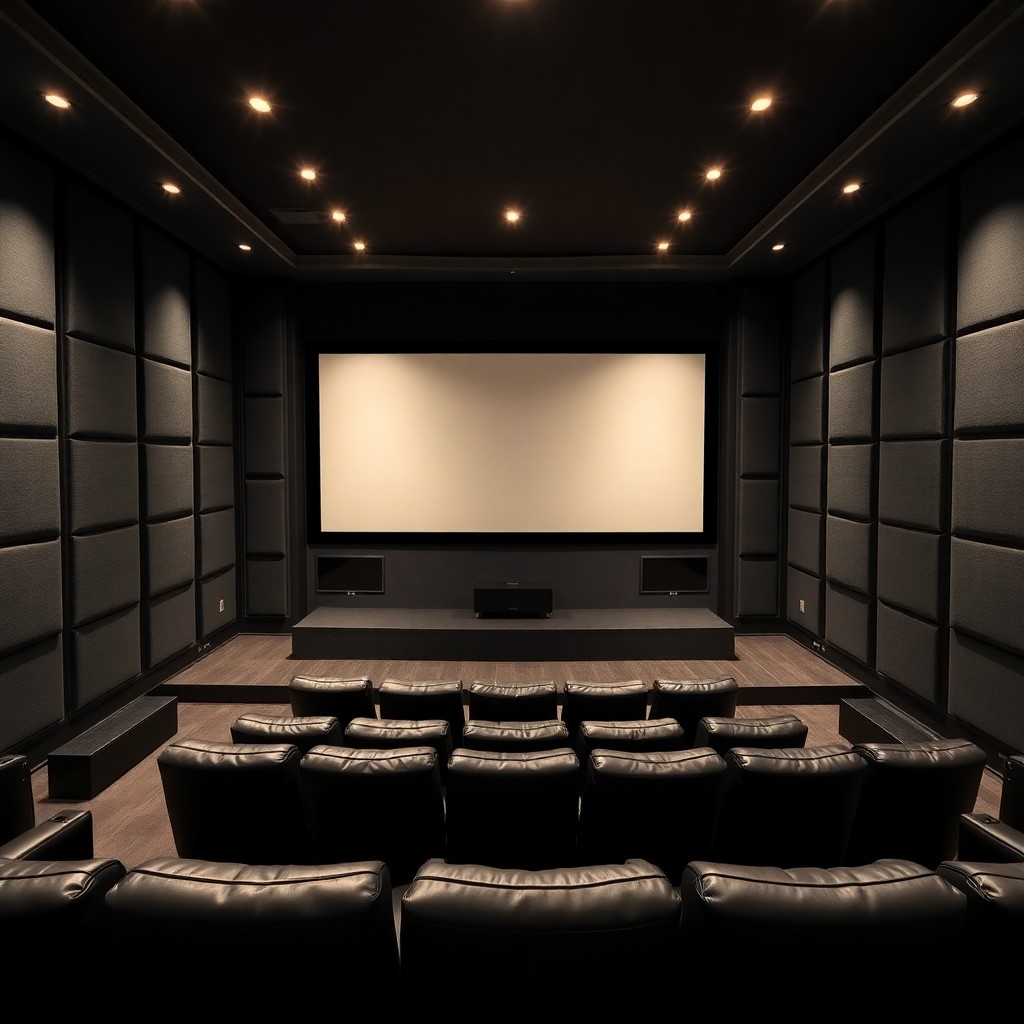
Acoustic panels address this by absorbing rather than reflecting sound energy. A panel with an appropriate absorptive material — typically open-cell foam or compressed rockwool wrapped in a breathable fabric — absorbs the sound energy that hits it, converting it to a tiny amount of heat, and returning very little as a reflection. Position panels on the first reflection points — the walls where sound bounces before reaching the listening position — and the reflected sound energy is reduced, the direct sound becomes cleaner and more defined, and the listening experience improves in a way that’s immediately perceptible to anyone who pays attention to it.
What they don’t do is block sound from leaving the room. Absorption and isolation are completely different acoustic disciplines. If the goal is to prevent sound from travelling to adjacent rooms, that’s a room construction question — decoupled walls, mass, isolation mountings — not an acoustic panel question. Panels inside a room improve the sound within that room. They don’t stop the neighbours hearing it.
The Different Types
Not all acoustic panels are the same, and the differences matter for both performance and appearance.
Absorption panels are the most common type and the most relevant for home theater use. They absorb sound energy across a range of frequencies depending on their thickness and density. Thin panels — 25mm foam or thin fabric-wrapped boards — absorb primarily high frequencies. Thicker panels — 100mm rockwool or similar — absorb mid-range frequencies as well. Bass frequencies require either very thick panels or a different approach entirely.
Bass traps address the low-frequency sound buildup that occurs in room corners, where bass energy accumulates and causes a booming, poorly defined low end. Corner-mounted bass traps — thick absorptive material in a triangular section fitting into the wall-ceiling or wall-wall corner — reduce this buildup and tighten the bass response of the room. In a home theater, where the low-frequency content of film soundtracks is significant, bass traps are often as important as broadband absorbers.
Diffusers scatter sound rather than absorbing it. Where absorption removes energy, diffusion redistributes it — breaking up the strong specular reflections that cause problems while preserving some sense of acoustic liveliness. A room treated entirely with absorption can sound uncomfortably dead — all the energy removed, nothing returning. A combination of absorption and diffusion produces a room that’s acoustically controlled but still feels alive. Diffusers typically use an irregular surface — a mathematical pattern of wells or protrusions at different depths — to scatter incoming sound in multiple directions.
Combination panels do both — a layer of absorptive material combined with a reflective or diffusive face. These are often used on rear walls in home theaters, where some absorption is needed without completely deadening the back of the room.
Do You Actually Need Them?
The honest answer is: it depends on the room, and the difference in performance between a treated and an untreated room depends enormously on what you’re starting with.
A room with a lot of soft furnishings — heavy curtains, upholstered seating, carpet, bookshelves full of books — already has significant acoustic absorption. The reflections are damped by the soft surfaces, and the acoustic problems that panels are designed to solve are less severe. In a room like this, a modest treatment — some strategic panels at the first reflection points — produces a noticeable improvement, but the starting point is already reasonable.
A room with hard surfaces — bare walls, hard floor, minimal soft furnishings — has strong, uncontrolled reflections that seriously compromise the listening experience. In a room like this, acoustic treatment is genuinely transformative. The same speakers, the same content, the same listener — the difference in perceived sound quality between a hard room and a properly treated one can be dramatic enough to seem like a different system.
The home theater specifically — designed as a dedicated room, often in a basement or a garden room, often with more controlled furnishing than a regular living room — typically benefits significantly from acoustic treatment because it’s designed to be taken seriously as a listening environment and deserves to be treated as one.
The Placement Question
Getting acoustic panels in the right positions produces results. Getting them in the wrong positions produces panels on the wall that don’t do much.
The primary positions to address are the first reflection points — the surfaces where sound from the speakers bounces toward the primary listening position before the direct sound has had time to fully establish itself. Identifying these points is straightforward: position a mirror on the side wall and move it along the wall until you can see the speaker reflected in it from the listening position. That point is where sound from the speaker reflects toward you first. That’s where a panel goes.
The same exercise on the ceiling — typically above and slightly in front of the listening position — identifies the ceiling reflection point. On the front wall between or flanking the speakers, some treatment helps manage the energy bouncing back from that wall. On the rear wall, a combination of absorption and diffusion handles the back reflections.
The corners of the room — all eight of them, but particularly the four wall-ceiling corners at the front and rear — are where bass traps go.
The common mistake is applying acoustic panels too symmetrically, covering every surface evenly, which over-damps the room. The goal is a targeted treatment of the specific reflection problems, not a complete absorption of the room’s acoustic character.
Aesthetics: The Reason Most People Hesitate
The functional case for home theater acoustic panels is straightforward. The hesitation usually comes from aesthetics — the assumption that acoustic treatment means covering walls in grey foam tiles that look like they belong in a recording studio, which is visually incompatible with a room that’s supposed to feel like a premium cinema.
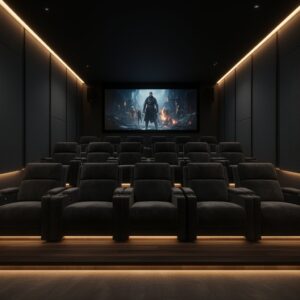
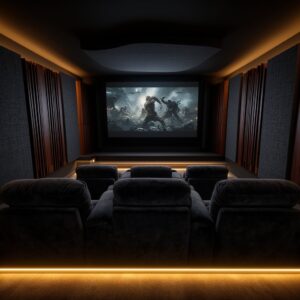
This assumption is outdated and based on the lower end of the acoustic panel market. The quality end of the acoustic panel industry produces fabric-wrapped panels in any colour, any size, and with any printed image on the fabric face. A panel can be a deep charcoal grey that disappears against a dark cinema wall. It can be a warm terracotta that contributes to the room’s colour scheme. It can carry a large-format printed image — a film still, an abstract graphic, a piece of artwork. It can be any shape: standard rectangles, bevelled edges, hexagons, architectural panel profiles.
Done well, acoustic panels are not a concession to the technical requirements of the room. They’re part of the room’s design language. In a well-designed home theater, the panels are positioned as a deliberate part of the composition of the walls — their size, shape, colour, and arrangement considered alongside the screen, the seating, and the lighting as part of a single designed environment.
The home theaters that look best almost always have the acoustic treatment integrated into the design from the start rather than added afterward. This is because designing around the panels from the outset allows them to be incorporated into the visual logic of the space rather than accommodated after the fact. It’s also because the panel positions that are acoustically optimal tend to have a visual symmetry that works well as a design element when they’re properly specified and detailed.
DIY vs Professional Installation
Both routes produce good results when executed properly, and the choice depends on budget, confidence, and how seriously the space is being taken.
DIY acoustic treatment — using commercial acoustic foam or rockwool panels wrapped in fabric — is genuinely achievable for someone willing to spend time on measurement and application. The acoustic foam products available from specialist suppliers are effective if positioned correctly. Fabric-wrapping rockwool or compressed glass mineral wool in a timber frame is a straightforward workshop project that produces a result indistinguishable from commercial panels at a fraction of the cost. The challenge for DIY is accuracy — getting the fabric tight and wrinkle-free, getting the panels level and symmetrically positioned, building the panel frames to consistent dimensions — rather than any fundamental technical difficulty.
Professional acoustic treatment from a specialist provides calibrated measurement of the room’s acoustic problems before any treatment is specified, precise calculation of the panel types and positions needed to address those specific problems, and panels manufactured to a high standard of finish. A professional installer working from measurement data will produce better acoustic results than a DIY treatment based on general principles, particularly in a room with unusual dimensions or proportions. For a significant home theater investment — one involving a high-quality projector, a full surround sound system, and dedicated construction — professional acoustic design is the appropriate complement.
Cost and What to Expect
Commercial fabric-wrapped acoustic panels typically cost somewhere between £30 and £150 per panel depending on size, specification, and supplier. A basic treatment for a modest home theater room — six to eight panels at first reflection points and some corner bass traps — might cost £400 to £800 in materials at the commercial end, or considerably less if self-built from rockwool and fabric. A full professional treatment with measurement and specification, bespoke panels, and installation for a serious home theater could run to several thousand pounds for a well-specified room.
What you can expect from a properly executed treatment: noticeably improved dialogue clarity, a cleaner and more precise stereo or surround image, better-defined bass, and a room that sounds significantly more like a cinema and less like a room with speakers in it. For anyone who takes film sound seriously — and a dedicated home theater implies that level of investment — the difference is not subtle. It’s the kind of improvement that makes the whole system sound better, even if nothing in the system itself has changed.
The Honest Summary
Home theater acoustic panels are a genuinely good idea for any dedicated cinema room, done properly and positioned correctly. They don’t need to look like a recording studio. They don’t need to be expensive. They do need to be thought about properly — which means understanding what they’re doing, where they should go, and how they fit into the overall design of the room rather than being an afterthought applied to a finished space.
The rooms that get this right are the ones where the acoustic treatment was part of the design brief from the start. The rooms that get it wrong — either by ignoring it entirely or by applying panels without adequate thought to position and type — make the same investment in speakers and projector and get a fraction of the result. Acoustics are the invisible infrastructure of a good home theater. They’re worth taking seriously.