Table of Contents
Good laundry room ideas don’t start with aesthetics. They start with an honest look at how the space currently fails you — the ironing that piles up on the wrong surface, the detergent bottles that have no logical home, the clothes that need to air dry and end up on the banister because there’s nowhere better — and work backward from those specific failures to solutions that actually fix them. The aesthetic conversation is important and genuinely worth having, but a laundry room that looks good and doesn’t function well is just a pretty problem.
The best laundry room ideas we’ve encountered and implemented over the years share a consistent quality: they come from careful observation of how the room is actually used, not from how a laundry room is supposed to look. A ceiling drying rack in the right position, a built-in ironing board that actually works, a worktop at the right height — these are the ideas that change the experience of doing laundry rather than simply changing the look of the room.
That said, getting the look right matters too. A well-designed laundry room that’s genuinely pleasant to be in makes the daily and weekly rhythm of laundry less of a chore. It’s a room used every day, and it deserves to be treated as such.
Here’s a collection of the ideas that have worked best — organised by function first, aesthetics second.
Storage Ideas That Actually Solve Problems
Storage is where most laundry rooms go wrong, and getting it right changes everything.
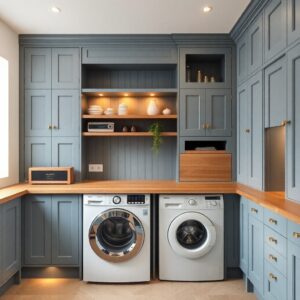
Floor-to-ceiling cabinetry on every available wall. The instinct is to put units at worktop height and leave the space above open. The result is a room where the top half of the walls become the place where things end up rather than the place where things are stored. Floor-to-ceiling units — with drawers and shelving below the worktop and cupboards above — use the full volume of the room and produce the kind of contained organisation that utility spaces need. In a small laundry room, upper cupboards are often the difference between a space that feels controlled and one that feels cluttered.
A dedicated ironing board housing. The ironing board that leans against the wall, or that opens out and blocks the doorway, is one of the most consistent sources of frustration in a utility space. A built-in ironing board — mounted on a pivot inside a floor-to-ceiling cabinet, folding out to the correct working height when the door is opened — takes up minimal wall space when closed and produces a proper ironing station when open. Several well-engineered systems are available that include a shelf for the iron when in use and a power socket inside the cabinet. This is one of those ideas that sounds like a small improvement and turns out to be transformative.
A pull-out laundry sorter. A single laundry basket is almost never sufficient in a family household, because laundry needs to be sorted before washing — lights, darks, delicates, at minimum. A pull-out unit with two or three fabric bags on a sliding frame, mounted in a base unit cabinet, allows sorting at the point of deposit rather than in front of the machine. The frame rolls out, each bag lifts off separately for carrying to the machine, and the whole thing pushes back in when not in use. It takes approximately the same footprint as a standard base unit and produces a laundry system that actually works.
A decanting station for detergents. Laundry products come in packaging optimised for retail shelf presence, not for use in a laundry room. Bulk bags of washing powder decanted into a ceramic jar with a scoop, liquid detergent in a glass dispensing bottle, fabric softener in a simple bottle rather than the original — these take five minutes to set up and make a material difference to how the worktop reads and how the products are used. Combine with a dedicated open shelf or shallow pull-out drawer at the correct height for the products in use.
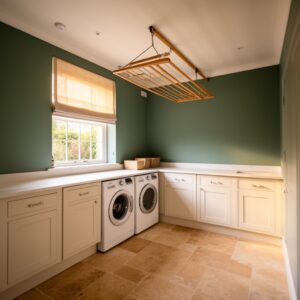
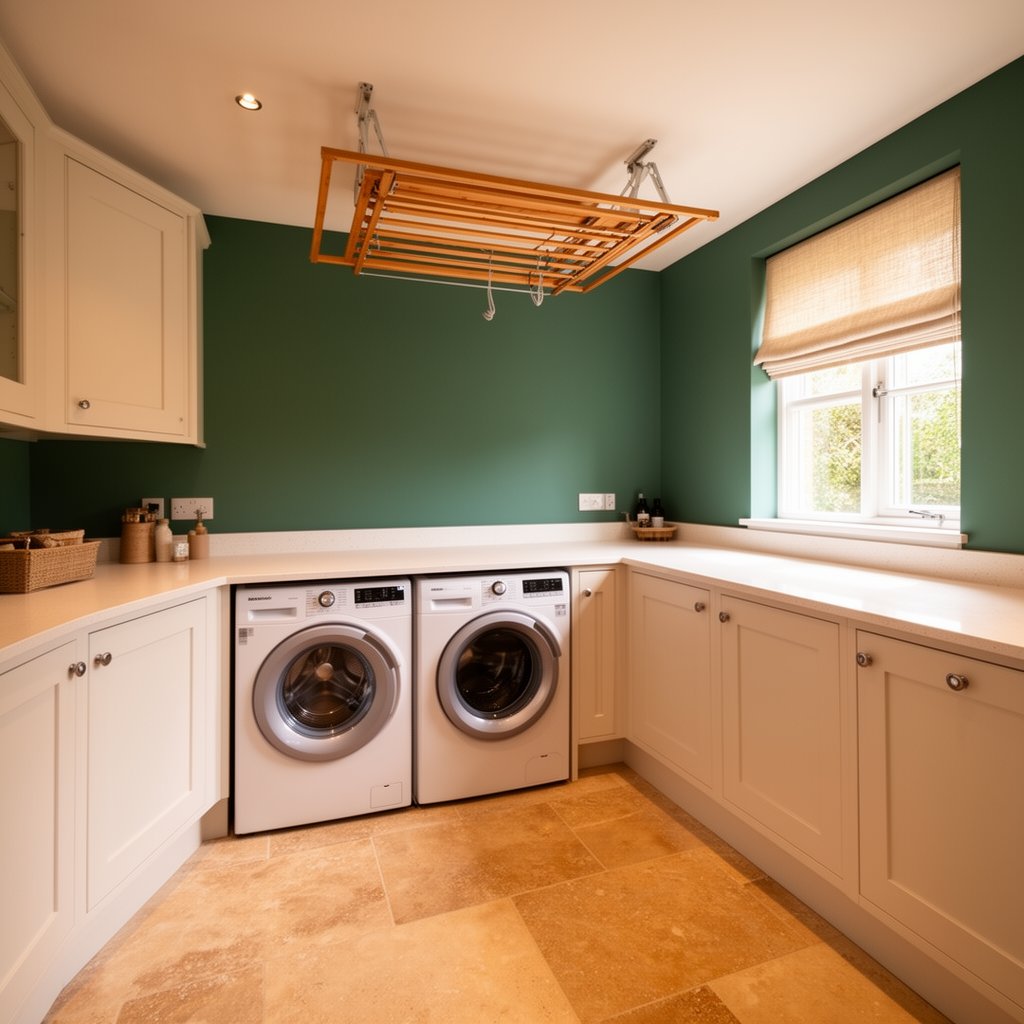
Wall-mounted folding racks for handwash items. A pull-down wall rack — mounted on the wall and folding flat against it when not in use — provides drying space for delicates and handwash items without the floor space footprint of a clothes horse. The ceiling-mounted pulley version is even more space-efficient: raised to the ceiling when fully loaded, it uses the least-valuable volume in the room and is out of the way until needed.
Layout Ideas for Difficult Rooms
Most laundry rooms are awkward shapes or awkward sizes, and the layout ideas that work best tend to be the ones that acknowledge the constraint rather than fighting it.
Stack the machines. In a room that’s too narrow for machines side by side, stacking is the obvious solution — but the obvious isn’t always fully exploited. A stacked washer-dryer pair frees a wall entirely. That wall can become a full-height storage wall, a drying area, or a combination of both. The worktop shifts to the side return or to a folding surface above the stacked pair. This is the layout that produces the most efficient use of floor area in a narrow room.
The worktop height question. Standard kitchen worktops are 900mm from the floor. Most laundry worktops are set at the same height, because that’s what kitchen unit carcasses come in. But a laundry worktop is used differently from a kitchen one — you’re sorting and folding standing up rather than preparing food — and most people find a height of 920mm to 940mm considerably more comfortable for sustained use. The difference is small, the benefit is real, and in a new installation it costs nothing to adjust.
A passageway laundry room. Some of the most efficient laundry setups we’ve seen are in rooms that are effectively corridors — a passage between kitchen and garage, a back hall connecting to the garden. Units on one wall only, a slim worktop, machines tucked under with adequate clearance — this works if the width is at least 1.4 metres and the storage is thought through carefully. The circulation function and the laundry function share the space without competing for it.
The laundry-to-garden connection. Where the laundry room connects to the garden — directly, or via a short passage — the outdoor drying option is worth designing for properly. A hook for the laundry bag, a coat hook for the outdoor clothes you put on to hang washing, the ability to open a door easily with arms full of wet laundry: these are small details that make the indoor-outdoor laundry routine work smoothly rather than awkwardly.
Aesthetic Ideas Worth Stealing
Once the functional decisions are made, the aesthetic choices are where the room gets its character. These are the ideas that consistently produce results worth the effort.
A strong wall colour throughout. The instinct for utility rooms is white or a pale neutral — clean, clinical, appropriate. The reality is that white utility rooms look fine and nothing more, and that a considered colour choice in a laundry room produces a space that feels designed rather than simply finished. Deep greens, dusty blues, warm terracottas, even a well-chosen near-black — dark colours in a laundry room read as luxurious rather than cramped if the lighting is right. The south- or west-facing laundry room can carry a deeper colour comfortably; a north-facing room without much natural light needs more caution.
Integrated appliances for a cleaner look. Washing machines and tumble dryers with matching cabinet doors in front of them — not built-in appliances in the kitchen sense, but standard machines with a simple door face fixed to the front — produce a significantly cleaner visual result than exposed machines with their various manufacturer graphics and control panels visible. The door face needs to be on a magnetic catch that allows the machine door to open freely, and the control panel remains accessible when the cabinet door is open. In a small room, the visual noise of two exposed machines is disproportionate, and eliminating it makes the room feel more composed.
A single material used consistently. Laundry rooms that feel chaotic usually have too many different materials in them — one worktop material, a different splashback material, mismatched unit doors, a floor that relates to nothing. Choosing one or two materials and using them consistently — the same tile on both the floor and the splashback, the same painted finish on both units and walls — produces a room that reads as coherent rather than assembled from whatever was available.
Open shelving for the things that look good. Closed units hide everything equally, which is practical but visually flat. A section of open shelving — for the ceramic detergent jars, the folded cleaning cloths, the plant that someone put there because it gets south light — introduces the visual variation that makes a room feel inhabited rather than merely finished. The rest stays behind doors. The few curated things that merit it go on the open shelf.
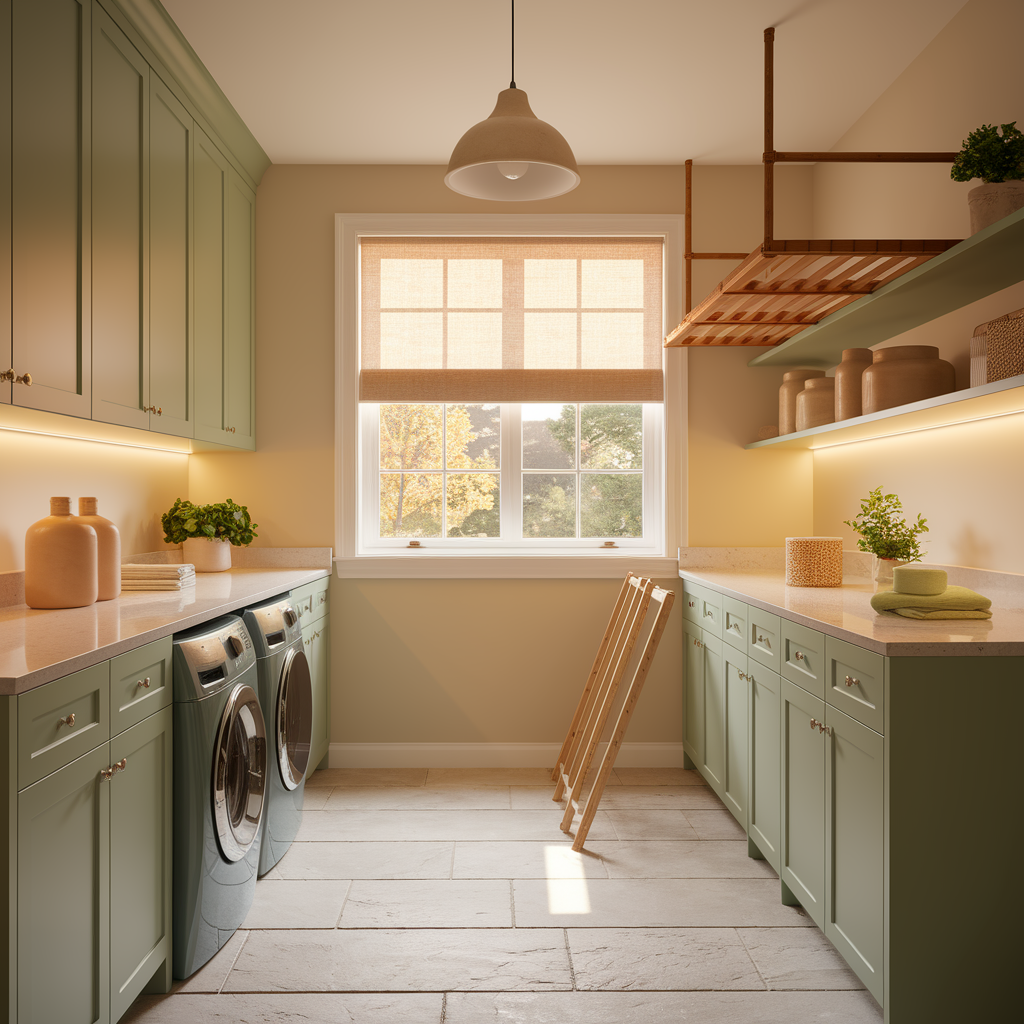
Proper window dressing. A laundry room window is frequently left bare because it overlooks something nobody wants to frame — a side passage, a fence, a neighbouring wall. The argument for dressing it anyway is that the window covering doesn’t have to frame the view; it can filter the light and mark the window as a considered feature rather than an overlooked element. A simple roller blind in a natural material, or a cafe-style curtain at the lower half of the window, addresses both the privacy issue and the aesthetic one.
Lighting Ideas That Transform the Experience
Laundry rooms are almost universally underlighted, and the quality of light in a room where you’re sorting colours and treating stains matters practically as well as aesthetically.
Under-cabinet task lighting. A strip of LEDs under the wall units above the worksurface provides direct, shadow-free illumination on the work surface — the surface where sorting, folding, stain treatment, and ironing happen. This is the light that makes doing laundry easier rather than squinting at stains under ambient light that comes from above and behind you. It should be on its own switch and is often the only light needed during daytime use.
A statement ceiling fixture. In a room that’s otherwise purely functional, a single interesting light fitting — a ceramic pendant, a rattan shade, a simple industrial bulkhead fixture — gives the room an anchor that makes it feel designed. It doesn’t have to be expensive or elaborate. It has to be intentional.
Sensor lighting for deep cupboards. A cupboard that requires reaching into a dark interior to find things is a cupboard that gets used reluctantly and organised poorly. LED sensor strips inside cupboards and pull-out units — the kind that activate when the door opens — are inexpensive, easy to install, and make a real difference to how the storage in the room gets used.
The Small Ideas That Make the Biggest Difference
Some of the best laundry room ideas aren’t structural or aesthetic — they’re operational. Small changes in how the room works that significantly change how it feels to use it.
A hook on the back of the door for garments that need to be treated or re-worn rather than washed. A small mirror at the door — because the laundry room is often where you check your appearance before leaving the house via the side door. A charging station inside a closed cupboard for the devices that accumulate in the utility room. A radio or speaker built into the wall unit for the company that makes an hour of ironing genuinely pass without resentment.
None of these are transformative individually. Together, they make a laundry room a room rather than a space you pass through with your eyes averted.
The Underlying Principle
All of the best laundry room ideas share a common quality: they start from how the room is actually used and design to support that use, rather than starting from how a laundry room is supposed to look and fitting the reality around the aesthetic.
The functional ideas — the pull-out sorter, the built-in ironing board, the ceiling rack — are what change the daily experience of the room. The aesthetic ideas — the colour, the lighting, the consistent materials — are what make it a room worth spending time in. Both matter. Neither works fully without the other.
A well-designed laundry room is one of the most consistently used spaces in a house, and one of the most consistently underinvested. The ideas here are the ones that change that ratio most efficiently.