
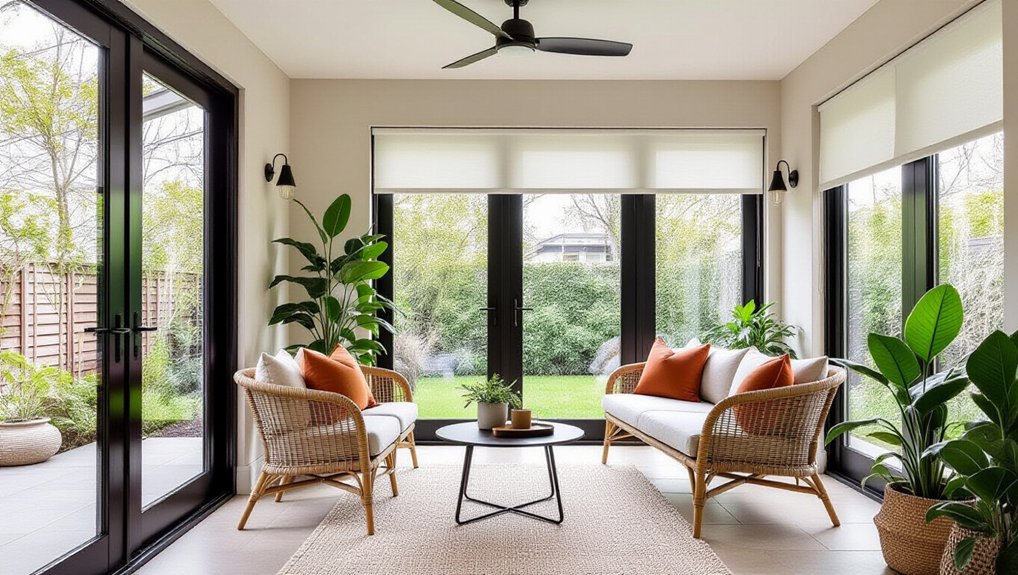
If your older conservatory feels too hot in summer, chilly in winter, or just dated, you can modernise it with a few targeted upgrades. Start by spotting where heat builds up and where draughts sneak in, then plan fixes that don’t require a rebuild—better blinds, roof insulation panels, tighter seals, and smarter lighting. Once comfort’s handled, you can update frames, flooring, and furniture for a cleaner look—but one change usually makes the biggest difference first.
Audit Your Conservatory: Heat, Glare, and Draughts
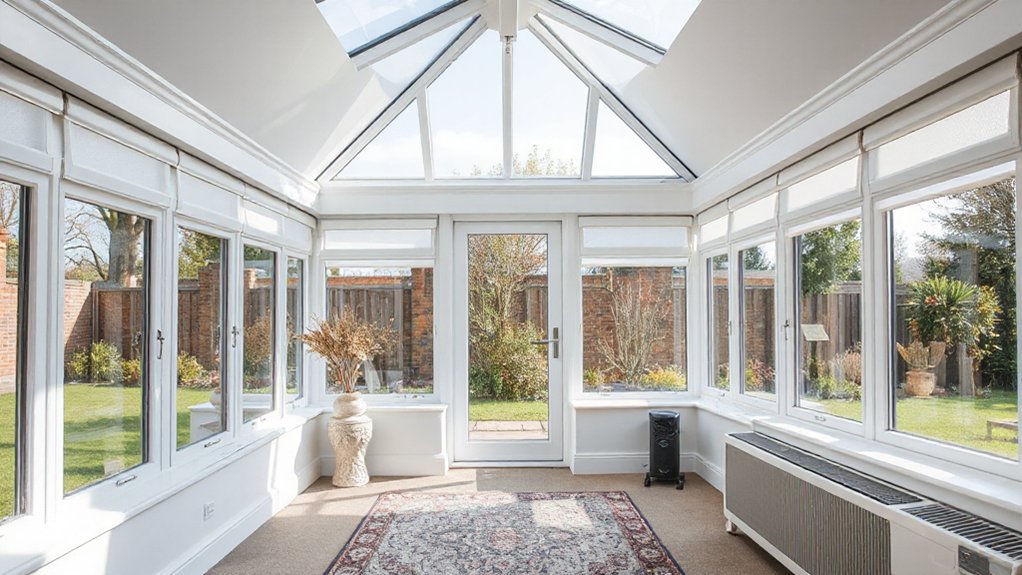
Before you pick new glazing or swap out the roof, audit what’s actually making your conservatory uncomfortable: where it overheats, where glare is strongest, and where cold air sneaks in.
On a sunny day, note the time and spot of peak temperature, then check which panes take direct sun; a simple thermometer and light meter app help.
Look for failed seals, misted units, and hairline gaps around frames.
On a windy day, run a damp hand or incense stick along sills, opening lights, and the wall junction to trace draught paths.
Check roof vents and trickle vents for blocked operation.
Photograph problem areas and map them.
You’ll protect conservatory aesthetics and preserve historical design elements by targeting fixes without ripping out original features.
Modern Conservatory Blinds to Cut Heat and Glare
Choose modern conservatory blinds that tackle heat at the source by using heat-reflective fabrics like metallised or solar-coated materials to bounce infrared back out.
Then control glare with the right style—top-down/bottom-up pleated blinds, cellular blinds, or roller screens—so you can cut brightness without losing all your daylight.
Match the fabric openness and colour to your sun-facing panes, and you’ll get a cooler, more usable space year-round.
Heat-Reflective Blind Materials
Although older conservatories flood your home with natural light, they can also trap heat and amplify glare. Upgrading to heat-reflective blind materials is one of the quickest, most practical fixes.
Choose Heat reflective linings that bounce solar energy back toward the glass instead of letting it radiate indoors. Look for metallised or pearlescent backings, UV-stable coatings, and fabrics rated for high-temperature spaces so they won’t warp, fade, or delaminate.
For roof panels, pick insulated cellular fabrics with reflective foil to slow heat transfer and reduce hot spots.
In side windows, opt for tightly woven polyester blends with reflective back-coating for durability and easy cleaning.
Measure precisely, seal light gaps at edges, and you’ll feel steadier temperatures with less reliance on fans.
Glare-Control Blind Styles
How do you cut harsh glare without turning your conservatory into a cave? Choose blind styles that filter light, not just block it.
Pleated roof blinds soften overhead sun and stop “hot spots” on seating areas.
For side windows, go for day-and-night rollers or top-down bottom-up cellular blinds, so you can shield low-angle glare while keeping daylight higher up.
Pick Contemporary fabric with a light-filtering weave to reduce dazzle yet maintain a bright feel.
If you need strong control for screens or afternoon sun, add blackout shades on the most exposed panes, then pair them with sheers elsewhere to avoid an all-or-nothing look.
Finish with slim aluminium tracks and tensioned fits to stop sagging and edge leaks.
Insulate the Conservatory Roof (No Rebuild)
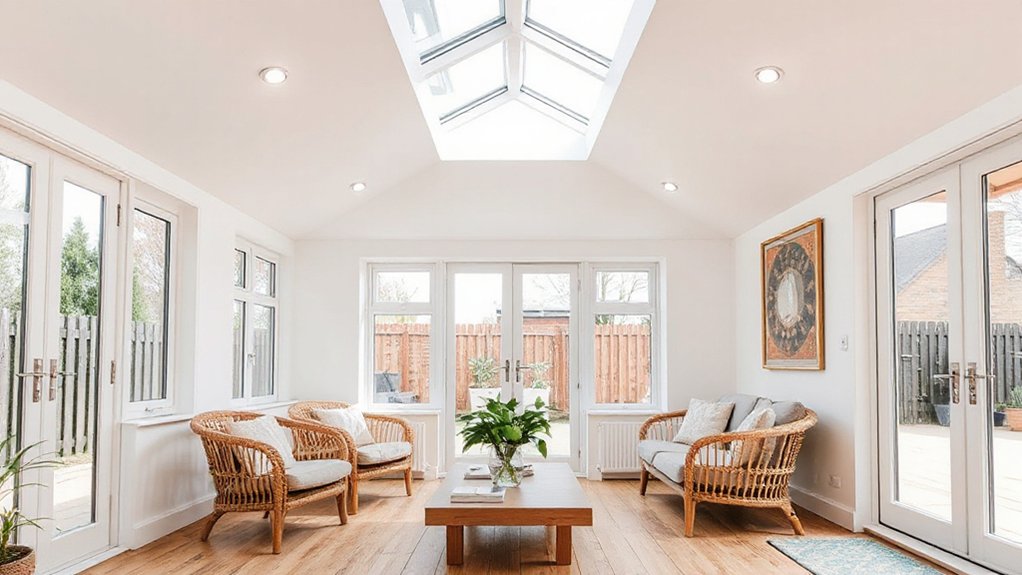
If you want a warmer conservatory in winter and a cooler one in summer without the cost and disruption of a full rebuild, start by insulating the roof. Fit a quilted, multi-foil layer or insulated panel system beneath the existing glazing to cut heat loss and solar gain while keeping the structure intact.
Choose panels with a wipe-clean finish and slim trims, so you preserve conservatory aesthetics and don’t lose much headroom. For outdoor integration, pick neutral colours that match your frames and keep light levels comfortable for plants and views.
Use a system with vapour control to reduce condensation, and specify a fire-rated lining where required. Most installs finish in a day, with minimal mess and zero structural changes.
Seal Gaps to Stop Conservatory Draughts
Once you’ve reduced heat loss through the roof, tackle draughts by sealing the small gaps that let cold air whistle in around frames, roof bars, vents, and the base.
Start by checking on a windy day: run your hand along joints, then mark leaks with masking tape. Clean and dry surfaces, remove crumbling silicone, and reapply an exterior-grade, UV-stable sealant for long-lasting draft prevention.
For opening windows and doors, replace worn gaskets and add brush strips to stop air movement without sticking. Use compressible foam tape behind trim where panels meet frames, and fit a threshold seal at the base to block under-door drafts.
Finally, seal gaps around services (cables, pipes) with expanding foam, then trim flush.
Year-Round Conservatory Heating and Cooling Options
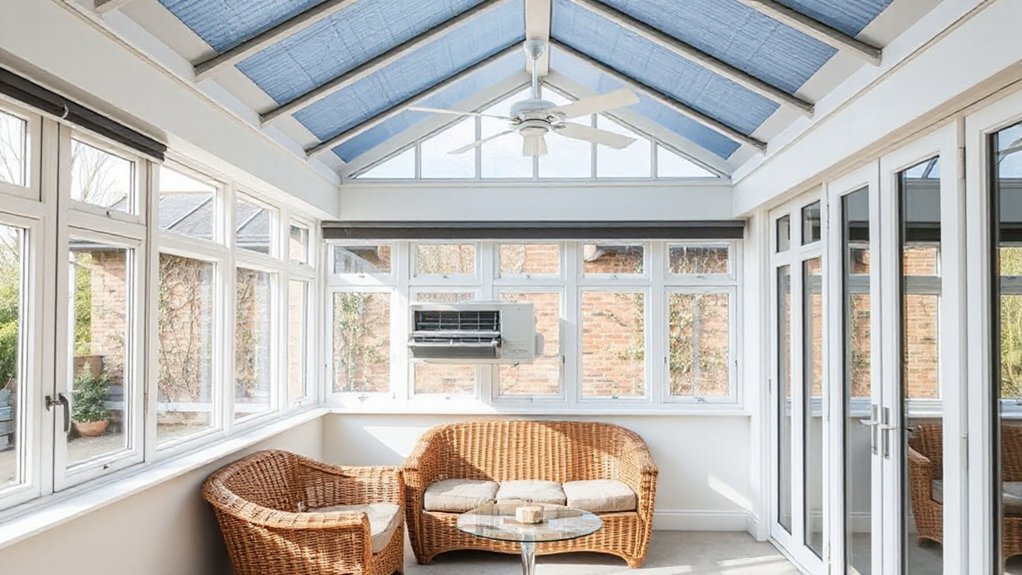
Once you’ve sealed draughts, you’ll get better year-round comfort by upgrading to efficient glazing and insulation that stabilises temperature and cuts heat loss.
You can then add zoned heating—like electric panels, underfloor mats, or a small radiator loop—so you only warm the areas you’re using.
For summer, you’ll keep things usable with smart cooling and ventilation, such as roof vents, low-energy fans, and blinds that reduce solar gain.
Efficient Glazing And Insulation
Because older conservatories often lose heat through the roof and glazing while trapping it in summer, upgrading your glazing and insulation gives you the biggest year-round comfort boost for the least disruption.
Start by replacing tired units with modern double or triple glazing that uses low‑E coatings and warm-edge spacers; this glass technology cuts winter heat loss and summer glare. If replacement isn’t possible, add secondary glazing or fit high-performance film.
Next, tackle the roof: insulated panels or a lightweight tiled system reduce overheating and cold spots.
Seal drafts around frames, vents, and sills with new gaskets and expanding foam, then finish with thermal breaks at thresholds.
Finally, use window treatments like reflective blinds or cellular shades to fine-tune comfort day to day.
Zoned Heating Solutions
Where should you start if your conservatory swings from chilly mornings to stifling afternoons? Add zoned heating so you only warm the areas you use, when you use them, rather than blasting the whole space.
Create thermal zoning by separating the conservatory from the main house with a well-fitted internal door or heavy curtain, then heat each zone independently.
Fit a programmable electric radiator or slim infrared panel for quick, targeted warmth, and pair it with a dedicated thermostat and timer.
If you’re on wet central heating, consider adding a separate loop with a thermostatic radiator valve and room stat, so it doesn’t overheat.
Set lower background heat, then boost briefly before you occupy the room.
Smart Cooling And Ventilation
Even if you’ve nailed zoned heating, your conservatory can still overheat fast in sun and feel stale in winter, so smart cooling and ventilation should be your next upgrade.
Fit Smart sensors that track temperature, humidity, and CO₂, then trigger fans or window actuators before the room swings uncomfortable.
Install automated vents at high points to dump hot air quickly, and pair them with low-level trickle vents for a steady cross-flow.
Choose a quiet, reversible ceiling or wall fan to destratify warm air in winter and boost evaporation in summer.
If you need more, add a compact split air-con or portable unit with a sealed window kit.
Set schedules and thresholds, then fine-tune after a week’s data.
Update Conservatory Lighting With LEDs and Dimmers
If your conservatory still relies on old halogens or a single harsh ceiling fitting, swapping to LED lighting and adding dimmers will give you instant control over brightness, glare, and mood.
Start with LED upgrades that match your existing fittings: GU10s for spotlights, E27/E14 for pendants, or integrated LED strips for pelmets and shelving. Choose warm-white (2700–3000K) for evenings, or neutral-white (3500–4000K) for a brighter work zone.
For dimmer installation, check the lamps are “dimmable” and pick a trailing-edge LED dimmer to prevent flicker and buzzing.
Add layered lighting: a dimmable main circuit, task lighting by seating, and low-level accent strips for night-time glow. Set scenes so mornings feel crisp and evenings feel calm.
Refresh UPVC Conservatory Frames With Paint or Wraps
Although older uPVC frames can make an otherwise bright conservatory feel dated, you can modernise the look quickly with either specialist paint or a colour-change wrap.
Start by washing frames with sugar soap, then lightly key the surface with fine abrasive pads and mask seals and glass.
Choose Conservatory paint formulated for uPVC, apply an adhesion primer if specified, then roll and brush two thin coats for an even finish and fewer runs.
Prefer a wrap if you want crisp colour, woodgrain, or matte effects with minimal drying time; book an installer for tight corners and clean joins.
For Wraps maintenance, wash with pH-neutral soap, avoid abrasives and pressure washers, and inspect edges annually for lifting.
Choose Warmer, Quieter Modern Conservatory Flooring
To make your older conservatory feel warmer underfoot and quieter, start by choosing an insulated flooring build-up that reduces heat loss and cold spots.
Add a noise-reducing underlay to cut footfall and rain-on-roof sound.
Then finish with a durable, moisture-resistant surface that won’t warp or stain with condensation.
These three choices work together, so you’ll get a room that’s more comfortable year-round and easier to maintain.
Insulated Flooring Options
Why does an older conservatory still feel chilly and echoey even after you’ve upgraded the glazing? The floor often acts like a cold sink, pulling heat out of the room and making the space harder to keep comfortable.
Switching to insulated flooring tackles that weak point and improves day-to-day usability.
If you’ve got a concrete slab, add a thin insulation layer with a moisture barrier, then install engineered wood or LVT on top for stability.
With suspended floors, lift boards and fit rigid insulation between joists, then re-lay a sturdy subfloor.
For a quick refresh, choose insulated laminate panels with integrated backing, but keep thresholds and door clearances in mind.
You’ll notice steadier temperatures and better underfoot warmth without changing your heating setup.
Noise-Reducing Underlay Choices
Once you’ve improved insulation underfoot, tackle the other thing that makes older conservatories feel uncomfortable: the hollow, “clicky” noise that bounces around on hard flooring.
Start by choosing an underlay rated for Acoustic insulation, not just comfort. For floating laminate or engineered boards, pick a dense rubber or high-mass PU underlay (around 2–3mm) to cut impact noise and reduce that sharp tread sound.
If you’re laying LVT, use the manufacturer-approved acoustic mat so joints stay stable while noise drops.
For carpet, felt-and-rubber or crumb-rubber underlay adds mass and stops drumminess. Check the dB reduction figure and compressive strength, and tape seams to prevent gaps.
These steps move you closer to true Soundproof flooring without major disruption.
Durable Moisture-Resistant Finishes
Because conservatories swing from steamy summer heat to winter condensation, you’ll get a longer-lasting, quieter floor by choosing moisture-resistant finishes that won’t swell, curl, or delaminate.
Start by confirming the subfloor’s dryness and adding Moisture barriers: a liquid DPM on concrete, or a vapour-control layer over timber with taped seams.
Then pick Water resistant finishes designed for temperature swings, like rigid-core LVT, porcelain tile with flexible adhesive, or engineered wood rated for conservatories.
Seal edges and thresholds so damp air can’t wick into joints, and use waterproof trim and silicone at perimeter gaps.
If you choose laminate, only use high-HDF, sealed-edge boards and keep it raised on a compatible underlay.
Finish with easy-clean, mould-resistant sealants.
Pick Modern Conservatory Furniture for the Space
Although a conservatory feels like an “extra” room, you’ll get a far more modern look if you furnish it as deliberately as the rest of your home. Choose slim, low-profile pieces with clean lines to suit contemporary design and keep sightlines open to the garden.
Measure the footprint, then plan furniture arrangement around how you’ll use the room: dining, lounging, or a compact office. Use a small sofa or two chairs instead of bulky suites, and pick armless options where the glazing narrows the space.
Add a storage ottoman or bench to hide throws without crowding walkways. Prioritise easy-clean, UV-stable upholstery and powder-coated, rust-resistant frames. Keep at least 60–75cm clearance for circulation and door swings.
Modern Styling Ideas: Colour, Plants, and Accessories
If your conservatory still feels dated after you’ve updated the furniture, modern styling can quickly sharpen the look with just a few deliberate choices. Start with Color schemes: pick one neutral base (warm white, soft grey, or sand) and add one accent tone like sage, navy, or terracotta. Repeat that accent across cushions, a throw, and one statement vase to keep it cohesive. Swap heavy patterns for clean geometrics or subtle textures to reduce visual noise.
Next, refine plant arrangements by grouping three pots in varied heights near the brightest corner, then echo one trailing plant on a shelf to draw the eye upward. Choose matching planters (matte ceramic or black metal) for a modern line.
Finish with a slim rug, minimal frames, and one sculptural lamp.
Frequently Asked Questions
Can I Add Planning-Permission-Free Doors to Better Connect the Garden?
Yes, you can often add planning-permission-free doors to boost garden integration, if you use permitted development rules, keep openings similar, and avoid structural changes. Choose door customization options, check building regs, and confirm with your council.
How Do I Modernise Conservatory Windows Without Replacing the Entire Unit?
You can modernise windows by adding secondary glazing, refurbishing seals, and applying low‑E film—homes lose about 30% of heat through windows. Improve Window insulation with thermal curtains, and update Conservatory lighting with LEDs.
What Are the Best Ways to Improve Conservatory Privacy From Neighbours?
Improve conservatory privacy by adding window frosting film, installing top-down blinds, and positioning tall planters for landscaping privacy. You’ll block sightlines while keeping light. Choose adjustable options, and seal gaps around frames for extra discretion.
How Can I Reduce Condensation and Mould in an Older Conservatory?
Condensation and mould can take over like a swamp—stop them fast: boost ventilation improvements with trickle vents, extractor fans, and cracked windows. Insulate cold spots, heat consistently, wipe moisture daily, and choose dehumidifier options sized appropriately.
Will Conservatory Upgrades Increase My Home’s Resale Value?
Yes, well-chosen conservatory upgrades can boost resale value if you target Energy efficiency and cohesive interior decor. You’ll attract buyers with insulated roofing, modern glazing, quality flooring, and controllable heating, plus documented improvements and warranties.
Conclusion
Start by auditing heat, glare, and draughts so you know what to fix first. Fit modern blinds, add roof insulation, and seal gaps to lock in comfort without rebuilding. Then fine-tune the temperature with efficient heating or cooling. Refresh tired uPVC frames with specialist paint or wraps, and swap in warmer, quieter flooring. Finish with slimline furniture and calm colours, plants, and accessories. You’ll hit the nail on the head: modern, usable, year-round.