Table of Contents
A laundry room doesn’t get the attention it deserves. Every house has one in some form — even if it’s a corner of the kitchen, a cupboard under the stairs, or a passageway that someone once put a washing machine in and called it done. The laundry room is where real domestic life happens, quietly and repeatedly, every single day. And yet it almost always ends up as the room that gets ignored when renovations are being planned, the one that stays tired while everything around it gets updated.
This particular laundry room had been tired for a long time. The clients — a couple with three teenagers in a large detached house in Cheshire — had renovated the kitchen, updated the bathrooms, and replastered the hallway over a period of about four years. The laundry room had watched all of this happen through its hollow-core door and received precisely nothing in return. It was functional in the loosest sense — the machines worked, the plumbing didn’t leak — but it had the atmosphere of a room that had given up. Pale blue walls with a watermark they’d never been able to account for. A fold-up ironing board that opened directly into the door frame. Fluorescent strip lighting from the early 1990s. A shelf that had started off horizontal and gradually expressed its opinion about that by tipping slightly to the left.
The project took about three weeks. The result is a room the family uses rather than tolerates.
What We Were Working With
The room itself is roughly 3.2 metres by 2.1 metres — not generous, but not as small as many utility spaces. A window on the external wall, modestly sized but facing south, which means more natural light than the room had ever been set up to use. Plumbing already in the right place for the washing machine and the standpipe for the tumble dryer. A doorway connecting to the kitchen and another leading to the integral garage.
The existing layout had the washing machine and tumble dryer side by side on the longest wall, with a full-depth base unit and work surface above them that had been put in at some point in the 1990s and had been carrying the psychological weight of the room ever since. The surface was laminate in a colour that had no name and no obvious relationship to anything in the house. The units beneath were carcasses only — no doors, because the doors had been removed at some unknown point and never replaced.
On the opposite wall: the boiler, boxed in, and a single shelf with the washing powder on it. Between these two walls: approximately 900mm of circulation space, which is enough if you’re doing nothing but walking through and desperately tight if you’re trying to do anything useful.
The floor was sheet vinyl, originally pale, now unoriginally grey in the patches that saw the most traffic.
The Planning Conversation
Before any decisions about aesthetics, the layout needed to be reconsidered. A laundry room that’s difficult to use is difficult to use regardless of how good it looks, and the existing layout had two specific problems that any refresh needed to address.
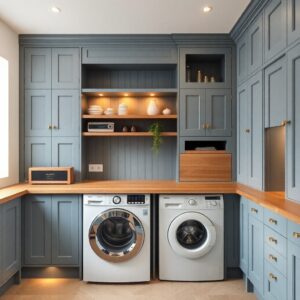
The first was ironing. The fold-up ironing board had no logical home in the room — it came out, it blocked the doorway, you ironed with one elbow in the door frame, and then it folded back up and leaned against the wall at a reproachful angle. A built-in ironing board, pulled from the wall on a pivot and folded away into a dedicated housing unit, was the solution that made ironing not just possible but vaguely pleasant. There are several good built-in systems available and they all occupy roughly the same wall depth as a standard cabinet.
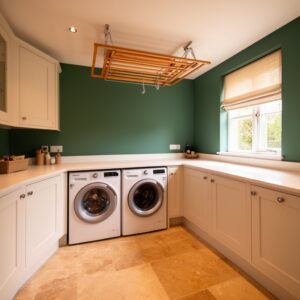
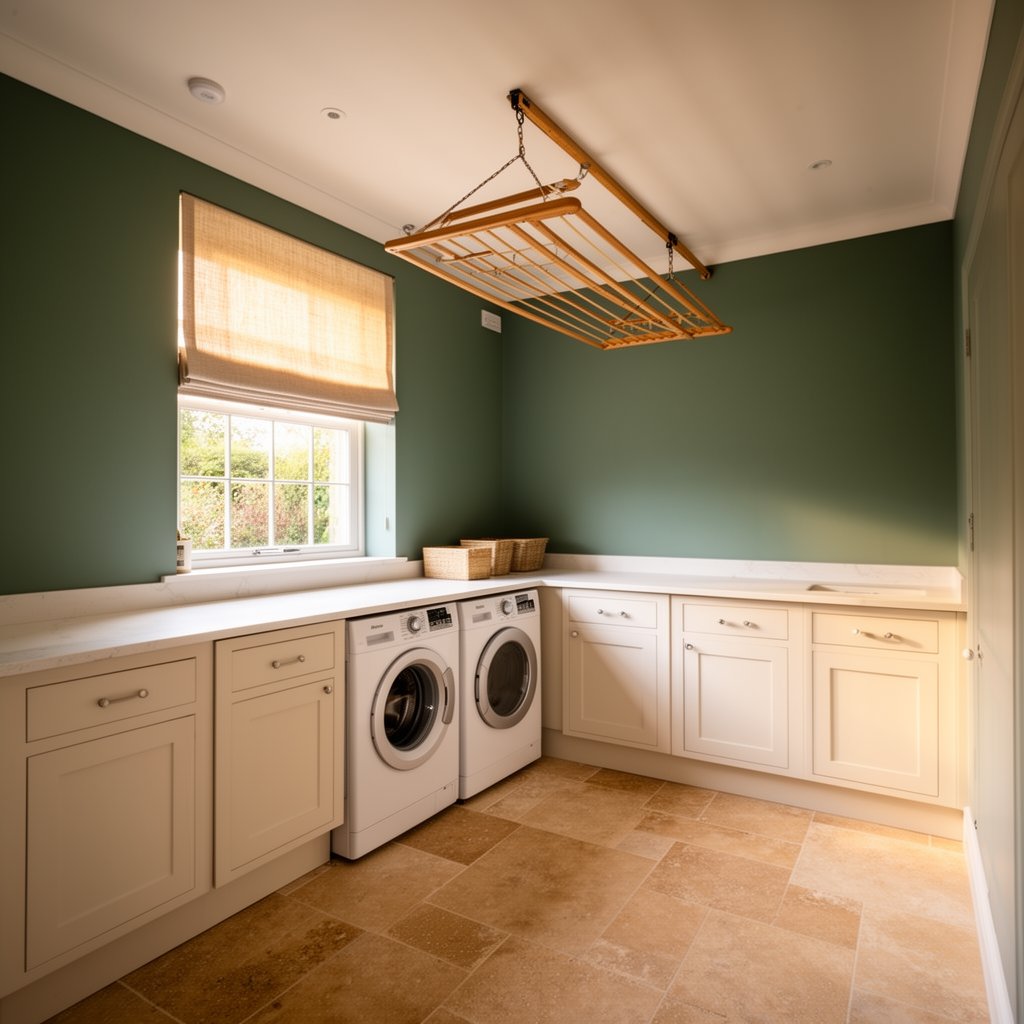
The second was drying. The tumble dryer handled most of the clothes, but handwash items, delicates, and school sports kit all needed to air dry somewhere. Previously this happened on a clothes horse in the kitchen or draped over the banister, which satisfied nobody. A ceiling-mounted pull-down drying rack — a traditional design updated with modern pulley hardware — fixed above the circulation zone provides approximately four linear metres of drying space when pulled down and tucks neatly against the ceiling when not in use. It takes two minutes to install mentally and about two hours to install physically.
With these two problems solved in the planning stage, the room layout clarified quickly. Machines on the long wall with a continuous worksurface above them — raised slightly higher than the standard 900mm to give a better working height for sorting and folding, and cantilevered forward slightly to sit over the machine doors without restricting their opening. The boiler boxing retained, clad in the same painted panel as the surrounding walls to absorb it visually. All other wall space used for storage.
The Build
Removing the old units was the first physical act, and the usual revelation occurred: the wall behind them had never been finished properly. Patches of plaster in various states of completion, a section of bare brick where a previous owner had put a vent that was subsequently blocked, and the ghost of a different unit arrangement entirely. All of this needed addressing before anything new went in.
The walls were replastered throughout and allowed to dry properly before any decoration was applied — a stage that’s consistently rushed and consistently regretted. A laundry room is a damp environment by definition. The plaster needs to be genuinely dry before paint or tiles go on it, or the dampness migrates outward and starts undermining the finish within months.
New units were installed across the machine wall — painted MDF cabinet doors on the existing base unit carcasses, which were structurally sound and well positioned and didn’t need replacing. The worktop is a quartz composite — genuinely waterproof, heat-resistant, and easy to clean — in a warm white with a very slight warm grey veining. It runs the full width of the machine wall and returns 300mm on the adjacent wall where it becomes a small folding station.
The ironing board housing was built into the return wall — a floor-to-ceiling panel unit that houses the ironing board in one section, brooms and mops behind a full-height door in another, and a pull-out laundry basket unit in the third. All painted to match the walls so that the unit, when closed, reads as part of the wall rather than a piece of furniture. The integration of storage into the architecture of the room — rather than introducing freestanding elements into a tight space — is the decision that makes small utility rooms feel organised rather than cluttered.
Walls, Floor, and the Decisions That Set the Tone
The colour conversation for a laundry room starts from a different place than for other rooms. The instinct is often towards white or very pale — a clinical cleanliness aesthetic — or towards a relatively bland neutral that seems safe and appropriate for a utility space. Both approaches produce rooms that feel like they’re trying not to be noticed.
The alternative, which we took here, is to treat the laundry room as a room with a genuine interior design brief rather than a secondary space that just needs to be functional. It’s used every day. It deserves to be somewhere you want to be, even briefly.
The colour chosen was a deep, slightly blue-tinted green — not a sharp or saturated tone but something with depth and a slight chalky quality. Applied to all four walls, with white ceiling and white painted woodwork and units, it produced a room that felt defined and considered rather than accidental. It has a quality that the clients described as “like being in a proper room” — which is exactly what a well-designed laundry room should feel like.
The floor is large-format porcelain tiles in a warm stone effect — 600 x 600mm, in a light tone that reflects the south-facing window light and makes the room feel larger than its footprint. Practical, waterproof, and genuine-looking. The grout is the same tone as the tile, which prevents the grid pattern from dominating.
Lighting: The Detail That Changed the Room Most
The fluorescent strip light came out on day one and was not missed. In its place: three recessed downlights on a dimmer for general ambient light, plus a single under-cabinet LED strip on the machine wall that lights the worksurface directly from below the wall units. This work light is on its own switch and is the light that’s most often on during actual laundry use — direct, shadowless illumination on the surface where the sorting, folding, and treating of stains happens.
The south-facing window was dressed for the first time — previously bare, because the original owners had apparently decided the view into the side passage wasn’t worth framing. A simple roller blind in a natural linen provides privacy without blocking the light when pulled to halfway, and the window now contributes to the room in a way it previously didn’t.
The Storage Logic
A laundry room’s storage needs are specific and it’s worth thinking them through before specifying anything. The categories that need homes in a functioning laundry room are: cleaning products and laundry detergent; ironing equipment; clothes that need to be ironed; clean clothes waiting to be distributed; clothes that need handwashing or special treatment; and the various accessories — laundry bags, mesh bags, stain removers, fabric softener — that accumulate around the machines.
Each of these categories needs a different kind of storage. Cleaning products want a lockable cupboard if there are young children in the house. Detergent wants to be accessible but contained — a pull-out unit or a fixed shelf at the right height. Ironing equipment, as discussed, wants its own integrated housing. Clean clothes waiting to go upstairs want a dedicated surface or basket, not the worktop, which is a working surface.
In this room, the storage plan was worked out category by category before any unit was specified. The result is a room where everything has an obvious home, which means everything gets put back in its obvious home, which means the room stays organised with minimal effort. This is the characteristic of a well-designed utility room that separates it from one that looks good in photographs but descends into chaos within three weeks.
Three Months On
The clients report that the laundry room is now the room in the house that generates the most unsolicited comments from visitors. People who come through on the way to the garage, who previously hurried past with averted eyes, stop. The room has enough character, and enough obvious thought behind it, to make people engage with it rather than look through it.
More practically: the built-in ironing board gets used rather than the system of avoiding ironing until it becomes unavoidable. The drying rack has eliminated the banister as a drying location, which the clients note with a relief that suggests this was a source of low-level domestic tension for some time. The organised storage means the room stays organised — not because anyone is particularly disciplined, but because there’s always somewhere logical to put things.
The laundry room is the room nobody notices when it’s right and everyone suffers when it’s wrong. Getting it right is one of the least glamorous home improvement investments available, and one of the most consistently rewarding.