Table of Contents
There’s a moment — usually when you’re tripping over sports equipment in the hallway for the third time in a week, or squeezing past boxes you swore you’d unpack “once things settled down” — when you start looking up. Not metaphorically. Literally. At the ceiling. At what’s above it. And you think: that space is just sitting there.
An attic conversion is one of those home improvement projects that looks, from the outside, like a fairly contained piece of work. You’ve got a roof. You’ve got a floor. How complicated can it be? The answer, as with most things in this house, was “more than expected but less than terrifying.” What came out the other side — a proper, usable room where there used to be cobwebs and one ancient suitcase — was absolutely worth every decision, every trade, and every slightly tense conversation about headroom.
This is the story of how we approached ours, what surprised us along the way, and what we’d do differently if we started again tomorrow.
Before Anything Else: Is Your Attic Actually Convertible?
Not all lofts are created equal, and this is the thing nobody tells you until you’ve already mentally furnished the room. The first thing we did was get a structural engineer in to look at the existing roof structure. Ours had a cut roof — the older style with individual rafters and a ridge beam — which is generally easier to work with. If you’ve got a trussed roof (the W-shaped timber frames common in houses built from the 1960s onwards), it’s more involved because those trusses do a specific structural job and can’t simply be removed.
Headroom is the other reality check. Building regulations in England require a minimum of 2.2 metres at the highest point. We had 2.6 metres at the ridge, which gave us a workable margin. Anything under 2.2 and you’re either looking at raising the roof — a whole different level of project — or accepting that it’s storage only.
The floor joists also need assessing. Attic joists are typically only sized to hold the ceiling below them, not people and furniture. In our case, they needed doubling up, which added to the structural work but wasn’t unexpected.
One more thing: how are you going to get up there? A staircase takes up more floor space than you think, and where it lands on the floor below matters enormously. We lost a section of the landing to accommodate ours, which was a fair trade, but it’s worth thinking through before you’re committed.
Planning Permission or Permitted Development?
Most attic conversions in England fall under permitted development, meaning you don’t need to apply for planning permission — provided you stay within certain rules. The main ones to know are that any dormer windows on the front elevation generally do require permission, rear dormers often don’t, and any extension to the roof must not exceed the existing roof plane on the front of the property.
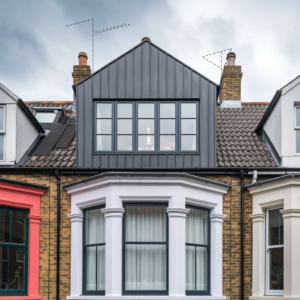
We kept it simple: a rear-facing dormer for light and headroom, no front alterations. It sailed through as permitted development.
What you do always need, regardless of permitted development status, is Building Regulations approval. This covers the structural work, fire safety (which is taken very seriously in loft conversions — more on that in a moment), insulation, electrics, and the staircase. We went with a full plans application rather than a building notice, which meant the drawings were checked and approved before a single tool came out. Slower to start, but you know exactly where you stand.
The Structural Work: What Actually Happens Up There
Once the scaffolding went up and the structural engineer’s drawings were signed off, the sequence of work made more sense than I’d expected. The roofers came first to cut the opening for the dormer and install the box frame. Watching a section of your roof open up to the sky is one of those moments that’s simultaneously exciting and quietly alarming — though they’re very good at keeping it weathertight as they go.
The structural steel work came next. We needed a steel beam to carry the load where a wall was being repositioned below. This is the kind of thing that sounds dramatic but in practice takes a day, makes a lot of noise, and then it’s just there, holding everything up permanently. You stop thinking about it almost immediately.
The floor was then reinforced with new joists running alongside the originals. Once boarded, the attic transformed almost overnight from a precarious balancing act between joist gaps into a solid, walkable surface. That moment — standing up there on actual flooring — was the first time it felt like a real room rather than a building site.
The dormer itself was framed out in timber, clad externally, and fitted with a flat roof. We chose a simple, clean box dormer rather than anything elaborate. It’s not architecturally exciting from the outside, but it gave us a full-width window and a flat ceiling section that added enormously to the usable floorplan.
Insulation: Don’t Skimp Here
If there’s one area where I’d urge anyone doing an attic conversion to spend properly, it’s insulation. You’re adding a room that’s directly under the roof, fully exposed to everything the climate throws at it. Get the insulation wrong and you’ll have a room that’s unbearably hot in summer and costs a fortune to heat in winter.
We used a combination approach: rigid insulation boards between and below the rafters, with a breathable membrane above. The U-value target under current Building Regulations is 0.18 W/m²K for roofs, which sounds like a technical abstraction until you realise it’s the difference between a room that works year-round and one that’s a seasonal write-off.
The flat dormer roof was insulated as a warm flat roof — insulation above the structural deck rather than between the joists. Again, get this specified properly. A cold flat roof over a habitable space is a recipe for condensation problems down the line.
Thermal performance is worth caring about for another reason too: if you’re in England and have an EPC rating that’s currently dragging its feet, a well-insulated attic room can make a meaningful difference to the score.
Fire Safety: The Bit That Doesn’t Feel Exciting But Really Matters
Building Regulations for loft conversions are particularly rigorous on fire safety, and for good reason. Adding a habitable room above the existing living floors creates a new storey, and the escape route from that storey in the event of a fire needs to be properly thought through.
In practice, this usually means:
The staircase from the loft must be enclosed — not open to the rest of the house. Ours has fire doors at the bottom and at the landing level, both with the correct fire resistance rating and self-closing mechanisms.
Any doors onto the escape route — including bedroom doors on the floors below — need to be upgraded to fire doors if they aren’t already.
Mains-wired smoke alarms need to be installed on every floor, including the new one, all interlinked so that if one triggers, they all sound.
It sounds like a lot of box-ticking, and honestly, some of the fire door conversations were a bit tedious. But this is the one area of a loft conversion where I’d say: just do what the Building Control officer says, don’t try to negotiate, and do it properly. The peace of mind is genuine.
The Interior: Designing Around the Constraints
A loft room has constraints that a regular room doesn’t. The sloping ceiling is the obvious one, and how you feel about it is somewhat personal — some people love the character, others find it oppressive. We landed somewhere in the middle: it’s genuinely charming on the dormer side where the ceiling is full height, and the sloped sections work fine for lower furniture.
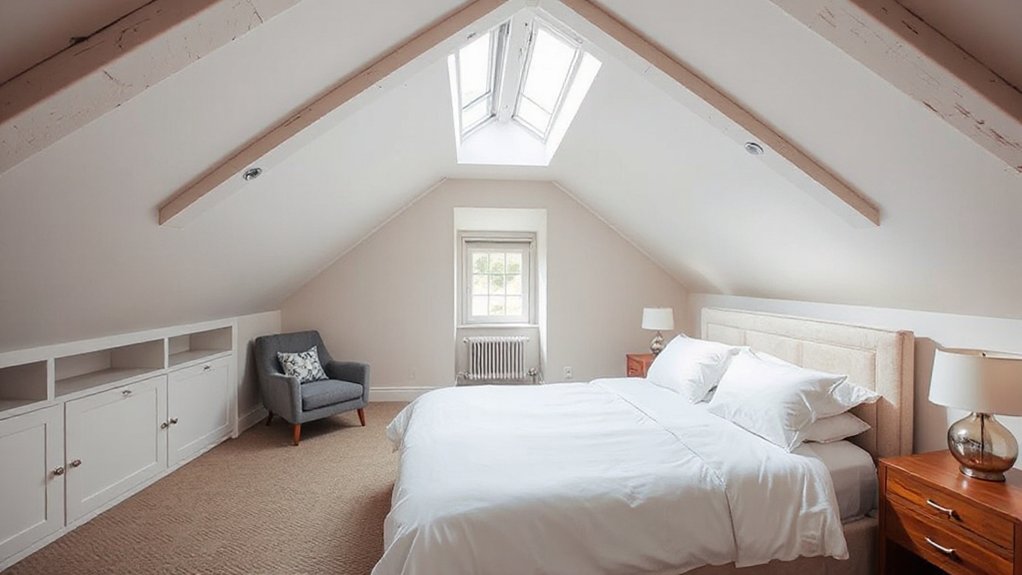
The knee walls — the short vertical walls where the ceiling meets the floor at the eaves — presented a choice. You can board them out and use the dead space behind as fixed storage, which is what we did on one side, or leave them as accessible storage with hinged doors. The fixed storage side was framed, insulated, and plastered flush, giving a clean wall. The other side got a run of fitted low cupboards with lift-up lids. Useful for bedding, luggage, things you want accessible but not on display.
Lighting required more thought than a ground-floor room. With a sloping ceiling, pendant lights are awkward and recessed downlights in the sloped sections often end up pointing at the wall rather than the floor. We ended up with a combination: recessed lights in the flat dormer ceiling section, and wall-mounted lights on the knee walls where the slope starts. The result is layered and warm rather than uniformly bright, which suits the room well.
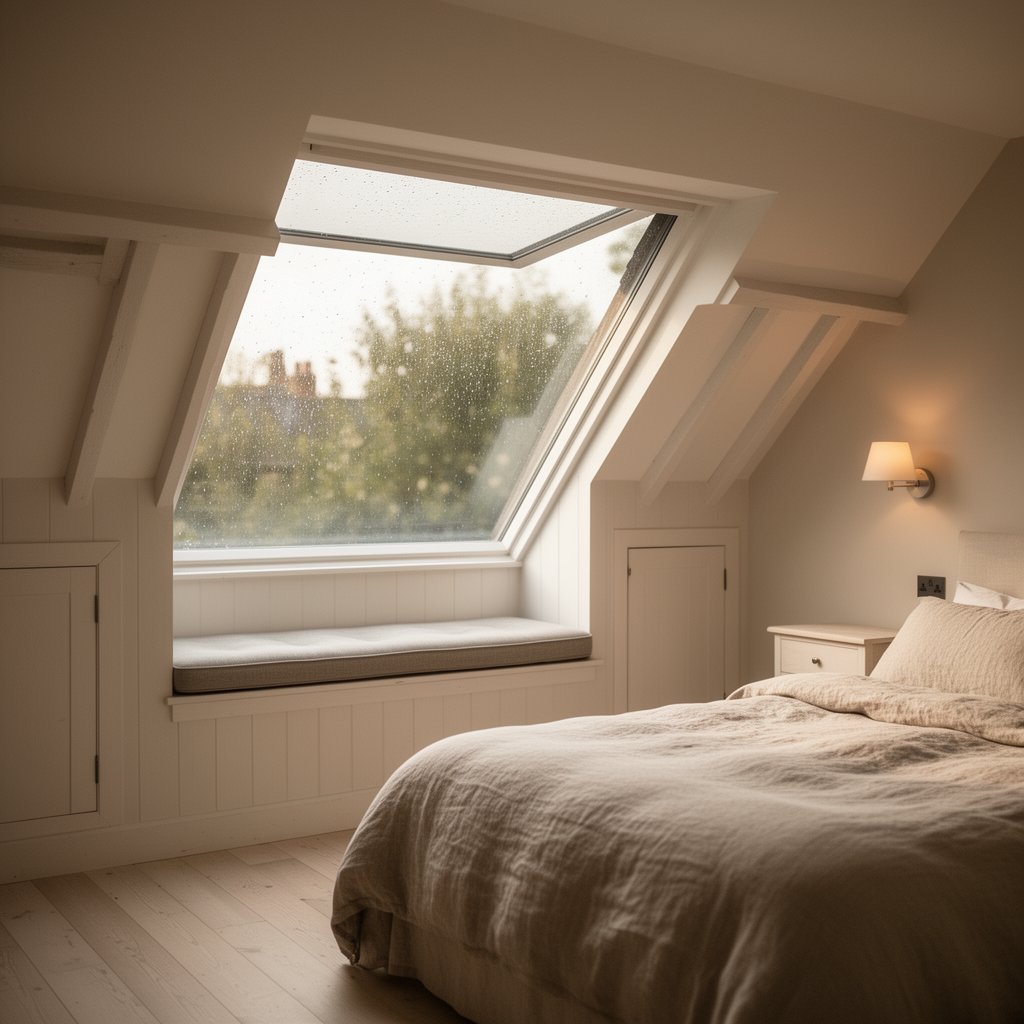
The window in the dormer is the heart of the room. We went larger than we thought we needed, and it was absolutely the right call. Light transforms a loft space. Combine it with a low window seat — just a painted timber box with a cushion on top — and suddenly you’ve got what everyone ends up using as their favourite spot in the house.
What It Cost and Whether It Was Worth It
Costs for attic conversions vary considerably depending on the type of conversion, your location, and what state the roof is in to begin with. A simple roof light conversion — no dormer, just windows set into the existing roof pitch — is at the lower end. A full dormer conversion like ours sits in the middle range. A hip-to-gable conversion, where the roof shape is altered on a detached or semi-detached house, adds more again.
We were in the middle band. The structural work, dormer, staircase, insulation, plastering, electrics and plumbing for a radiator came to more than we’d initially budgeted — they usually do — but not by an embarrassing margin. We managed the finishing ourselves: decorating, fitting the window seat, the storage doors. That saved a meaningful chunk.
Was it worth it? Without hesitation. We added a proper double bedroom and a lot of functional storage to a house that previously had neither to spare. Estate agents, when we’ve had valuations done since, have been consistent that it adds more to the value than it cost. That’s not why we did it — we did it because we needed the space — but it’s a useful confirmation that the money didn’t disappear into the brickwork.
More than the numbers, though: the room is just good. It has character. The light in the afternoon is unlike anything in the rest of the house. On rainy evenings, you can hear it on the roof in a way that’s oddly comforting rather than annoying. It feels earned, in the way that rooms you’ve worked on always do.
A Few Things We’d Do Differently
Every project teaches you something for next time. The things I’d change:
We underestimated how disruptive the staircase installation would be to the floor below. Two weeks of dust sheets and limited access to part of the landing was manageable but frustrating. If you can, sequence this stage for when you’re least reliant on that part of the house.
I’d pay more attention earlier to where the radiator pipework runs. The plumber made it work, but it involved some creative routing that could have been cleaner with earlier planning conversations.
We fitted a standard-height window in the dormer initially and later added the window seat, which meant the sill was higher than ideal for sitting. Design the seat and the window together from the start if that’s what you want.
And lastly: budget a contingency. Ours was fifteen percent, and we used almost all of it. That’s not a complaint — it’s just how these things go.
If you’re sitting in your house right now calculating ceiling heights and wondering what’s above you, the short version is: it’s probably worth finding out properly. Get a structural engineer to have a look. Get a couple of builders in for quotes. The room might be closer than you think.